Quick Summary
NGO registration in India usually happens through a trust, Society, or Section 8 Company structure, depending on your mission, management style, and funding goals. A proper registration certificate helps your NGO open a bank account, apply for tax benefits, and become eligible for grants, CSR, and compliance-based funding.
This guide covers the NGO registration certificate process step by step, required documents, fees, timelines, verification methods, common mistakes to avoid, and what to do after registration. Whether you're starting a small local trust or a large Section 8 company, it helps you obtain your NGO legal registration certificate correctly and become funding-ready faster.
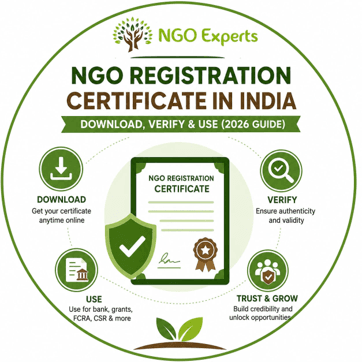
What Is an NGO Registration Certificate in India?
This certificate is legal proof that your NGO officially exists and can work toward a social cause within a proper structure.
- It shows that your organization is registered as a valid legal entity, such as a Trust, Society, or Section 8 Company. This helps you build trust with donors, banks, CSR partners, and government departments.
- It is important because many funding and compliance activities need proof of legal existence. Without it, you may face problems in opening accounts, applying for tax benefits, or receiving grants.
- It is one of the first things a beginner NGO should get before starting serious operations. It demonstrates the NGO's authenticity.
Types of NGO Registration Certificates Available in India

India allows three popular NGO structures, each with a different certificate and compliance requirements.
- A trust registration certificate is suitable for small charitable setups with simple management. It is often preferred by founders who want fewer formalities and clearer control.
- A society registration certificate is best for groups of people working together on a common cause. It works well for educational, cultural, welfare, and community-based projects.
- A Section 8 company certificate is ideal for NGOs that want a strong legal structure. If your long-term goal is to attract larger grants, CSR funding, and institutional partnerships, a Section 8 Company registration can provide a stronger foundation for sustainable growth and accountability.
Have Questions?
Documents Required to Get an NGO Registration Certificate
This is the basic document checklist you should prepare before applying for NGO registration.
| Document | Trust Registration Certificate | Society Registration Certificate | Section 8 Company Registration Certificate |
| Basic Identity Proof | PAN and Aadhaar of all trustees | PAN and Aadhaar of all governing body members | PAN and Aadhaar of all directors (minimum 2) |
| Address Proof | Electricity bill/rent agreement/ownership proof of registered office | Same as Trust (office address proof) | Same as Trust + NOC from the owner if the premises are rented |
| Founder Details | Name, address, contact, and photo of all trustees | Name, address, contact, and photo of a minimum of 7 governing members | Name, address, contact, DIN (Director Identification Number) of directors |
| Legal Deed / Memorandum | Trust Deed with objectives, rules, trustee list, and beneficiary details (signed & stamp duty paid) | Memorandum of Association + Rules & Regulations signed by a minimum of 7 members | Memorandum of Association (MOA) and Articles of Association (AOA) with charitable objectives |
| Digital Requirements | Not mandatory in most states | Not always required | DSC (Digital Signature Certificate) is mandatory for all directors |
| Application Form | Form for registration with the local Sub-Registrar's office | Form for Society Registration with the State Registrar of Societies | SPICe+ (INC-32), MoA (INC-33), AoA (INC-34), and Section 8 License (INC-12) filed on MCA portal |
| Witness/Member List | 2 witnesses (with ID and address proof) for deed registration | List of all founding members (minimum 7) with attendance sheet | List of all directors and key personnel, along with consent letters |
| Office Proof | Proof of registered office address (utility bill + address affidavit) | Same as Trust | Registered office proof + utility bill + NOC from owner |
| Additional Documents | Bank account details (can be opened after registration) | List of office bearers and their roles | DSC, DIN, and estimated income projection for at least 3 years |
| Fees & Stamp Duty | Based on state stamp duty (varies by state and property value) | State registration fees (vary by state and society type) | MCA filing fees + stamp duty (higher than Trust/Society due to company structure) |
Process to Obtain an NGO Registration Certificate
The process is easy to understand when you break it into clear steps.
- First, choose the right structure: Trust, Society, or Section 8 Company.Your choice should match your cause, team size, and future funding plans.
- Next, carefully prepare all required documents.Small mistakes in names, addresses, or objectives can delay approval.
- After that, file the application with the correct authority.The authority depends on the type of NGO and the legal form you choose.
- Then the authority checks the NGO's details, documents, and purpose.If everything is correct, the registration certificate is issued.
- For Section 8, the process usually includes DSC, DIN, name approval, licensing, and incorporation.That is why it takes more formal steps than trust or society registration.
How long does It take to receive an NGO Registration Certificate?
The time depends on the structure and the completeness of your papers.
- Trust registration can be faster when documents are ready, and the deed is properly drafted.In many cases, local processing speed affects the final timeline.
- Society registration may take a little longer because of member verification and state procedures.The exact period varies by state and application quality.
- Section 8 company registration usually takes the shortest time, because it is registered on MCA and it is completely online process.
- In all cases, incomplete papers or wrong details can slow things down. Clean documentation saves time and stress.
Have Questions?
Cost of Getting an NGO Registration Certificate in India
The cost changes based on legal structure, drafting work, and professional support.
| Registration Type | Government Fees (₹) | Professional/Consultant Fees (₹) | Total Estimated Cost (₹) |
| Trust Registration | 2000 – 5000 | 5,000 – 15,000 | ₹7,000 – ₹20,000 |
| Society Registration | 2,000 – 5,000 | 15,000 – 50,000 | ₹17,000 – ₹55,000 |
| Section 8 Company Registration | 0 – 3,000 | 2,000 – 3,000 | ₹7,000 – ₹15,000 |
If you want a smooth approval process, it is smart to budget for proper drafting and filing assistance.
How to Download or Verify an NGO Registration Certificate Online?
Verification helps donors, banks, and funding agencies trust your NGO.
- Section 8 company details can usually be checked through MCA-related records.This is useful when someone wants to confirm legal status.
- NGOs should keep scanned copies of all certificates safely stored.These files are needed for grants, banks, tax work, and compliance.
- Verification rules may differ for Trusts and Societies.In such cases, checking the relevant state or portal record is important.
Common Mistakes That Delay NGO Registration Approval
Most delays stem from avoidable document and filing errors.
- A vague NGO objective is a common reason for rejection.The purpose should be clear, legal, and linked to charitable work.
- Name mismatch or address mismatch can also create problems.All details should match across every document.
- Missing signatures, incomplete forms, or poor drafting can slow approval.This is why careful review before filing matters.
- Choosing the wrong structure for your goals is another common mistake.The structure should match your funding, compliance, and management style.
What to Do After Receiving Your NGO Registration Certificate?
Once the certificate is received, your NGO should move to the next compliance steps quickly.
- Open a bank account in the NGO’s name.This makes donations and expenses more professional and easier to trace.
- Apply for PAN and set up basic financial records.Good bookkeeping helps with tax and grant compliance.
- Prepare for 12A and 80G if you want tax-related benefits.These registrations help improve donor confidence and exemption planning.
- If you plan to get CSR funding, work on CSR-1 readiness.For foreign donations, FCRA planning becomes important later.
How to Get 12A, 80G, CSR-1, and FCRA After NGO Registration?
These certificates help your NGO become fund-ready and compliance-ready.
- 12A is important because it helps with income tax exemption planning.It is one of the most common next steps after registration.
- 80G helps donors claim tax benefits on donations.This makes giving easier and often increases donor interest.
- CSR-1 is needed for CSR-related funding from companies.Many corporate donors ask for this before considering support.
- FCRA is required if you want to receive foreign contributions.It has strict rules, so NGOs should apply only when truly eligible.
Conclusion
Getting an NGO registration certificate in India is the first big step toward building a serious nonprofit.
- If you want the simplest setup, a Trust may suit you.If you want member-led governance, Society can work well.
- If you want better structure, funding credibility, and compliance strength, Section 8 is often the best choice.
While Trusts and Societies remain popular options, many modern nonprofits prefer Section 8 Company registration because it enhances credibility, improves governance, and increases eligibility for CSR funding and large-scale grant opportunities. Your final choice should match your mission, budget, and long-term goals.
Frequently Asked Questions
An NGO Registration Certificate is a legal document issued by the relevant authority that confirms the official registration of a Trust, Society, or Section 8 Company in India. It serves as proof of the organization's legal existence.
A Section 8 Company is often preferred for CSR funding because it offers greater transparency, stronger governance, and higher credibility among corporate donors and funding agencies.
The timeline depends on the chosen structure. Trust registration may take a few days to a few weeks; Society registration may take a few weeks; and Section 8 Company registration generally takes 15–30 working days, subject to document approval.
While informal charitable activities can be conducted without registration, an unregistered NGO cannot easily open a dedicated bank account, apply for grants, obtain tax exemptions, or receive CSR and institutional funding.
Yes. After obtaining the registration certificate, the NGO should apply for a PAN card to manage financial transactions, maintain accounts, and comply with tax regulations.
The certificate can be verified through the relevant registration authority. For Section 8 Companies, verification can be done through MCA records, while Trusts and Societies can be verified through their respective state registration authorities.