


Quick Summary
CSR (Corporate social responsibility) in company law is a structured compliance mechanism that ensures businesses contribute to social welfare while continuing to grow commercially. Today, understanding what CSR in corporate law is is important not only for legal compliance but also for building long-term trust and sustainable business value. Some leading CSR companies in India include Tata Group, Wipro, Infosys, Reliance Foundation, and Hindustan Unilever, all of which actively invest in education, healthcare, sustainability, and skill development. If you are curious about what CSR is in business law, how companies implement it, and why it matters to modern businesses, this guide explains it all in simple language.
Overview
CSR in company law is a structured, mandatory process empowering Indian companies to deliver real social impact. India is one of the very few countries where CSR in corporate law is legally mandated. With more than 8 years of expertise in handling CSR and NGO registration, we’ve seen how businesses gain stronger brand reputation, deeper stakeholder trust, and greater access to global opportunities through responsible and sustainable practices.
In fact, some of the leading CSR company examples, such as Wipro, Tata Group, and Hindustan Unilever, are often recognised for their contributions to education, healthcare, and environment-focused projects. This blog will help you understand what CSR is in the business context, and how companies can utilize proper documentation and transparent reporting to establish lasting reputations as responsible corporate citizens.
What is CSR in Company Law?
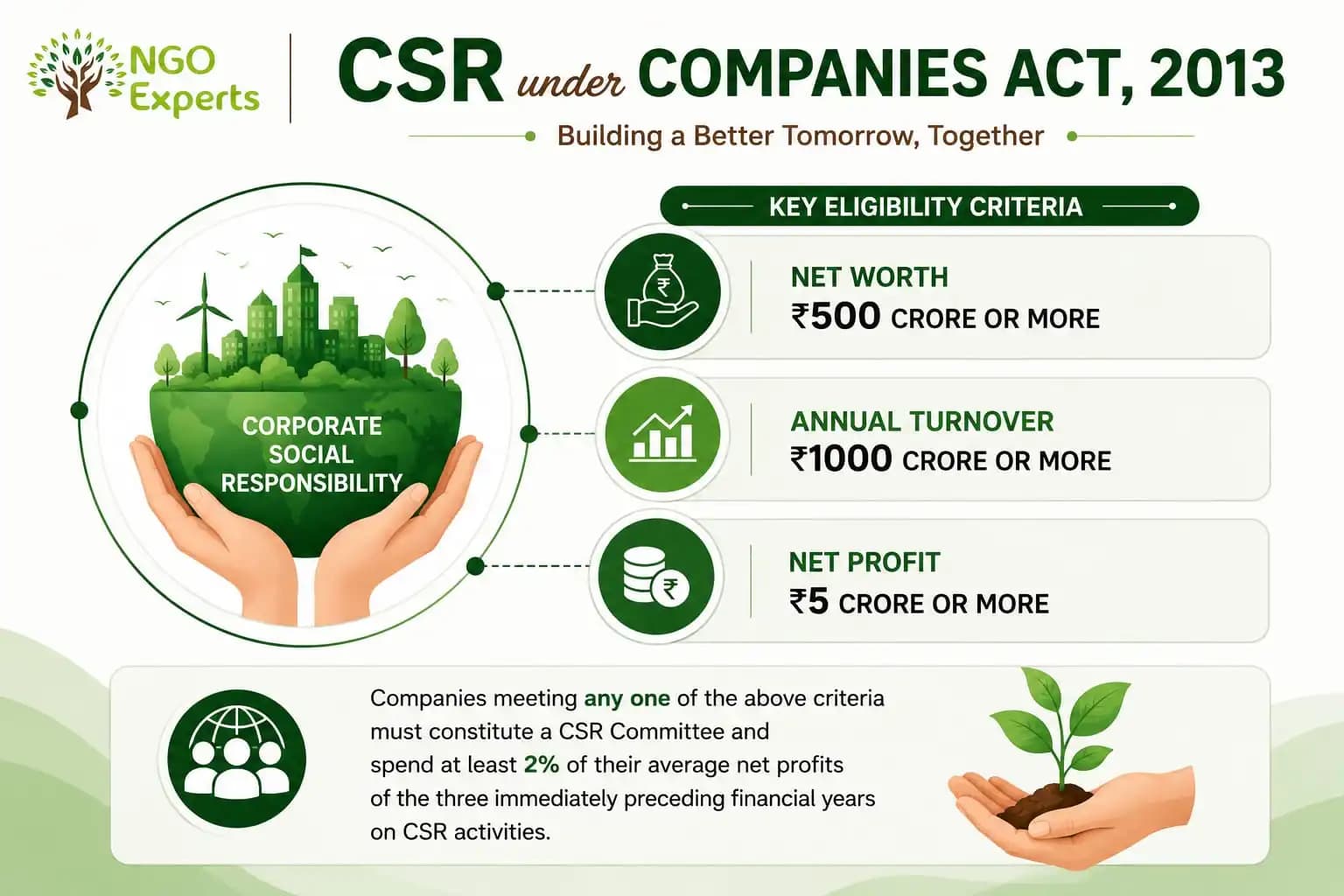
CSR in company law or business law generally refers to a special compliance requirement for companies to allocate a portion of their profits to initiatives promoting community welfare, sustainability, and ethical governance. Under Section 135 of the Companies Act, 2013, CSR is mandatory for companies meeting any of these limits in the preceding financial year:
- Net worth ≥ ₹500 crore
- Annual turnover ≥ ₹1,000 crore
- Net profit ≥ ₹5 crore
Companies that fall under these legal duties must:
- Constitute a CSR committee in the company law (minimum three directors, including at least one independent director)
- Create a formal CSR policy aligned with the law
- Allocate and spend at least 2% of their average net profits from the last three years on approved projects.
Why Is CSR Crucial in Business and Corporate Law?
CSR in business law and corporate law is designed to balance profit-generation with social good. Companies fulfill moral and legal expectations, contribute to nation-building, and forge stronger relationships with stakeholders. For example, CSR companies in India include Tata Group, Infosys, and Reliance Foundation, which have undertaken large-scale educational and health initiatives.
Key Responsibilities of the CSR Committee
- Drafting the CSR policy
- Recommending CSR expenditure
- Monitoring CSR implementation
- Ensuring compliance with CSR rules
- Reporting CSR activities to the board
The role of the committee is central to understanding what CSR is in corporate law and in practical CSR compliance.
The CSR Policy of a Company
Another important aspect businesses must understand is a company's CSR policy.
A CSR policy is an official document prepared by the CSR Committee and approved by the Board of Directors. It outlines:
- CSR objectives
- Focus areas
- Budget allocation
- Implementation strategy
- Monitoring framework
- Reporting mechanisms
The policy must align with activities listed under Schedule VII of the Companies Act, 2013.
Common CSR Activities Covered Under Schedule VII
- Education and skill development
- Healthcare initiatives
- Women empowerment
- Rural development
- Environmental sustainability
- Hunger and poverty eradication
- Disaster relief
A properly drafted CSR policy strengthens legal compliance and helps companies achieve measurable social impact.
How to Implement CSR in India
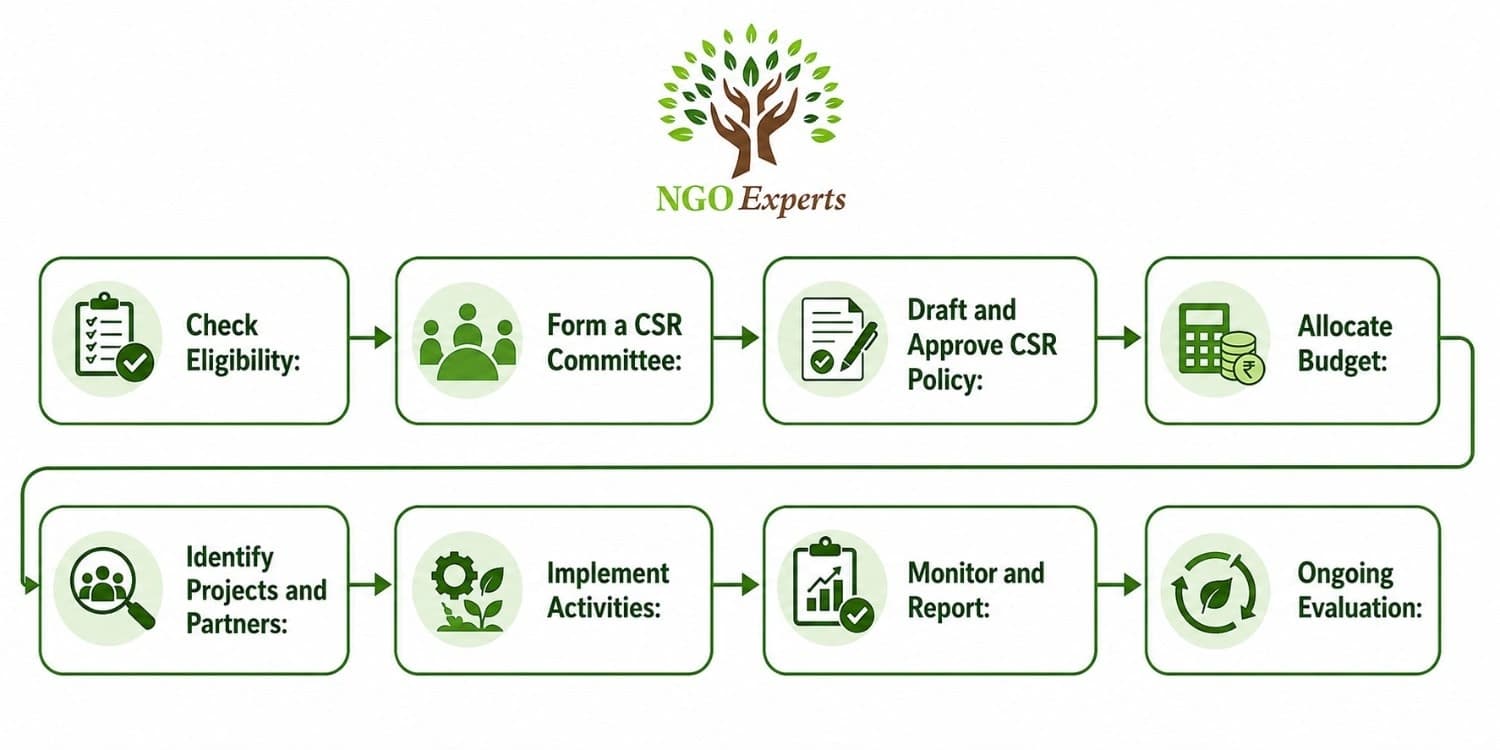
- Check Eligibility: Assess if net worth, turnover, or profits meet CSR statutory limits.
- Form a CSR Committee: Appoint at least three directors (one independent). Two suffice for certain private companies.
- Draft and Approve CSR Policy: The committee formulates a CSR policy specifying activities (aligned with Schedule VII); the board approves it.
- Allocate Budget: Allocate a minimum of 2% of the average net profits from the past three years.
- Identify Projects and Partners: Select projects (education, environment, health, etc.) and NGOs or Section 8 companies as implementing agencies.
- Implement Activities: Execute projects practically so that employees can participate or work with external partners.
- Monitor and Report: The committee oversees implementation; progress is reported annually to the board, shareholders, and published online.
- Ongoing Evaluation: Review and adapt strategies to maximize positive social impact.
Process & Compliance Checklist to Implement CSR
| Requirement | Legal Basis | Action |
| Eligibility Assessment | Section 135(1) | Check net worth, turnover, and profit criteria |
| Constitute the CSR Committee | Section 135(1) | Minimum 3 directors (1 independent) |
| Formulate CSR Policy | Section 135(3)(a) | Draft and recommend policy for board approval |
| Approve & Disclose Policy | Section 135(4) | Board approval; share on website/annual report |
| Allocate Minimum 2% Profits | Section 135(5) | Use 2% of average net profits (3 yrs) |
| Identify & Execute Projects | Schedule VII, Section 8 | Undertake qualified activities with partners |
| Monitor & Report | Reporting Rules | Transparent disclosure and performance review |
Benefits of Forming a CSR Committee in Businesses
When you start forming a dedicated CSR Committee in businesses, you gain several benefits, bringing powerful and measurable advantages:
- Better Reputation & Trust: Builds goodwill with customers, investors, and regulators.
- Legal Security: Prevents penalties, reputation damage, or director liability.
- Long-Term Sustainability: Business with community and environmental needs.
- Stakeholder Engagement: Motivates employees and attracts responsible investors.
Final Thoughts
By properly planning, implementing a compliant CSR policy, and establishing an effective CSR committee under the Company Law, businesses can create meaningful social impact while strengthening corporate reputation and stakeholder trust.
From CSR policy drafting to NGO partnerships and CSR compliance, NGOExperts helps companies implement impactful CSR projects aligned with the Companies Act, 2013.
Partner with NGOExperts to build responsible, compliant, and high-impact CSR initiatives.
Frequently Asked Questions
What is CSR in business law and corporate law?
CSR in business law and corporate law ensures that businesses address environmental, social, and ethical obligations alongside regulatory compliance. It mandates strategic social initiatives as part of a company’s operational responsibilities.
Who must form a CSR committee under the Companies Act, 2013?
Any company with a net worth ≥ ₹500 crore, a turnover ≥ ₹1000 crore, or a net profit ≥ ₹5 crore must form a CSR committee comprising at least three directors, including one independent director.
How much must companies spend on CSR activities?
Companies meeting eligibility must spend at least 2% of their average net profits from the past three financial years on CSR projects.
Can a company work with NGOs for CSR?
Yes, companies commonly partner with registered NGOs, particularly Section 8 companies, for the effective implementation of CSR projects and fulfillment of compliance.
Author
Srijita Chatterjee
I am a Content Specialist holding a Master’s degree and with over 5 years of experience in the creative arena. I specialize in breaking down complex concepts into clear, understandable insights that help my viewers deeply engage and retain. Known for my approachable and engaging style, I am committed to providing accurate, trustworthy information that empowers individuals and organizations to make informed decisions and achieve their goals.
Written by Srijita Chatterjee. Last updated on June 12, 2026