
Ready to Start Your Section 8 Company?
Get expert assistance with Section 8 registration, CSR eligibility, and funding opportunities.
What Is a Section 8 Company, and Why Do Funders Like It?
- It shows strong control: It must file its accounts and reports to the MCA every year. This lets donors check its health before they give money.
- It looks and feels like a real company: Its setup is close to a normal private company, minus the profit part. This makes it easy for CSR teams and big funders to trust and approve it.
- It is built to grow big: A Society is run by members who vote and can change often. A fixed Board runs a Section 8 Company, so it can grow, open branches, and handle large budgets more smoothly.
What Registrations Does a Section 8 Company Need to Receive Funding?
- 12AB registration: This gives tax relief on the company's own income. From the Finance Act, 2025, if your income is under ₹5 crore, this now lasts 10 years instead of 5.
- 80G registration: This lets your donors get a tax deduction when they give you money. It must be renewed every 5 years. Most CSR and big donors ask for this before they give funds.
- CSR-1 registration: This is a form filed with the MCA. It gives you a CSR Registration Number. Without it, no company can legally send you CSR money, as per the CSR rules from 2021.
- NGO Darpan (NITI Aayog) ID: This is a free ID number. Most government departments ask for it before you can even apply for a scheme or grant.
- FCRA registration: You need this only if you want to take money from outside India. More on this below.
How Does a Section 8 Company Get CSR Funding?
- Three simple checks: To get CSR funds, you must be a Section 8 Company (or a trust/society), have both 12AB and 80G, and show at least 3 years of real charity work.
- CSR-1 is a must: Since April 2021, every group that wants CSR money must file Form CSR-1 with the Registrar of Companies and get a CSR Registration Number. Without this, a company cannot legally send you funds.
- Your project must match the approved list: Even if you have CSR-1, your project must fall under the list in Schedule VII of the Companies Act, 2013 — things like education, health, environment, or rural development.
- The process is fast once papers are ready: CSR-1 approval usually takes about 5–7 working days if your PAN, registration papers, director details, and a professional's sign-off are all in order.
Can a Section 8 Company Receive Foreign Funds?
- FCRA is the only legal way: Any Section 8 Company that wants foreign donations, grants, or money from an overseas parent company must register under the FCRA law. Taking foreign money without it is a crime.
- You need a track record: You usually need at least 3 years of existence, clean work in social, cultural, education, or similar fields, and no link to political activity.
- You need a special bank account: All foreign money must go through one dedicated FCRA account at the State Bank of India, New Delhi Main Branch. You must keep this money separate and use it only for its stated purpose.
- 2026 adds more checks: Under the FCRA Amendment Rules, 2026, most foreign citizens (except some Persons of Indian Origin and Overseas Citizens of India) cannot hold key roles in an FCRA-registered group. Reporting is also moving from once a year to every quarter.
Unlock Grants, CSR Funding & Donation Opportunities
Set up your Section 8 Company with proper compliance to improve your chances of receiving institutional funding.
What Government Grants Can a Section 8 Company Apply For?
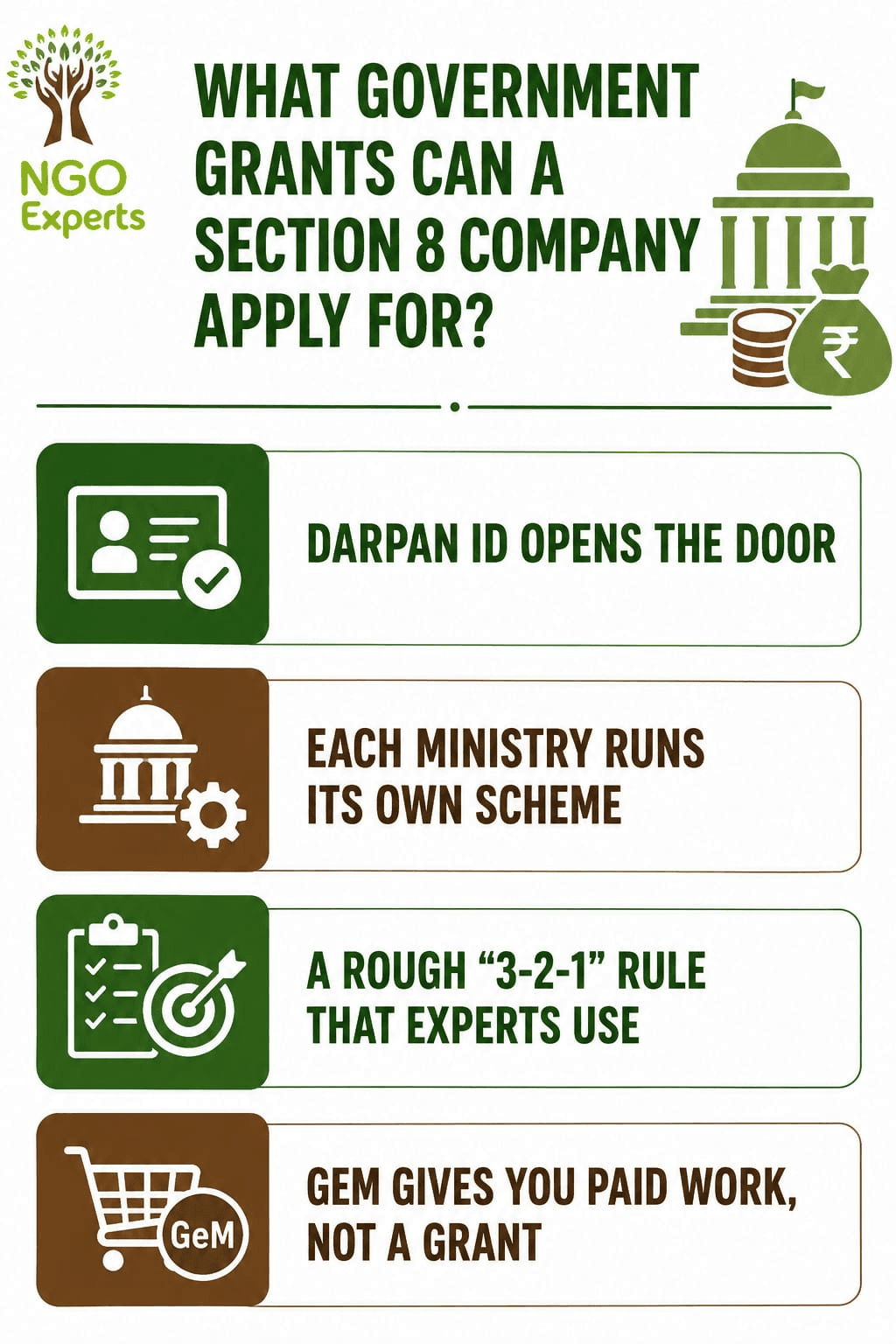
- Darpan ID opens the door: You register on NGO Darpan (ngodarpan.gov.in), run by NITI Aayog. This gives you a unique ID. Almost every central and state scheme asks for this ID, and it also helps when you renew your FCRA.
- Each ministry runs its own scheme: Once you have a Darpan ID, you can apply to schemes from bodies like the Ministry of Rural Development or the Ministry of Women & Child Development. Each has its own form and review process.
- A rough "3-2-1" rule that experts use: Many consultants say departments usually expect about 3 years of audited work, 2 years of experience in that specific field, and 1 fully filled-out Darpan profile before they take your request seriously.
- GeM gives you paid work, not a grant: If your Section 8 Company delivers services, like training or health support, you can register as a seller on the Government e-Marketplace (GeM). This lets you bid for and get paid for government contracts. This is extra income, not a grant.
What Other Funding Options Are Available for a Section 8 Company?
- Normal donations with 80G: Once your 80G is active, any person or company can donate to you and get a tax deduction. This makes more people willing to give.
- Foreign foundations and grant bodies: Once you have FCRA, you can apply straight to global foundations and big international bodies for project grants. This is separate from CSR or government money.
- Crowdfunding websites: Many trusted crowdfunding platforms ask for proof of 12AB, 80G, and sometimes FCRA before they let you run a campaign. So these registrations also help you raise money online.
- Money you earn yourself: A Section 8 Company can charge fees for training, advice, or programs it runs. This is allowed, as long as all the extra money goes back into the company's charity work and is never shared as profit.
What Are the Latest Section 8 Company Funding Rules for 2025–2026?
- 12AB now lasts longer: The Finance Act, 2025 increased 12AB validity from 5 to 10 years for groups earning under ₹5 crore. This means less paperwork for funders to check.
- New tax forms: From April 1, 2026, the Income-tax Act, 2025 replaced the old Form 10A/10AB with Form 104 (if you haven't started activities yet) and Form 105 (if you have already started).
- Stricter FCRA rules on people: The FCRA Amendment Rules, 2026 stop most foreign citizens from holding key roles in FCRA-registered groups. Worth checking early if your board has overseas members.
- More online processes: States like Maharashtra and Delhi now let you register fully online, and Uttar Pradesh has moved its papers and renewals online too. This speeds up related steps like Darpan and CSR-1.
Which Funding Option Should a Section 8 Company Choose First?
| Funding Source | Who Runs It | What You Need | Extra Registration | Best For |
| CSR Funding | MCA (Form CSR-1) | 12AB + 80G, 3 years of charity work, project matches Schedule VII | CSR-1, 12AB, 80G | Established groups wanting large, repeat company funding |
| Foreign Money (FCRA) | Ministry of Home Affairs | 3 years' history, clean record, special SBI account | FCRA registration | Groups with links to foreign donors or foundations |
| Government Grants | NITI Aayog (Darpan) + each ministry | Darpan ID, experience in that field, full profile | NGO Darpan registration | Groups matching a ministry's focus area (health, rural work, education) |
| Donations & Crowdfunding | Income Tax Dept. / crowdfunding sites | Valid 12AB and 80G | 12AB, 80G | Newer or smaller groups building a donor base |
| GeM Government Contracts | Government e-Marketplace | Valid registration, ability to deliver a service | GeM seller registration | Groups that deliver services and want paid government work |
Why Choose NGOExperts for Funding Help?
- NGOExperts knows all the funding paths, not just one: CSR, FCRA, government grants, and donations each have their own rules. We help you pick the right path for your Section 8 Company, instead of a one-size-fits-all approach.
- We keep your papers ready before funders ask: 12AB, 80G, CSR-1, and NGO Darpan ID all need to work together. We help you get and keep them active, so you don't lose a funding chance due to missing paperwork.
- We explain rules in plain words: Government rules change often, like the 2025 and 2026 updates in this guide. We track these changes and explain what they mean for your organisation, without confusing legal language.
- We support you at every stage: From your first Section 8 Company registration to your CSR-1 filing, FCRA application, and Darpan profile, we help you at each step, not just at the start.
Build a Fund-Ready Non-Profit Organization
From registration to 12A, 80G, and CSR compliance, our experts help you create a strong foundation for fundraising.
Frequently Asked Questions
Can a Section 8 Company get CSR funds right after it's registered?
Can a brand-new Section 8 Company take money from other countries?
Is NGO Darpan registration compulsory for a Section 8 Company?
Do 12AB and 80G need to be renewed?
Can a Section 8 Company earn its own money besides grants and donations?
How long does CSR-1 approval usually take?
Author
A Content Strategist at NGOExperts, who focuses on NGO registration, 12A and 80G registration, FCRA compliance, income tax filing for non-profits, and CSR funding guidelines in India. I research and write our compliance guides in collaboration with our in-house Chartered Accountants and Company Secretaries, so every article reflects current tax and regulatory requirements for the NGO and non-profit sector.
Written by Aabha Garg. Last updated on August 7, 2026