

Quick Summary
Companies in India often choose ongoing projects for their CSR efforts to create lasting social impact. Unlike one-time donations, these are multi-year commitments that allow companies to create long-term social impact. So, Ongoing CSR projects are multi-year initiatives up to three years (excluding the commencement year), defined under Rule 2(1)(i) of CSR Rules, 2014. They require specific documentation and board approvals. Unspent fund transfers within 30 days to a dedicated account by detailed reporting in Form AOC-4.
What Is an Ongoing Project Under CSR
An ongoing project under CSR, as per the Companies Act, 2013 and the Companies Amendment Rules, 2021, is a multi-year initiative with a timeline not exceeding three years, excluding the commencement financial year. It includes projects initially planned as one-year but extended by the board with reasonable justification. This definition helps companies plan sustainable efforts, such as education or health programs spanning multiple years.
Meaning of Ongoing Project Under CSR Rules (Rule 2(1)(i))
Rule 2(1)(i) of the Companies (CSR Policy) Rules, 2014, defines an ongoing project as one stretching over more than one financial year, with a maximum of three years, excluding commencement and board-approved extensions for originally short-term projects. The project starts right after issuing a work order. This legal meaning ensures the identification of start and end dates for better accountability.
When Can a CSR Project Be Treated as an Ongoing Project?
A CSR project qualifies as ongoing if it is multi-year, commences in the current financial year through a work order or contract and remains within the three-year limit post-commencement.
- Commencement: The project commenced within the financial year it was approved and lasts for up to 3 years.
- Board Designation: The Board must explicitly pass a resolution identifying the project as Ongoing.
- Year-wise Allocation: There must be a clear plan for year-wise fund allocation.
Maximum Time Limit for Ongoing Projects Under CSR
Timing is the most critical compliance factor for the ongoing project
- The 3-Year Rule: The maximum duration of ongoing CSR projects is three financial years, excluding the year of commencement.
- Total Span: Effectively, a company has 4 years (1 initial year + 3 additional years) to complete the project and utilise the funds.
Difference Between Ongoing Projects and One-Time CSR Projects
| Aspect | Ongoing Projects | One-Time CSR Projects |
| Duration | Up to 3 years (excl. commencement year) | Within one financial year |
| Unspent Funds | Transfer to Unspent CSR Account within 30 days | Transfer to the Schedule VII fund within 6 months |
| Bank Account | Separate Unspent CSR Account required | No separate account needed |
| Flexibility | The board can extend or abandon with justification | Must conclude in the same year |
This classification helps companies choose based on project scale and compliance needs.
Documentation Required for Ongoing Projects Under CSR
To stay compliant, maintain a CSR ongoing project documents checklist:
- Detailed Project Report (DPR): Objectives, beneficiaries and milestones.
- Implementation Agreement: Signed MoU with the NGO or any other Implementing Agency.
- Fund Utilisation Certificates: Periodic reports from the agency.
- Impact Assessment Reports: If the company meets the ₹10 crore CSR obligation threshold.
Maintain records such as baseline assessments, expenditure proofs and partners' CSR-1 registrations. A checklist ensures audit readiness.
Board approval process for Ongoing projects under CSR
Board approval for ongoing CSR projects is not just a formality; it’s a statutory requirement.
- Step 1: The CSR Committee recommends the project as Ongoing.
- Step 2: The Board passes a CSR board resolution specifically approving the multi-year nature and the budget.
- Step 3: The Board monitors implementation and ensures funds are used in accordance with the approved timeline.
Approvals must be secured before starting any project; the work cannot be validated.
CSR Committee’s Role in Approving and Monitoring Ongoing Projects
The CSR committee recommends projects, formulates policy, monitors implementation and progress through periodic reviews, and evaluates impact before reporting to the board. It ensures alignment with Schedule VII and stakeholder engagement and reduces potential threats to the project. It conducts Regular meetings to track the progress and make adjustments accordingly.
Treatment of Unspent CSR Amount Related to Ongoing Projects
If you have unspent amounts for ongoing projects under Section 135(6), they must be transferred to a Unspent CSR Account within 30 days of the financial year-end and be usable within three years from the transfer. This prevents misuse while allowing flexibility. Do not transfer it to a general government fund immediately.
Transfer of Unspent CSR Amount to Unspent CSR Account
This is where many companies stumble.
- The 30-Day Rule: The unspent amount must be transferred to a special bank account called the Unspent CSR Account within 30 days from the end of the financial year.
- Spending Deadline: The money in this account must be spent within three financial years. If it remains unspent after three years, it must be moved to a Schedule VII fund within another 30 days.
Non-compliance with the above regulations may invite penalties.
Disclosure and Reporting of Ongoing Projects in CSR Annual Report
You must report your ongoing projects in the Form AOC-4 addendum, detailing the project ID, name, location, duration, amount spent, and implementing agency (with the CSR-1 number). You need to disclose unspent amounts, transfers, and excess spent. Also, you should separate your ongoing project from other projects.
Common Compliance Mistakes in Ongoing CSR Projects
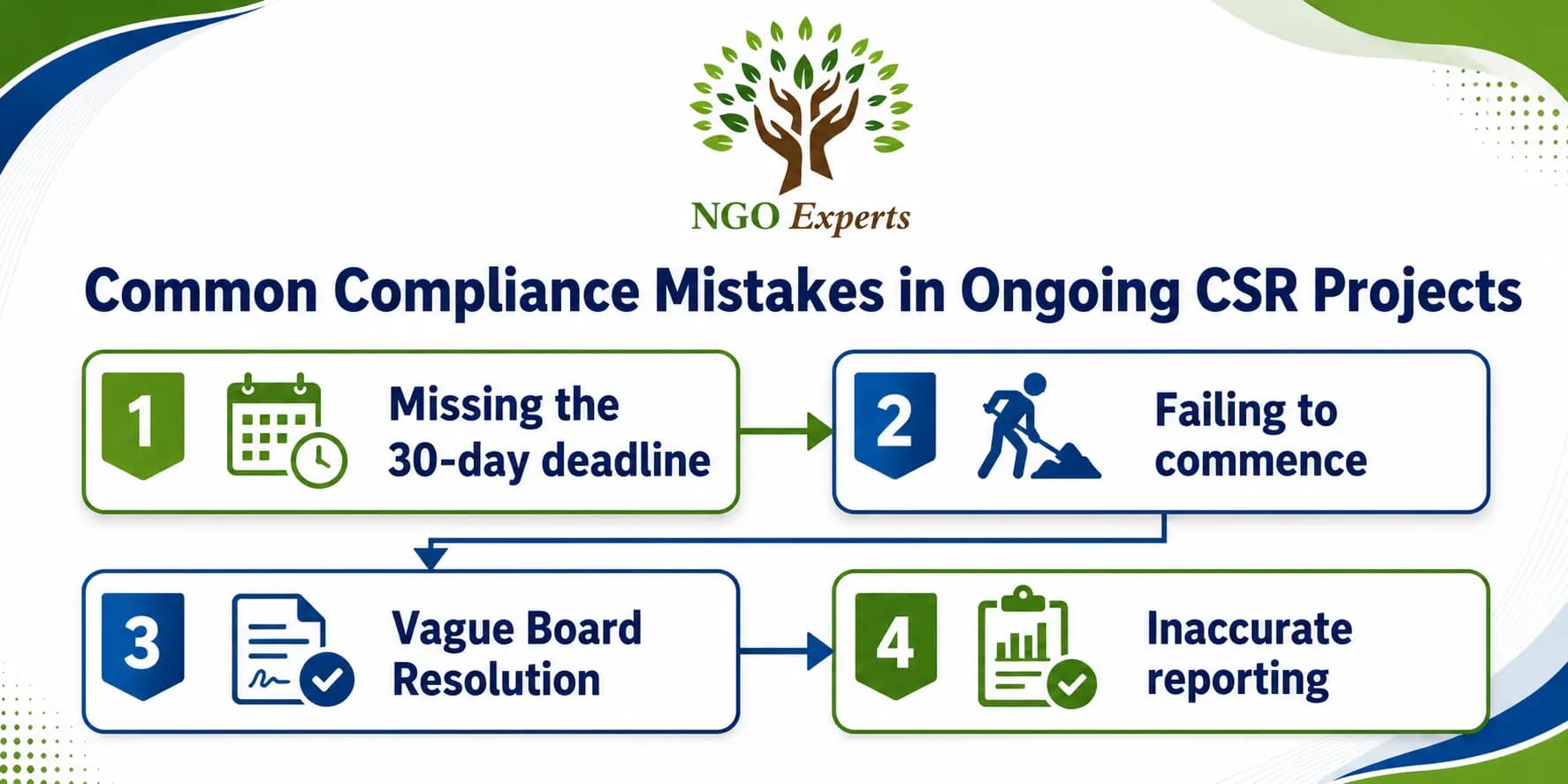
You should avoid these CSR ongoing project compliance mistakes:
- Missing the 30-day deadline for transferring funds to the Unspent CSR Account.
- Failing to commence the project in the first year.
- Vague Board Resolutions that do not specify the project as "Ongoing."
- Inaccurate reporting in Form CSR-2.
Practical Examples of Ongoing Projects Under CSR
The following are some Real examples
- Mahindra Group's Project Nanhi Kali has been educating over 550,000 girls across 15 states over the years.
- SBI's Youth for India offers skill-building in rural areas as multi-year fellowships. These span education and health under Schedule VII.
Checklist for Companies Managing Ongoing Projects Under CSR
- Approve via board resolution with a duration of 3 years excl. commencement
- Issue work order/contract to commence
- Prepare proposal: objectives, budget, timelines and milestones
- Sign the MOU with the CSR-1 registered agency
- Transfer unspent funds to the dedicated account within 30 days
- Monitor quarterly; report in AOC-4
- Retain all docs for audits
Conclusion
Mastering ongoing CSR projects boosts impact while ensuring compliance by starting with clear board approvals, complicated documentation and timely reporting to avoid penalties.
Ready to launch compliant ongoing CSR projects without penalties or hassle? At NGOExperts, our experts handle everything, from board resolutions and documentation to unspent fund transfers and AOC-4 reporting, so you can experience seamless Companies Act compliance.
Frequently Asked Questions
What is an ongoing project under CSR?
A multi-year CSR project up to three years, excluding commencement, per Rule 2(1)(i).
What is the time limit for ongoing CSR projects?
Maximum three financial years post-commencement; no extensions allowed.
How to handle unspent CSR for ongoing projects?
Transfer to the Unspent CSR Account within 30 days; spend over the next three years.
What documents are needed for ongoing CSR?
Proposal, board resolution, work order, MOU, progress reports.
Can ongoing projects be abandoned?
Yes, by board on committee advice with justification, within the time limit.
Author
Aabha Garg
A Content Strategist at NGOExperts, who focuses on NGO registration, 12A and 80G registration, FCRA compliance, income tax filing for non-profits, and CSR funding guidelines in India. I research and write our compliance guides in collaboration with our in-house Chartered Accountants and Company Secretaries, so every article reflects current tax and regulatory requirements for the NGO and non-profit sector.
Written by Aabha Garg. Last updated on October 6, 2026