
Section 8 Company Registration – The Best Choice for Growing NGOs
Build a credible NGO with a Section 8 Company Registration. It is the preferred structure for organizations seeking CSR funding, grants, donor trust, and long-term growth.
What Is a Trust?

- Formed by registering a Trust Deed and paying stamp duty.
- Managed by trustees, not a democratic membership.
- Quick to set up, minimal upfront approvals.
- A Charity Commissioner oversees major decisions in most states.
What Is a Section 8 Company?
- Requires a Central Government license via SPICe+ (INC-32).
- Cannot use "Private Limited" or "Limited" in its name.
- All profits reinvested — no dividends to members.
- Perpetual succession, limited liability, no mandatory minimum capital.
- Minimum directors/members: 2 directors and 2 shareholders for a private Section 8 Company; a public Section 8 Company needs at least 3 directors and 7 shareholders.
- Full Companies Act compliance: audits, ROC filings, board meetings.
Advantages and Disadvantages of a Trust
Advantages:
- Cheap and quick — no central license needed.
- Simple paperwork: Trust Deed and stamp duty.
- Good fit for small, local, or religious charities.
- Easier day-to-day decisions with fewer people involved.
Disadvantages:
- It is considered less transparent by big donors.
- Its rules vary by state.
- A Charity Commissioner can intervene in decisions.
- Once created, it is difficult to amend or restructure.
- Harder to attract large CSR or foreign funding.
Advantages and Disadvantages of a Section 8 Company
Advantages:
- Recognized across India via one central registration.
- Preferred by CSR committees and foreign donors.
- Public MCA filings mean more transparency.
- No minimum capital required.
- Separate legal identity protects personal assets.
Disadvantages:
- Costs more, takes longer (MCA license required).
- Heavier yearly compliance like audits, filings, meetings.
- Can't distribute profits; surplus stays with the cause.
- Regular CA/CS support often needed.
What Are the Key Differences Between a Trust & a Section 8 Company?
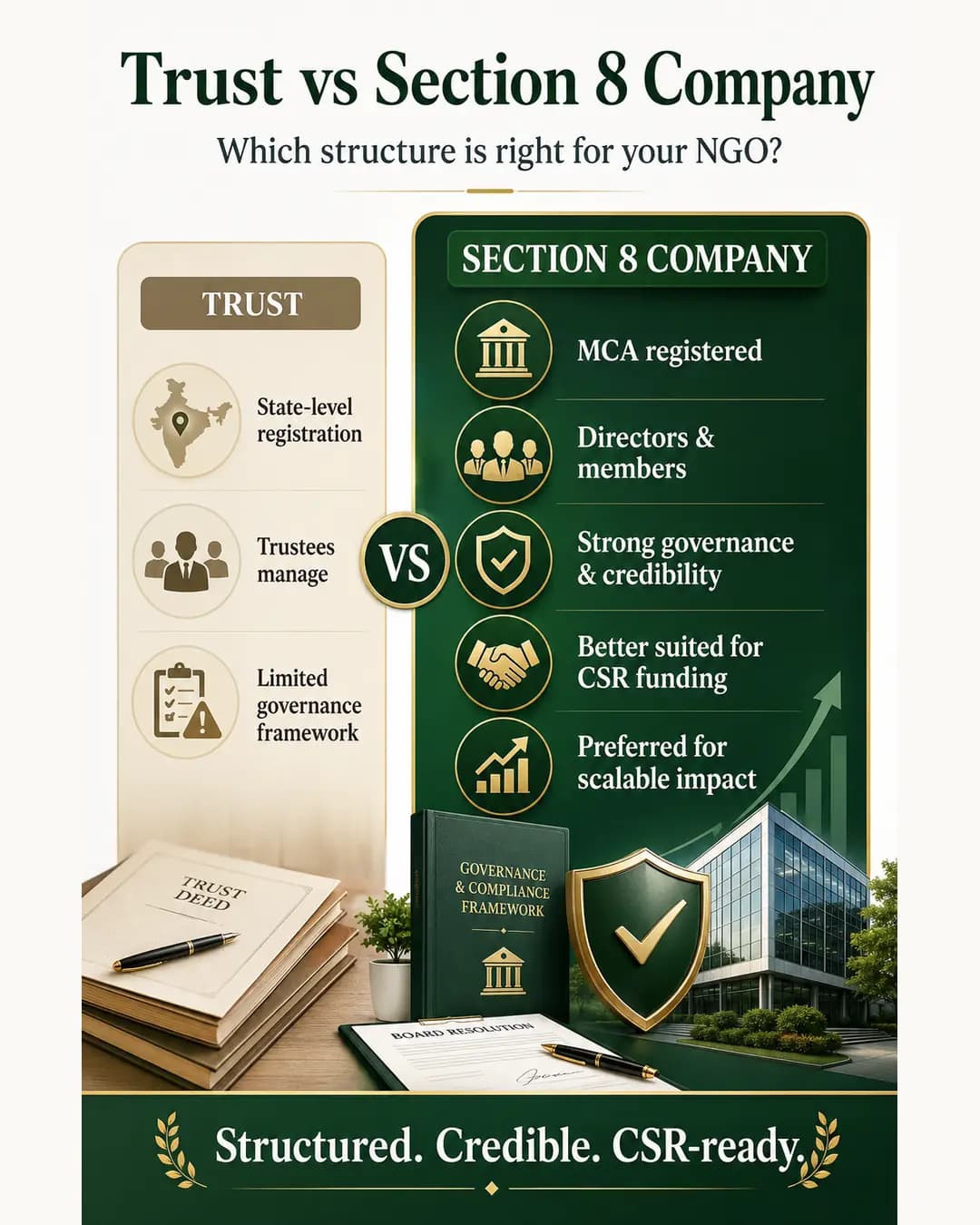
| Parameter | Trust | Section 8 Company |
| Governing Law | Indian Trusts Act, 1882 / State Public Trust Acts | Companies Act, 2013 |
| Registering Authority | Sub-Registrar / Charity Commissioner | MCA, via Regional Director license |
| Formation Document | Trust Deed | Memorandum & Articles of Association |
| Minimum Members | 2 trustees (typical) | 2 directors/shareholders (private); 3 directors/7 shareholders (public) |
| Governing Body | Board of Trustees | Board of Directors |
| Jurisdiction | Often state-specific in practice | Nationwide, single registration |
| Annual Compliance | Comparatively lighter | Mandatory audit, ROC filing, board meetings |
| Transparency | Limited public disclosure | High — publicly searchable filings |
| Approx. Cost | ₹5,000–₹10,000 | ₹7,000–₹8,000+ |
| Registration Time | Days to two weeks | 10–25 working days |
| Donor/CSR Perception | Considered less transparent | Generally preferred |
Why Choose Section 8 Company Registration?
A Section 8 Company Registration gives your NGO stronger legal credibility, nationwide recognition, and better opportunities to secure institutional funding. Let our experts handle the complete online registration process.
Trust vs Section 8 Company in Simple Words
- A Trust is like a small family-run shop: quick to open, cheap to run, light on permissions, but bigger donors may trust it less.
- A Section 8 Company is like a branch of a registered brand: more paperwork, more rules yearly, but government-checked records earn easier donor trust.
Latest Regulatory Updates You Need to Know (2025–2026)
- 12AB validity extended: Under the Finance Act, 2025, trusts with income under ₹5 crore get 10-year 12AB registration, up from 5 years. 80G still renews every 5 years.
- Fewer automatic cancellations: Incomplete Form 10A filings are no longer automatic violations; the "substantial contributor" threshold rose to ₹1 lakh a year.
- New Income Tax Act, 2025 (effective April 1, 2026): Reportedly requires trusts to be irrevocable. (Verify against final Act text.)
- FCRA scrutiny continues: Over 20,600 NGOs lost foreign-funding eligibility in the past decade, per Amnesty International.
- NGO Darpan remains mandatory: Last verified count showed roughly 1.87 lakh registered NGOs (all structures) as of October 2023.
Tax, Cost, and Timeline
- Trust: ₹5,000–₹15,000, mostly stamp duty, generally faster with no central licensing step.
- Section 8 Company: ₹8,000–₹15,000+ including government fees, roughly 10–25 working days for DSC, DIN, name approval, and SPICe+ licensing.
Credibility, CSR, and FCRA
- Section 8 Companies are seen as most credible for CSR committees and foundations, due to stricter ROC oversight.
- Under Section 135 of the Companies Act, CSR funds can reach any structure, but the recipient must register on Form CSR-1 with the MCA.
- FCRA is open to both, but donors often lean toward Section 8 Companies for standardized filings.
Which One Should You Choose?
Complete Your Section 8 Company Registration Online
Register your Section 8 Company from anywhere in India without visiting any government office. We take care of documentation, MCA filing, approvals, and post-registration compliance.
Frequently Asked Questions
Is a Section 8 Company legally "better" than a Trust?
Do the two get different tax treatment?
Which is cheaper: Trust or Section 8 Company registration?
Can a Trust receive CSR funding?
How long does Section 8 Company registration take?
Is 12AB registration valid for the same period for both structures?
Author
A Content Strategist at NGOExperts, who focuses on NGO registration, 12A and 80G registration, FCRA compliance, income tax filing for non-profits, and CSR funding guidelines in India. I research and write our compliance guides in collaboration with our in-house Chartered Accountants and Company Secretaries, so every article reflects current tax and regulatory requirements for the NGO and non-profit sector.
Written by Aabha Garg. Last updated on August 6, 2026