
A Section 8 Company is a non-profit company registered under the Ministry of Corporate Affairs (MCA). It cannot distribute profits to its members, requires no minimum capital to start, and gives members limited liability. A Section 8 Company is a special kind of company made to help people, not to make profit. If you want to start an NGO in India, this guide will explain what a Section 8 Company means and why so many people choose it.
A Section 8 Company is a non-profit company. It cannot distribute profits to its members, requires no minimum capital to start, and gives members limited liability. It can get tax benefits and CSR funds, and is more trusted than a Trust or Society, though it has more rules to follow. This guide explains its meaning, its main features, and how it differs from other NGO types.
What is a Section 8 Company in India?
A Section 8 Company is a company made for a good cause, not for profit. It is formed under Section 8 of the Companies Act, 2013. It is registered with the MCA.The company cannot give its profit to its members. All the money it earns must go back into its work. This is different from normal companies, where members get a share of the profit.
What Are the Key Features of a Section 8 Company?
A Section 8 Company offers limited liability, a non-profit structure, formal governance, and the ability to reinvest income into its stated objectives.
- Works for a good cause: It only works for things like charity, education, or social welfare, not for profit.
- No minimum money needed: You do not need any minimum capital to start this company.
- Limited liability: If the company faces a loss, members do not have to pay from their own pocket beyond what they agreed to invest.
- Its own legal identity: The company is separate from its members. It can own property, sign agreements, and even go to court in its own name.
- No word "Limited" needed: Unlike other companies, it does not need to add "Limited" or "Private Limited" to its name. It can use words like Foundation, Trust, or Association instead.
- Goes on forever: Even if members leave or change, the company keeps running.
- Needs government approval: You need a license from the government to start it. You also need approval to change its rules later.
- Can get CSR money: Big companies must spend some profit on social work. This is called CSR. They can give this CSR money to a Section 8 Company.
- No stamp duty: It does not have to pay stamp duty when it is set up, unlike most other companies.
Section 8 Companies must use their income for their stated objectives and follow applicable MCA and tax compliance requirements.
Activities Allowed Under Section 8 Company in India
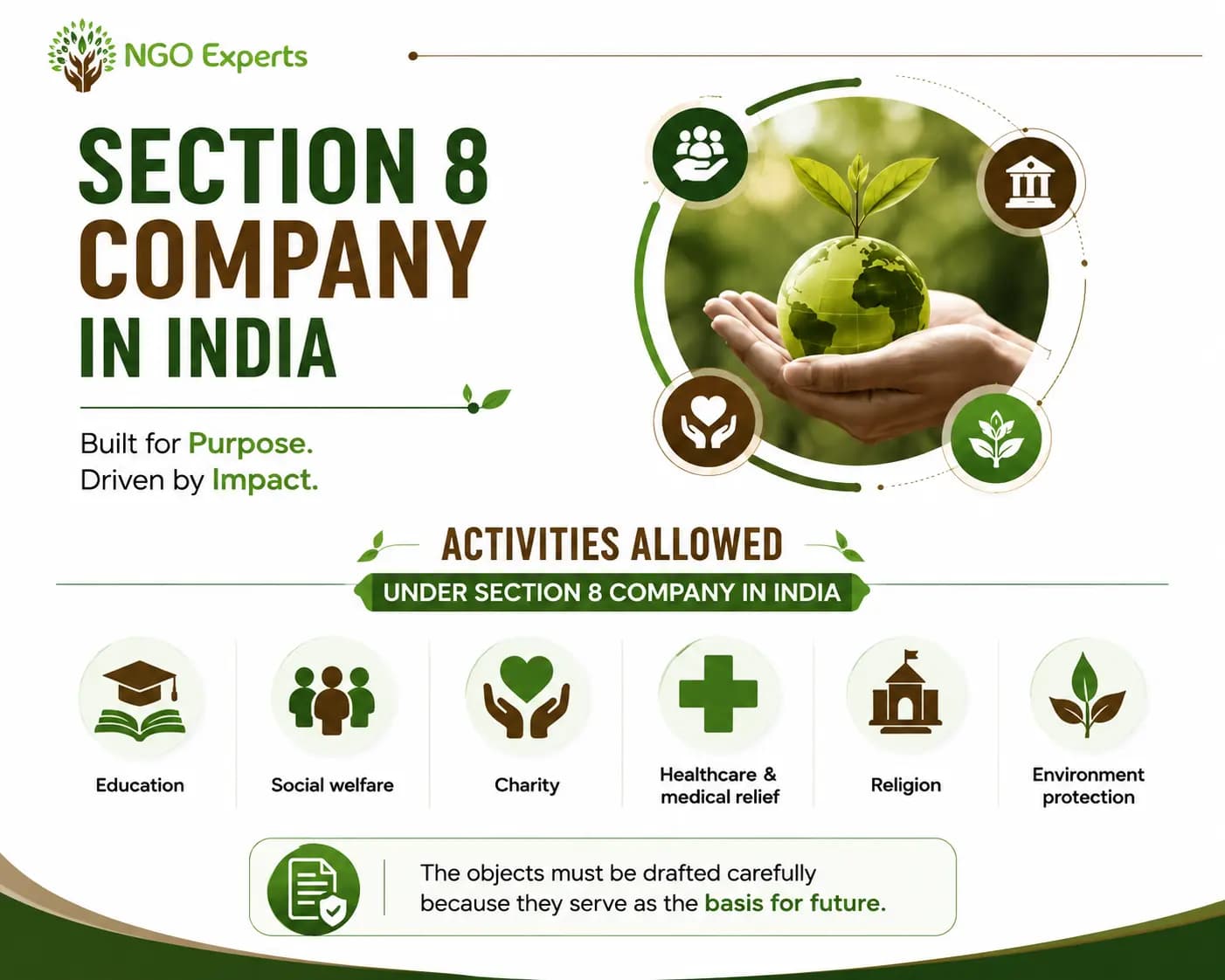
- Education
- Social welfare
- Charity
- Healthcare and medical relief
- Religion
- Research
- Science
- Art and culture
- Sports
- Environment protection
- Skill development
- Women empowerment
- Child welfare
- Rural development
- Any other charitable or social development object
The objects must be drafted carefully because they serve as the basis for future
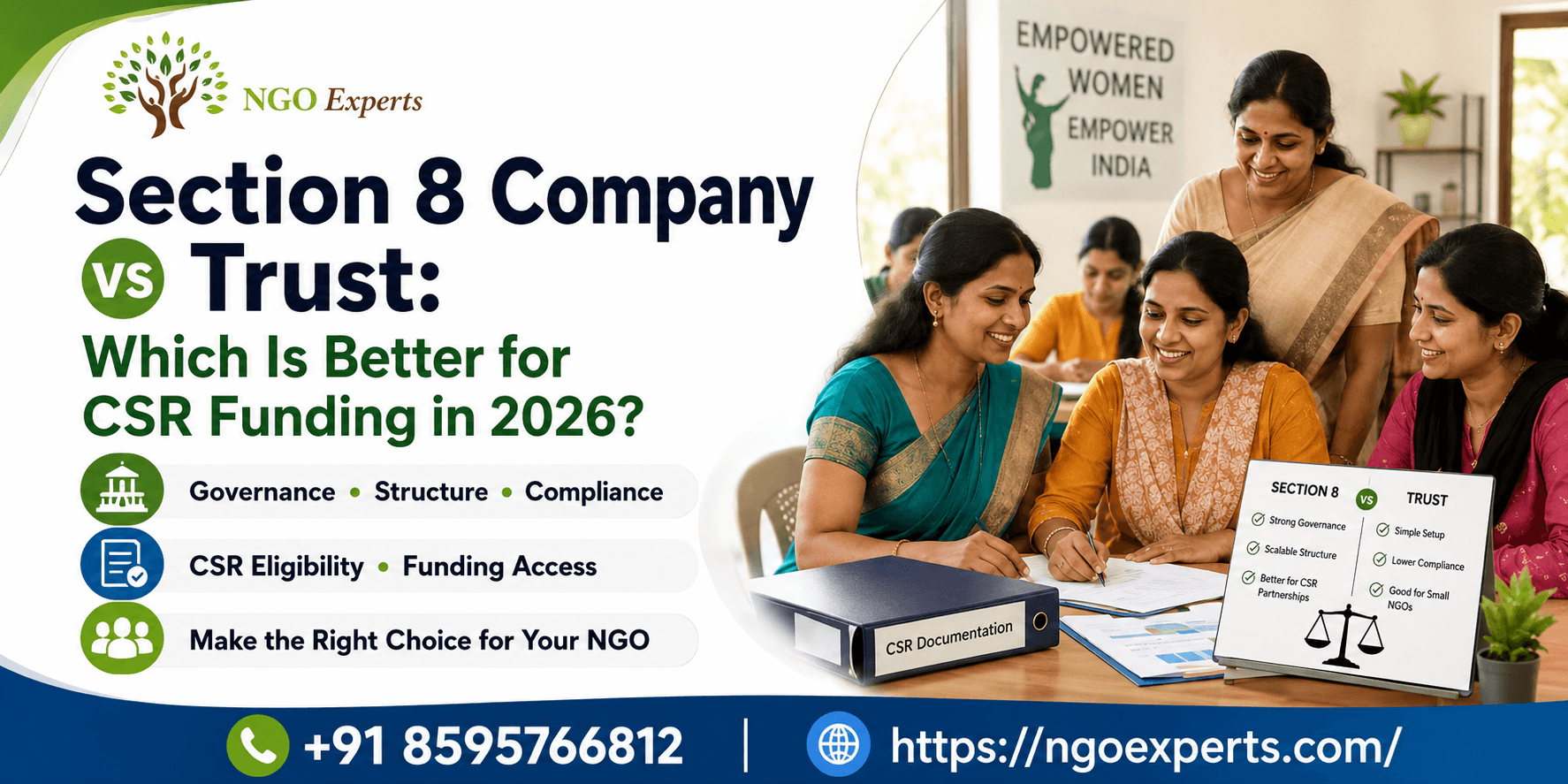
How Is a Section 8 Company Different from a Trust or Society?
All three are non-profit structures, but their registration, governance, and compliance requirements different. Lets understand all about thethree structures.
| Feature | Section 8 Company | Trust | Society |
| Governed by | Companies Act, 2013 | Indian Trusts Act, 1882 | Societies Registration Act, 1860 |
| Who registers it | Ministry of Corporate Affairs (Central) | State government office | State government office |
| Own legal identity | Yes | Not always | Yes |
| Minimum members | 2 (private) or 7 (public) | Usually 2 | 7 |
| Liability | Limited | Not limited | Limited |
| Trust from donors | High | Medium | Medium |
| Rules to follow | More | Fewer | Some |
Who Can Start a Section 8 Company in India?
Almost any person or group of people can start a Section 8 Company if they follow the rules. Here is what is needed:
- At least 2 directors and 2 members for a private company, or 3 directors and 7 members for a public company.
- One director must live in India.
- Directors and members cannot take any salary or payment for their work in the company.
- People from other countries can also become directors, as long as one director lives in India.
What Are the Latest Section 8 Company Updates in 2026?
Here are the key legal, tax, CSR, FCRA, and compliance changes Section 8 Companies should know in 2026.
- New online system: From 14 July 2025, the MCA moved its main forms, like SPICe+, to a new system called V3. This changed how the forms look and work.
- No fee for small companies: If your company's capital is up to ₹15 lakh, the MCA does not charge any fee to register it through SPICe+.
- Fewer board rules: A Section 8 Company does not need to appoint an independent director or form extra committees that other companies need. This makes it simpler to run.
What Are the Benefits of a Section 8 Company?
People choose this company type for many good reasons. These are as following:
- Tax benefits: It can apply for 12A and 80G registration on the Income Tax website. This gives the company tax relief and lets donors get a tax deduction too.
- More trust: Because the government watches over it closely, donors and banks trust it more than a Trust or Society.
- No minimum capital: You can start it even with very little money.
- Safe for members: Members do not risk their personal money if the company loses money.
- Keeps running: The company does not stop even if people leave or change.
- Can work with other countries: With an extra registration called FCRA, done on the FCRA website, it can take donations from other countries and work with foreign groups.
Final Thoughts
A Section 8 Company is one of the best ways to start a trusted NGO in India. It gives you legal protection, no minimum money requirement, and strong government backing. It does need more paperwork than a Trust or Society, but if you want long-term trust, CSR funds, or big donations, it is usually worth the extra effort.
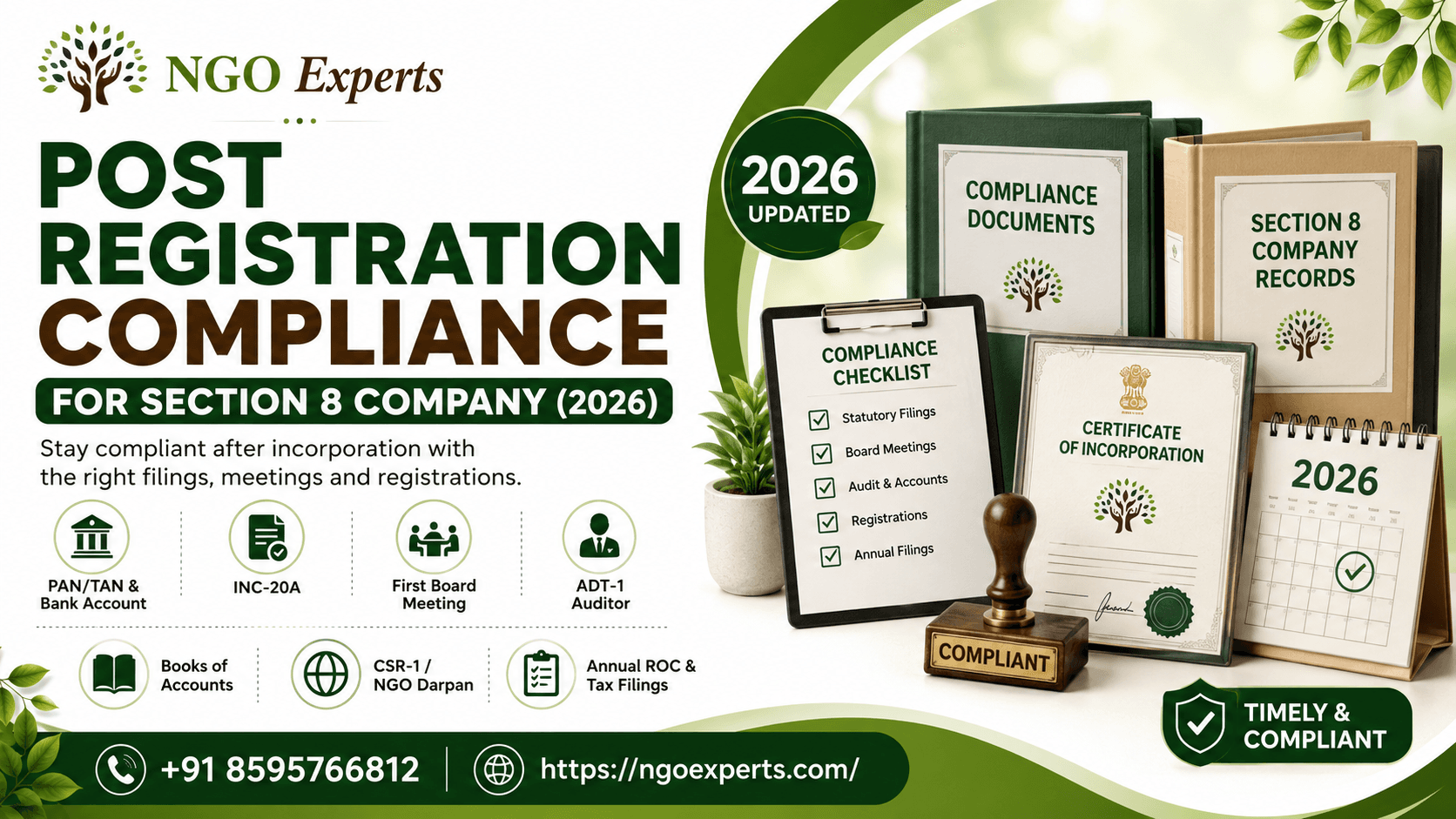
Once the registration process is completed, the Section 8 Company receives its incorporation documents, which serve as proof of registration. This NGO registration certificate can be used when opening a bank account, applying for other registrations, and dealing with government or funding organisations
Frequently Asked Questions
Can a Section 8 Company earn profit?
Yes. It can earn income, but profits cannot be distributed to members. They must be used for the company’s charitable objectives.
What is the minimum capital for a Section 8 Company?
There is no minimum capital requirement. The company can be incorporated with the capital needed for its activities.
How many directors are required?
A private Section 8 Company needs at least 2 directors, while a public Section 8 Company needs at least 3 directors.
Can a Section 8 Company receive CSR funds?
Yes. Subject to applicable CSR rules and eligibility requirements, a Section 8 Company can undertake CSR activities and receive CSR funding.
Can a Section 8 Company receive foreign donations?
Yes, but it must comply with FCRA requirements and obtain the necessary registration or prior permission.
Is Section 8 better than a Trust or Society?
It depends on the NGO's goals. Section 8 offers a formal structure and limited liability but generally has higher compliance requirements.
Author
Aabha Garg
A Content Strategist at NGOExperts, who focuses on NGO registration, 12A and 80G registration, FCRA compliance, income tax filing for non-profits, and CSR funding guidelines in India. I research and write our compliance guides in collaboration with our in-house Chartered Accountants and Company Secretaries, so every article reflects current tax and regulatory requirements for the NGO and non-profit sector.
Written by Aabha Garg. Last updated on September 9, 2026