
Quick Summary
If you’re a CSR leader, compliance officer, or corporate decision-maker, you already know the importance of Corporate Social Responsibility (CSR) in driving meaningful impact. However, unspent CSR funds can quickly become a compliance headache, putting your company at risk of penalties, reputational damage, and missed opportunities for social good. The good news? You’re not alone, and there are smart, strategic ways to ensure your CSR budget is utilized effectively. In this guide, NGOExperts will walk you through everything you need to know about managing unspent CSR funds, ensuring compliance, and maximizing your company’s social impact.
What is an unspent CSR amount?
The unspent CSR amount is the portion of your mandatory CSR spend that isn't used by year-end. Imagine your company calculates a CSR obligation of Rs. 10 crore for FY 2025-26 but spends only Rs. 8 crore by March 31, 2026. The remaining Rs. 2 crore is the unspent CSR amount. Several factors contribute to this underspending:
Project Delays: Initiatives may experience unforeseen delays due to regulatory hurdles, logistical challenges or external factors, leaving funds unutilized.
Inadequate Planning: A lack of thorough planning can result in the selection of projects that are not feasible within the allocated timeframe or budget.
Limited Stakeholder Engagement: Insufficient stakeholder involvement can lead to projects that fail to align with community needs, resulting in low participation and unspent funds.
Types of Unspent CSR Amount
As per the Companies Act,2013, the law treats unspent money differently depending on why it wasn't spent:
- Ongoing Project Unspent CSR Amount
These are multi-year projects (over one FY), like building a school over 2-3 years. Unspent funds here go to a dedicated Unspent CSR Account for continuation.
- Non-Ongoing Project Unspent CSR Amount
Short-term initiatives intended to finish in one FY, such as a one-off health camp. These must transfer directly to government funds.
| Type | Transfer To | Timeline |
| Ongoing Project | Unspent CSR Account | 30 days |
| Non-Ongoing | Schedule VII Fund | 6 months |
Transfer Rules for Unspent CSR Amount
Companies must transfer unspent amounts in accordance with their type. Ongoing funds are deposited into a scheduled bank account, while non-ongoing funds are deposited into specified funds, such as Clean Ganga.
Rule 7 of CSR Rules (pre-amendments) defined eligible spends, but transfers are governed by Sections 135(5)-(6).
CSR Obligation Calculation
Unspent CSR amounts are calculated as the difference between a company's annual CSR obligation and its actual spend by March 31 of the financial year. These are then classified as ongoing (multi-year projects up to 3 years, excluding commencement FY) or non-ongoing (single-year activities).
First, compute the average net profit of the immediately preceding 3 FYs using Section 198 rules (add-backs like dividends; exclude prior losses and depreciation per Schedule II).
CSR obligation = 2% of this average.
Example: Profits (Sec 198): FY23 Rs. 80 Cr, FY24 Rs. 100 Cr, FY25 Rs. 120 Cr.Average = (80 + 100 + 120)/3 = Rs.100 Cr.The obligation for FY26 is calculated as 2% of Rs.100 Cr, which equals Rs.2 Cr.
Ongoing Unspent Calculation
Ongoing projects: Board-approved multi-year. Unspent portion transfers to Unspent CSR Account if not spent by FY-end.
Example: FY26 obligation: Rs. 2 Cr. Allocates Rs. 1 Cr to a 3-year school project (to start in FY26). Spends Rs. 60L by Mar31,26.Unspent ongoing = Rs.1 Cr - Rs.60L = Rs.40L (transfer by Apr30,26).
Non-Ongoing Unspent Calculation
Non-ongoing: Single-FY activities. Full unspent transfers to the Schedule VII fund.
Example: From the same Rs. 2 Cr obligation, allocate Rs.1 Cr to FY26 health camp. Spends Rs. 70L. Unspent non-ongoing = Rs.1 Cr - Rs.70 L = Rs.30 L (transfer by Sep 30, '26).
Unspent CSR Amount Transfer to Government Funds: Rule 7
While Rule 7 originally covered the scope of CSR expenditure, transfers of non-ongoing unspent amounts are now covered under Schedule VII funds as per Section 135(5). Examples: PM's National Relief Fund, Swachh Bharat Kosh.
Ongoing unspent funds can't go here initially; they're used only after 3 years if still unused.
Timeline for Transfer of Unspent CSR Amount
You cannot miss transfer deadlines to avoid penalties.
- Ongoing: By April 30 next year.
- Non-Ongoing: By September 30.
Spend ongoing funds within 3 FYs from transfer, or move to Schedule VII within 30 days post-3rd year.
CSR Transfer Timeline for Ongoing vs Non-Ongoing Projects
- Ongoing: 30 days to Unspent Account → Spend in 3 FYs → 30 days to Schedule VII if leftover.
- Non-Ongoing: 6 months direct to Schedule VII Fund.
Step-by-Step Compliance Process for Unspent CSR Amount
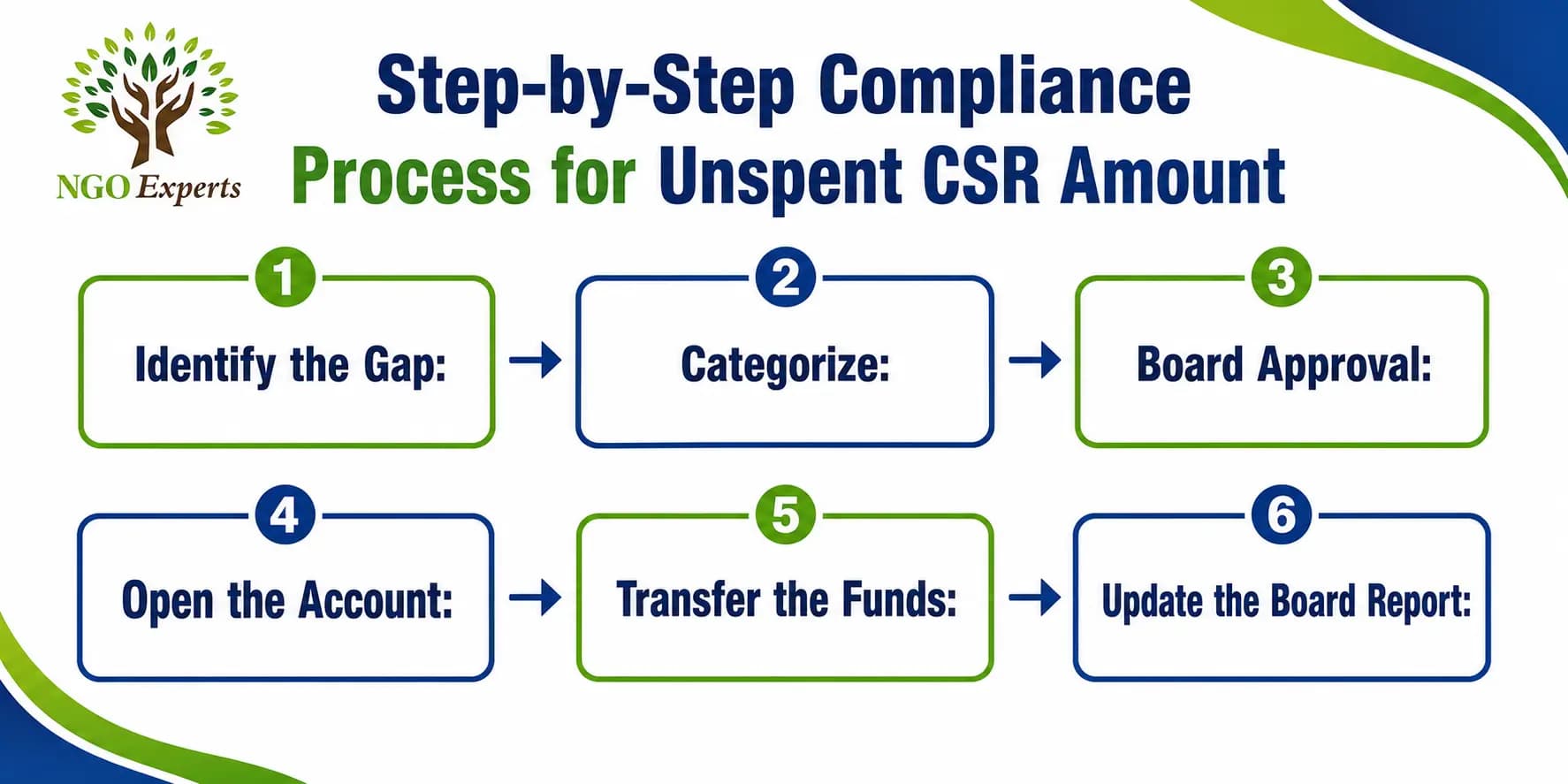
- Identify the Gap: On March 31st, calculate the exact unspent balance.
- Categorize: Determine whether the unspent amount belongs to an "Ongoing Project" (approved by the Board).
- Board Approval: Document the reasons for the unspent amount in the board meeting minutes.
- Open the Account: If it's an ongoing project, open the Unspent CSR Account with a scheduled bank.
- Transfer the Funds: Move the money by April 30 (ongoing) or Sept 30 (non-ongoing).
- Update the Board Report: Disclose the transfer details in the annual report.
Penalty for Non-Transfer of Unspent CSR Amount
Company: Twice unspent or ₹1 crore, whichever is lower.
Officers: 1/10th unspent or ₹2 lakh (lower).
Even if you are late addressing the issue, it doesn't erase penalties; you may pay from your own funds.
Disclosure of Unspent CSR Amount in Board Report
Your board report must include the following:
- The amount needed to be spent.
- The amount actually spent.
- The amount unspent.
- Detailed reasons why the money wasn't spent.
- Details of the transfer to the Unspent Account or Schedule VII fund.
Consequences of Non-Compliance Under Section 135
Non-compliance may result in fines, reputational damage, ROC scrutiny, and director disqualification. If you repeat, Criminal proceedings are possible.
Stay proactive to protect your brand.
Common Mistakes Companies Make in CSR Fund Transfer
- Treat all unspent items as ongoing without proof.
- Missing deadlines despite late transfers.
- Poor disclosures or no CSR committee for balance sheet items.
- Using an unspent account for non-CSR.
Conclusion
By understanding unspent CSR and clearly defining timelines and transfers, you can protect your company from penalties. By distinguishing between ongoing and non-ongoing projects, you can ensure your company stays on the right side of the law while making a genuine impact. At NGOExperts, we specialise in full compliance roadmaps, filings, and audits for Indian companies. Contact us today for expert guidance!
Frequently Asked Questions
What if the CSR is not spent by March 31?
Transfer ongoing amounts to the Unspent Account within 30 days and non-ongoing amounts to Schedule VII within 6 months.
Can unspent account funds be used for business?
No, this is strictly for ongoing CSR projects only.
What's the penalty for late transfer?
Twice unspent (max ₹1 crore) for the company; up to ₹2L per officer.
How long to spend on the ongoing unspent?
Within 3 FYs from the transfer date.
Do small balances need the CSR Committee?
Yes, if any unspent account balance exists.
Author
Aabha Garg
A Content Strategist at NGOExperts, who focuses on NGO registration, 12A and 80G registration, FCRA compliance, income tax filing for non-profits, and CSR funding guidelines in India. I research and write our compliance guides in collaboration with our in-house Chartered Accountants and Company Secretaries, so every article reflects current tax and regulatory requirements for the NGO and non-profit sector.
Written by Aabha Garg. Last updated on October 12, 2026