
Quick Summary
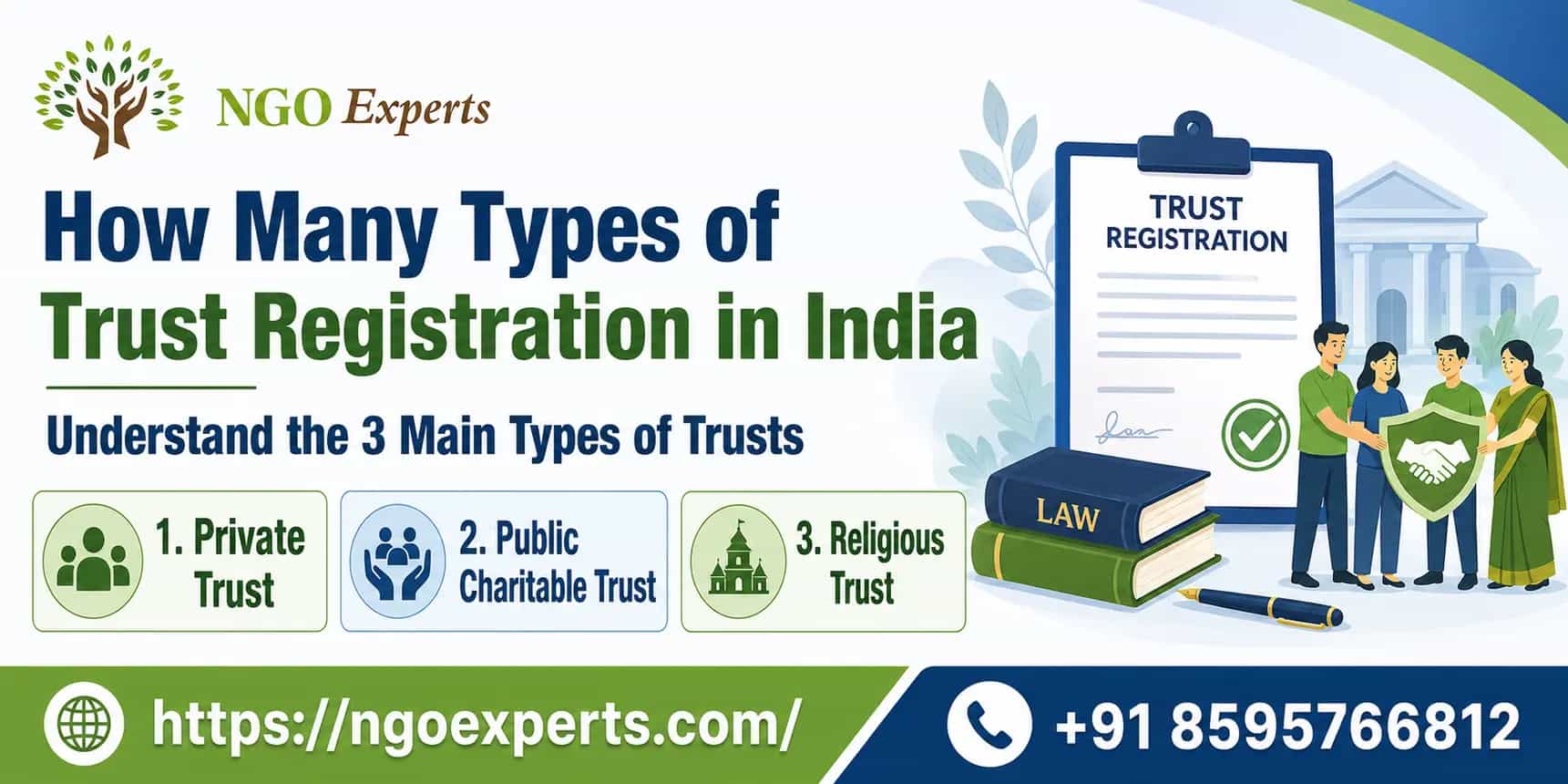
Understanding the types of trust registrations are there in India is essential for anyone looking to establish a trust for social welfare or asset management. Typically, there are 2 types of major trusts in India: Private and Public. However, within these categories and under kinds of trusts in property law, there are multiple subcategories based on purpose, creation method, and operational structure.
Overview
A trust is a legal arrangement where a settlor transfers assets to a trustee to manage them for the benefit of beneficiaries. Trusts play a crucial role in Indian law for managing property, supporting charitable causes, and ensuring family welfare. In India, different laws cover different types of trusts, and the most important is the Indian Trusts Act, 1882.
Whether you're planning to set up a charitable organization, manage family property, or create a legacy fund, knowing the types of private trusts in India and trust registration requirements can help you make informed decisions. This comprehensive guide walks you through the different trust classifications, their meanings, and practical implications.
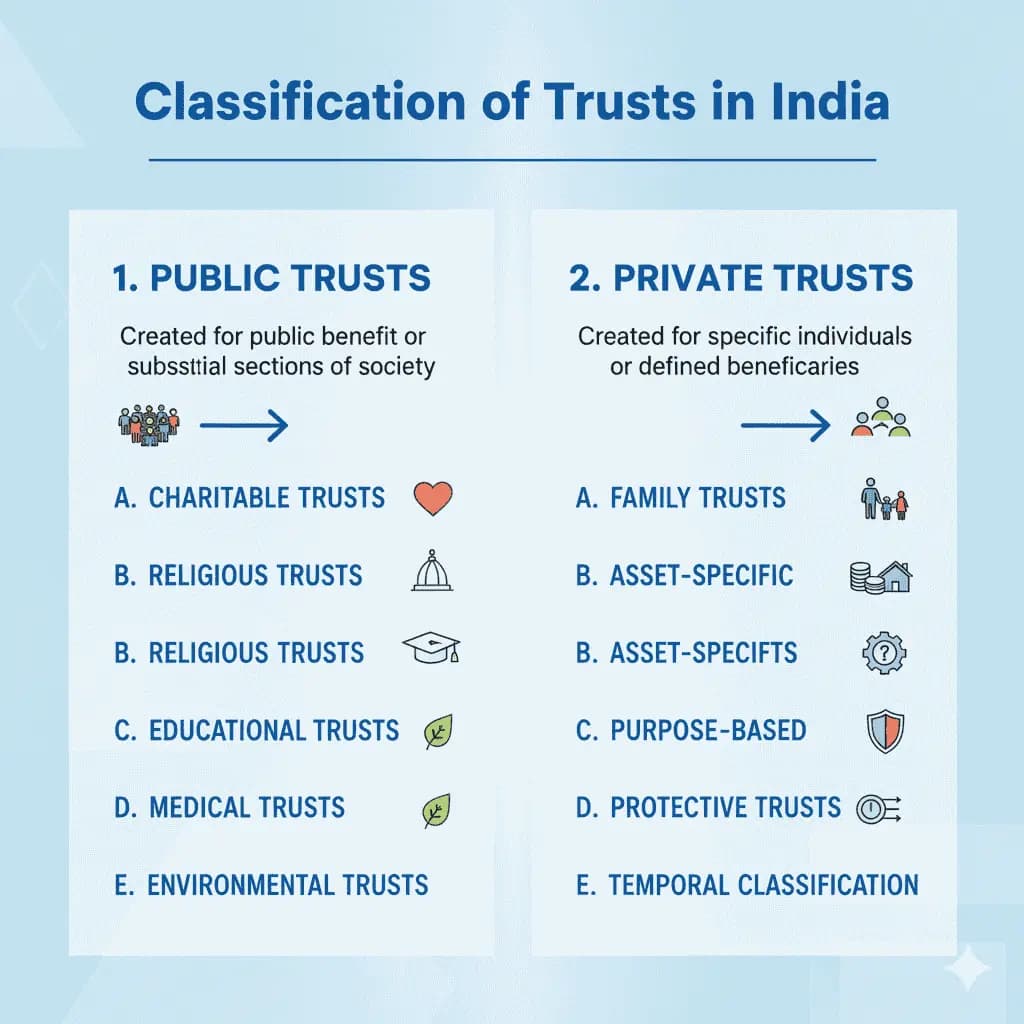
Classification of Trusts in India: Public and Private
1. Public Trusts
Created for public benefit or substantial sections of society
A. Charitable Trusts
- General Charitable: Multiple causes (Example: Azim Premji Foundation - education, healthcare, social reforms)
- Specific Purpose: Single objective (Example: CRY - exclusively child welfare)
B. Religious Trusts
- Temple Trusts: Hindu religious institutions (Example: Tirumala Tirupati Devasthanams)
- Mosque/Dargah Trusts: Islamic institutions (Example: Haji Ali Dargah Trust)
- Church Trusts: Christian establishments (Example: St. Thomas Cathedral Trust)
- Gurudwara Trusts: Sikh institutions (Example: Delhi Sikh Gurdwara Management Committee)
C. Educational Trusts
- School Trusts: Primary/secondary education (Example: Delhi Public School Society)
- Higher Education: Colleges/universities (Example: Bharati Vidyapeeth Trust)
- Scholarship Trusts: Financial aid (Example: JRD Tata Scholarships)
- Research Trusts: Innovation funding (Example: IISc Trust, Bangalore)
D. Medical Trusts
- Hospital Trusts: Medical institutions (Example: Tata Memorial Centre)
- Disease-Specific: Focused healthcare (Example: Indian Cancer Society)
- Mental Health: Psychological support (Example: Live Love Laugh Foundation)
E. Environmental Trusts
- Wildlife Conservation: (Example: Wildlife Trust of India)
- Animal Welfare: (Ex ample: People for Animals)
2. Private Trusts
Created for specific individuals or defined beneficiaries
A. Family Trusts
- Discretionary: Trustee decides distributions (Example: Trust where trustees allocate family income based on needs)
- Fixed Interest: Predetermined shares (Example: Three children receive equal 33.33% rental income)
- Generation-Skipping: Benefits grandchildren (Example: Trust bypassing children for grandchildren's education)
- Spendthrift: Controlled disbursements (Example: Monthly allowances for a financially irresponsible beneficiary)
B. Asset-Specific Trusts
- Property Trusts: Real estate management (Example: Commercial building with rental distributions)
- Business Trusts: Company shares (Example: Family business succession planning)
- Investment Trusts: Securities portfolio (Example: Mutual funds for minor children)
- Intellectual Property: Copyrights/patents (Example: Author's royalties for heirs)
C. Purpose-Based Trusts
- Educational: Named beneficiaries' education (Example: Grandchildren's college fund)
- Marriage Settlement: Spouse/children benefit (Example: Property settled at marriage)
- Maintenance: Regular support (Example: Monthly income for elderly parents)
- Retirement: Post-retirement corpus (Example: Business owner's retirement income)
D. Protective Trusts
- Creditor Protection: Asset shielding (Example: Irrevocable trust protecting family assets)
- Special Needs: Disability care (Example: Lifelong care for a disabled child)
E. Temporal Classification
- Revocable: Settlor can modify (Example: Trust with right to reclaim assets)
- Irrevocable: Permanent transfer (Example: Ancestral property permanently transferred to heirs)
Note: Public trusts governed by state charitable trust acts, religious endowment acts, whereas private trusts are governed by the Indian Trust Act 1882.
Here is a user-friendly, concise table listing the major trust classifications, from family trusts to large public or charitable trusts, and includes practical examples seen in India for a wider and deeper insight:
| Trust Type | Who Benefits? | Legal Basis | Key Features / Examples |
| Private Trust | Individuals, families | Indian Trusts Act, 1882 | For personal, family asset planning |
| Public Trust | General public, society | Charitable & Religious Trusts Act, 1920 | For schools, hospitals, and temples |
| Public-cum-Private | Public + individuals | Mixed (as per objectives) | Family fund with public charities |
| Testamentary Trust | As stated in a Will | Indian Succession Act | Activated after the creator’s death |
| Living Trust | Chosen by settlor, family | Indian Trusts Act, 1882 | Active while the creator is alive |
| Special Purpose Trust | Persons, pets, causes | Indian Trusts Act, 1882/others | Pet care, parks, scholarships, businesses |
| Charitable Trust | Public relief, social work | Charitable & Religious Trusts Act, 1920 | For orphanages, educational help |
| Religious Trust | Faith communities | Charitable & Religious Trusts Act, 1920 | For temples, churches, and religious sites |
| Revocable Trust | Settlor/family | Indian Trusts Act, 1882 | The settlor can change the terms or cancel |
| Irrevocable Trust | Settlor, family, causes | Indian Trusts Act, 1882 | Cannot be changed after creation |
| Simple Trust | Passive holding | Indian Trusts Act, 1882 | Minimal trustee duties, beneficiary controls |
| Special Needs Trust | Disabled persons | Disability laws / Trust Act | Supports persons with disabilities |
Documents Required for Trust Registration
Understanding the documents required for trust registration is crucial for smooth establishment:
- Trust Deed - The primary document outlining trust objectives, trustees, beneficiaries, and operational rules
- Identity Proofs - PAN cards, Aadhaar cards, and photographs of all trustees
- Address Proof - Utility bills, rent agreements, or property documents of trustees
- Property Documents - If property is being transferred to the trust
- NOC from Property Owner - If the trust office is in rented premises
- Affidavit - Sworn statement by trustees accepting their roles
- Registration Fees - Varies by state and trust type
Important Tips for Trust Registration
1. Choose the Right Trust Type: Carefully evaluate your objectives—charitable work requires public trusts, while family wealth management needs private trusts.
2. Draft a Comprehensive Trust Deed: This is the constitutional document of your trust. Include clear objectives, succession planning, and dissolution clauses.
3. Select Trustees Wisely: Trustees carry legal responsibility. Select individuals with integrity, relevant expertise, and a demonstrated commitment to the long term.
4. Understand State-Specific Laws: Trust registration varies across states. Maharashtra follows the Bombay Public Trusts Act, whereas Tamil Nadu has its own set of regulations.
5. Regular Compliance: File annual returns, maintain accounts, and conduct audits as required by law to avoid penalties.
6. Seek Professional Guidance: Consult chartered accountants or a trusted trust registration consultancy specializing in trust law for proper structuring and compliance.
Download this Inspiring Case Study PDF to learn ’How the right trust setup makes a big difference’
Conclusion
The key to successful trust registration lies in thorough planning, proper documentation, and ongoing compliance. By following the guidelines outlined in this article and gathering the necessary documents required for trust registration, you can establish a trust that fulfills your vision while adhering to Indian legal frameworks. Remember, trusts are powerful instruments for social good and personal legacy. Use them wisely to create lasting positive impact.
Frequently Asked Questions
What are the primary objectives of forming a trust?
Trusts are usually created for asset management, family wealth protection, charitable works, religious purposes, or social welfare. Clearly defining these objectives in the trust deed is essential for legal recognition.
What is the minimum number of trustees required for a trust?
At least two trustees are needed to register a private trust. For charitable trusts, a minimum of three trustees is recommended for efficient functioning and legal compliance.
How long does it take to register a trust in India?
The trust registration process usually takes 7–15 working days, depending on the state's rules, completeness of documents, and verification steps. Delays may occur if documents are incomplete or further clarification is required.
Who can register a trust in India?
Any adult person, group of people, or legal entity, including individuals, families, companies, or organizations, can register a trust for charitable, religious, or private purposes.
Author
Sakshi Kashyap
I am a dedicated and detail-oriented Website Content Writer with over two years of experience in creating compelling, reader-friendly, and SEO-optimized content. My expertise lies in developing well-structured web pages, landing pages, blogs, and service descriptions that enhance user engagement and drive organic traffic.
Written by Sakshi Kashyap. Last updated on June 2, 2026