


Need Help with Section 8 Company Annual Compliance?
Keep your Section 8 Company compliant with expert assistance for annual filings, tax compliance, MCA requirements, and regulatory obligations. Avoid penalties by filing everything accurately and on time.
What Does Compliance Mean for a Section 8 Company?
- The government office called the MCA watches over Section 8 Companies the same way it watches over any other company.
- Donors and companies giving CSR money often check your filing history before they give you money. If your filings are late, they may say no.
- If your organisation has NGO Darpan registration, keep your profile updated whenever there are changes in directors, office bearers, PAN, address, or registration details to avoid delays in government grant applications and verification.
- If the company keeps breaking the rules, the government can cancel the Section 8 license completely.
What Forms Must a Section 8 Company File Every Year?
- Form ADT-1: Tells the government who your auditor is. Usually good for 5 years.
- Form AOC-4: Sends your checked accounts (money in, money out) within 30 days after your yearly meeting.
- Form MGT-7: Sends details about your directors and members within 60 days after your yearly meeting.
- Form DIR-3 KYC: Yearly ID check for every director. Skip this and the director's ID number gets switched off.
- Form ITR-7: Your income tax return. You must file this even though the company doesn't pay tax, because an auditor must always check the accounts.
- Form 10B/10BB: The auditor's report that supports your tax-free status. Filed a bit before ITR-7.
- Form CSR-1 and FC-4 (if needed): CSR-1 lets you receive CSR money. FC-4 is filed every year if you receive money from other countries.
What Is the Complete Section 8 Company Filing Calendar for 2025–26?
| What to File | Form Name | When It's Due (if your year ends 31 March) |
| Yearly Meeting (AGM) | — | Within 6 months of year-end (by 30 September) |
| Money Records | AOC-4 | Within 30 days after the AGM |
| Company Details | MGT-7 | Within 60 days after the AGM |
| Auditor's Tax Report | Form 3CA/3CB-3CD | 30 September |
| Tax Return | ITR-7 | 31 October |
| Director ID Check | DIR-3 KYC | 30 September |
| Deposit Report | DPT-3 | 30 June |
| Foreign Money Report (if any) | FC-4 | 31 December |
How Many Board Meetings Must a Section 8 Company Hold?
- Board meetings: At least 4 a year, with one in every 3-month block.
- Annual General Meeting (AGM): A Section 8 Company must generally hold an AGM every year, subject to the applicable provisions and exemptions under Companies Act, 2013.
- The first AGM must happen within 9 months of starting the company. Later AGMs must happen within 6 months of year-end, and no more than 15 months should pass between two AGMs.
- Form MGT-14: File this within 30 days if the board makes big decisions, like changing the company's goals or rules.
What Happens If a Section 8 Company Misses a Filing Deadline?
- Daily fine: ₹100 per late form, with no cap.
- Company fine: Between ₹10 lakh and ₹1 crore, depending on how bad the delay is.
- Director fine: Between ₹25,000 and ₹25 lakh, and in serious cases, up to 3 years in jail.
- License canceled: The government can shut down your Section 8 status if it looks like the company isn't really doing charity work anymore.
- Tax trouble: A late tax return adds interest and extra fees, and can put your tax-free status at risk.
What’s New for Section 8 Companies in 2025–2026?
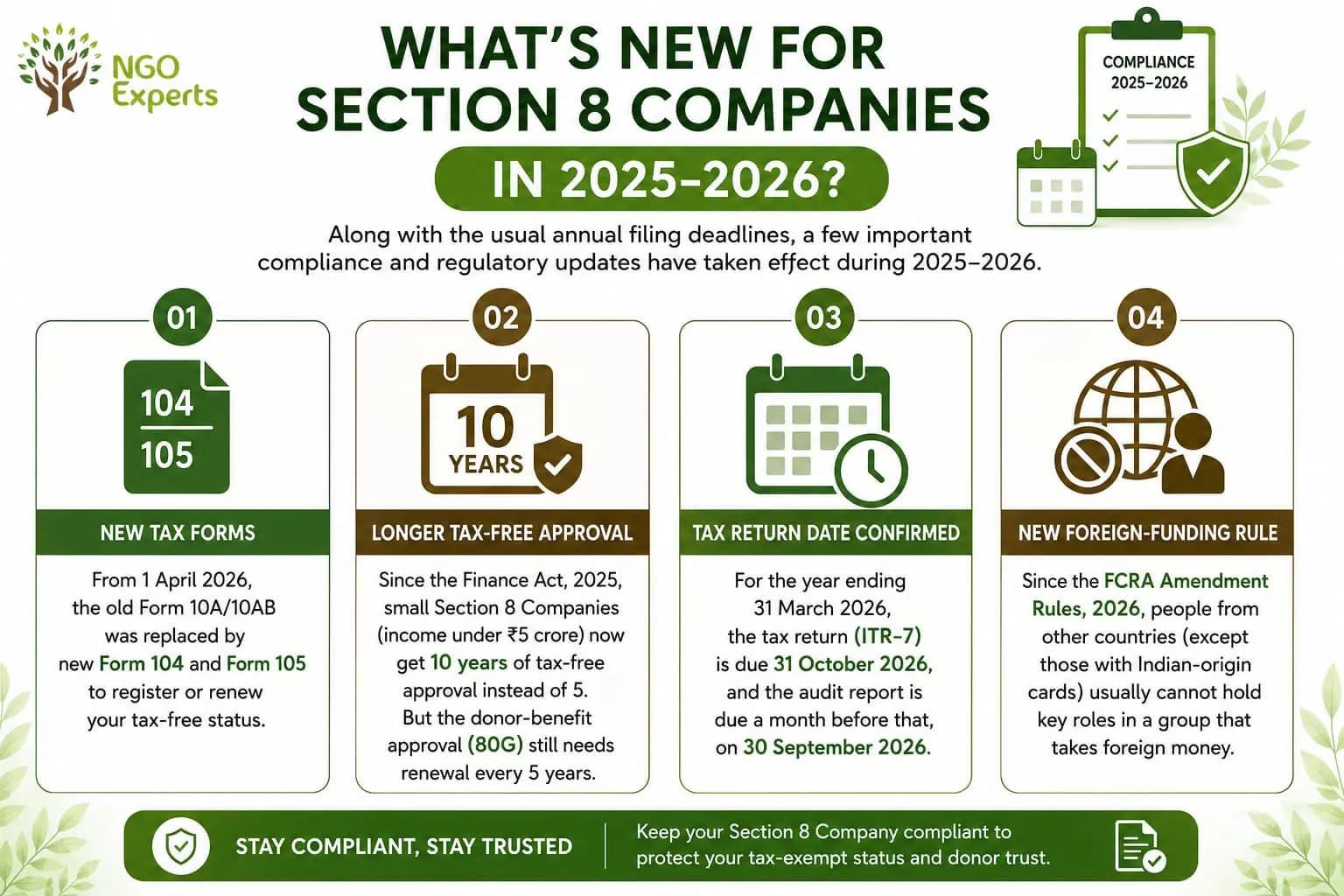
- New tax forms: From 1 April 2026, the old Form 10A/10AB was replaced by new Form 104 and Form 105 to register or renew your tax-free status.
- Longer tax-free approval: Since the Finance Act, 2025, small Section 8 Companies (income under ₹5 crore) now get 10 years of tax-free approval instead of 5. But the donor-benefit approval (80G) still needs renewal every 5 years.
- Tax return date confirmed: For the year ending 31 March 2026, the tax return (ITR-7) is due 31 October 2026, and the audit report is due a month before that, on 30 September 2026.
- New foreign-funding rule: Since the FCRA Amendment Rules, 2026, people from other countries (except those with Indian-origin cards) usually cannot hold key roles in a group that takes foreign money.
Stay Compliant with Your Section 8 Company Filings
From AOC-4 and MGT-7 to ITR-7, DIR-3 KYC, and audit support, our experts handle your complete annual compliance so you can focus on your NGO's mission.
How Can a Section 8 Company Avoid Penalties and Stay Compliant?
- Start from the AGM date and work backward: Finish your accounts by July, get them checked by August, and hold your AGM by early September. This gives you breathing room.
- Watch three different government offices: The MCA, the Income Tax office, and, if you take foreign money, the Home Ministry. Each has its own separate deadlines.
- Don't assume the AGM buys you extra time: Many people think they have until December after a September AGM. In truth, one form is due just 30 days after the AGM.
- Keep director ID checks on time: If you skip DIR-3 KYC, the director's ID gets switched off, which can block other filings too.
- Track big decisions separately: MGT-14: Track this filing separately because its 30-day deadline applies from the date of the relevant resolution or event, rather than following the company’s annual filing cycle.
Complete Your Section 8 Company Compliance with Confidence
Whether you're managing your first annual filing or ongoing compliance, our legal professionals ensure your Section 8 Company meets every statutory requirement without delays.
Frequently Asked Questions
Does every Section 8 Company need its accounts checked by an auditor?
What's the fine for a late AOC-4 or MGT-7 form?
Does a Section 8 Company have to hold a yearly meeting?
When is the tax return due for a Section 8 Company?
Author
A Content Strategist at NGOExperts, who focuses on NGO registration, 12A and 80G registration, FCRA compliance, income tax filing for non-profits, and CSR funding guidelines in India. I research and write our compliance guides in collaboration with our in-house Chartered Accountants and Company Secretaries, so every article reflects current tax and regulatory requirements for the NGO and non-profit sector.
Written by Aabha Garg. Last updated on August 7, 2026