


Quick Answer
An Old Age Home Project Report provides a structural proposal covering capital expenditure, operational costs, and care metrics. Customized drafting costs start at ₹4,999, delivered in 3 to 5 days. Crucial for securing government land grants and CSR capital
Quick Summary
Establishing an old-age home is one of the most noble yet complex social ventures in India. If you’re planning to start or expand an old-age home as an NGO in India, one thing will decide your success: a strong, professional project report for sponsors, banks, CSR committees, and government departments. Funders don’t fund ideas; they fund well‑documented plans. In this guide, let's discuss what an NGO project report for an old-age home really means and is all about, from budgeting to funding.
What is an NGO project report for an old age home?
An NGO project report for an old-age home is a structured document that explains:
- Why is an old-age home needed?
- Who it will serve,
- How it will run day‑to‑day,
- What facilities and services will it offer, and
- How much money will be needed and how it will be used.
Why does this report matter?
- Proof of seriousness: Donors and banks see this report as your business plan; it shows you have thought beyond just goodwill.
- Gateway to funding: Government schemes like Atal Vayo Abhyuday Yojana (AVYAY) provide grants to NGOs running senior citizen homes; a proper project report is almost always mandatory.
- Corporate CSR departments and trusts also ask for full project reports before releasing funds.
- Clarity for your own team: Even if you don’t need external funding immediately, writing the report itself forces you to plan your staffing, facilities and budget logically.
How to Prepare a Project Report for an Old Age Home NGO?
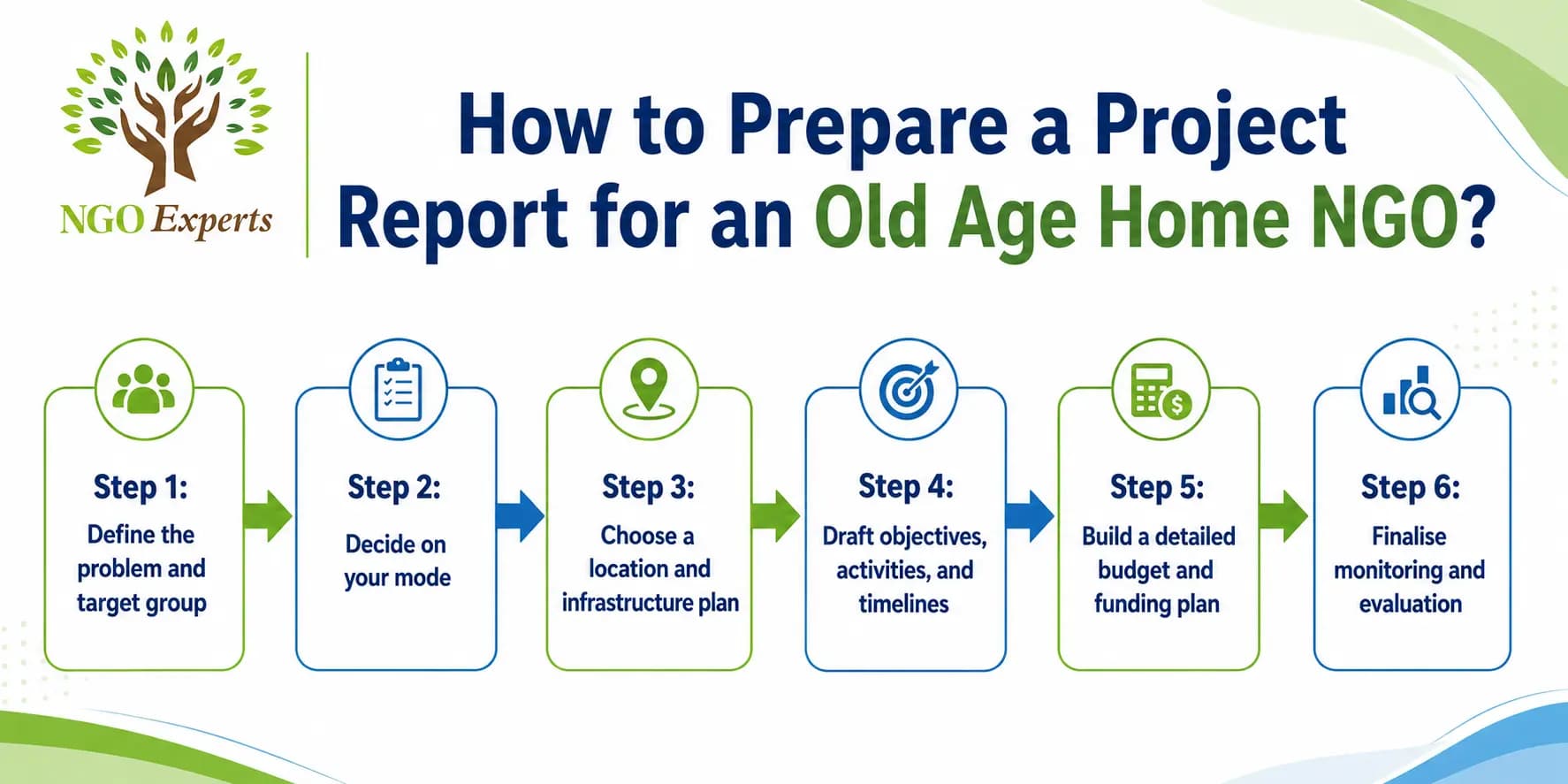
Here’s a step-by-step guide for the old age home project report in India you can follow:
Step 1: Define the problem and target group
- Start with the current ageing statistics in India:
- Around 10% of India’s population (over 130 million people) is aged 60 or older, and this is expected to reach 20% by 2050.
- Mention issues: loneliness, no family support, medical neglect, and financial insecurity.
Step 2: Decide on your mode
Will your old age home be:
- Full‑time residential (24×7 stay),
- A day care centre, or
- A mixed model (day care plus short‑stay/respite care)?
This choice directly affects space, staff, and budget.
Step 3: Choose a location and infrastructure plan
- Select a safe, accessible area with basic amenities (water, electricity, medical access).
- Decide: 1. Number of beds/rooms (for example, 25–50 inmates).
2. Common areas: kitchen, dining, recreation, prayer/meditation, medical room, and staff area.
Step 4: Draft objectives, activities, and timelines
- List clear, measurable objectives (covered in detail in section 5 below).
- Prepare a 12‑month activity calendar: monthly routines, health check‑ups, social events, training, etc.
Step 5: Build a detailed budget and funding plan
- Estimate one‑time costs (construction/rent, furniture, equipment) and recurring costs (staff salaries, food, medicines, utilities).
- Mention possible funding sources (government schemes, CSR, individual donors, and membership fees, if any).
Step 6: Finalise monitoring and evaluation
- Decide how you will track:
- Health and nutrition of inmates,
- Participation in activities,
- Complaints and feedback,
- Financial discipline and audit requirements.
Detailed Format of NGO Project Report for Old Age Home
Use this NGO project report format for India's old-age home as your checklist. You can convert it to an old-age home project report format PDF later.
1. Cover Page
- NGO name, logo
- Project Report for Establishment/Optimisation of Old Age Home for Senior Citizens
- Location, city, state
- Date and version
2. Executive Summary (½ to 1 page)
- Brief need: How many elderly people are currently underserved in your area?
- What your project will do (number of beneficiaries, duration, key services).
- Total approximate budget and expected sources.
3. Background and Need Assessment
- Aging trends at the national and local level.
- Problems faced by the elderly without family support.
- Why your city/district needs this home.
4. Project Objectives
- Mission, vision, and specific, measurable objectives.
5. Project Description
- Type of home: residential / day care / mixed.
- Number of inmates (for example, 25–50 seniors).
- Age group (usually 60+ years).
- Services offered: shelter, food, medical care, counselling, recreation, skill‑based activities, and spiritual support.
6. Implementation Plan
- Timeline (e.g., 12 months).
- Key activities each month:
- Recruitment and training of staff,
- Facility setup,
- Admission of inmates,
- Health camp,
- Monthly review meetings, etc.
7. Organisational Capacity
- NGO details: registration number (Trust/Society/Section 8), registration date, and address.
- Brief profile of trustees, key staff, and any experience in senior‑care or social work.
8. Monitoring and Evaluation
- Indicators (e.g., number of beneficiaries, improvement in health indicators, satisfaction surveys).
- Frequency of review: monthly, quarterly, and annual.
- The funder requires an external evaluation.
9. Budget and Financial Plan
- Capital expenditure (one‑time): building/rent, furniture, medical equipment, security, etc.
- Recurring expenditure: salaries, food, medicines, utilities, maintenance, transport.
- Revenue/Income: donations, CSR, government grants, occasional fundraising.
10. Annexures
- Registration certificates, PAN, 12A and 80G, and audited statements (if available).
- Layout plan or site photos.
- Staff CVs or brief profiles.
Objectives of Old Age Home NGO Project
Your objectives for the old-age home NGO project should be SMART (Specific, Measurable, Achievable, Relevant, and Time-bound).
- Mission: To provide a safe, abuse-free, and dignified environment for abandoned seniors.
- Vision: A society where every elderly person lives with health, respect, and joy.
- Goals of senior citizen welfare NGO: Providing 1700 calories of nutrition daily, 24/7 nursing care, and monthly health camps.
These objectives for the old-age home NGO project must be written in a way that a donor can clearly see the change, given their funding.
Budget Planning for Old Age Home NGO Project Report
Typical cost structure
Using example data from similar old‑age proposals and NGO reports:
- One‑time setup (for 25–30 residents):
- Rent/security deposit or building setup: ₹10–15 lakh in Tier‑2/3 cities.
- Furniture, beds, mattresses, wardrobes: ₹3–5 lakh.
- Kitchen setup, utensils, basic medical equipment (BP machine, wheelchair, etc.): ₹2–3 lakh.
- Monthly recurring cost per inmate (approx. based on sample proposals):
- Food: ₹1,500–₹2,500 per person per month.
- Staff (if shared among 25 inmates): per‑inmate cost around ₹1,000–₹1,500/month.
- Annual budget ballpark for a 25‑bed home:
- Salaries: ₹12–18 lakh,
- Food: ₹6–10 lakh,
- Medicines, utilities, transport: ₹4–6 lakh.→ Total recurring: roughly ₹22–34 lakh/year, depending on city and staff mix.
Funding Sources for Old Age Home NGOs in India
1. Government Schemes
- Atal Vayo Abhyuday Yojana (AVYAY): Provides grants to NGOs running senior citizen homes, covering food, shelter, and basic medical care.
- State‑level schemes: Many states have separate schemes for Vridha Aashram, or senior citizen homes, with similar grant structures.
2. CSR Funding
- CSR funding for old-age homes in India is allowed under Schedule VII of the Companies Act, including the setting up of old-age homes, day care centres, and similar facilities.
- In practice, corporate CSR budgets for senior care remain modest, but credible NGOs with strong project reports are attracting more attention.
3. Trusts, Foundations, and Individual Donors
- Many Indian trusts and foundations prioritise elderly care, health, and geriatric support.
- A clear, professional project report increases your chances of getting committed individual donors.
Conclusion
A well-documented NGO project report for an old-age home bridges the gap between your intent and the funder's impact goals. By following this roadmap, you ensure that your NGO isn't just a registered entity but a beacon of hope for India's Senior citizens.
If you’re planning to start an old-age home NGO in India and need a professional, ready‑to‑use project report, NGOExperts offers expert drafting, compliance mapping, and customisation for your exact city and budget. Contact us today for a donor‑ready old age home project report that maximises your chances of approval.
Frequently Asked Questions
What is the main purpose of an NGO project report for an old-age home?
It is a formal document that explains why an old age home is needed, how it will operate, for whom, and how much funding it requires; it is used to apply for grants, CSR funds, and bank loans.
How long should an old-age home project report be?
For most CSR and government schemes, a 10–20-page detailed report is ideal; it should be concise yet cover all key sections.
Can an unregistered NGO write a project report for a nursing home?
Yes, you can draft the report, but most serious donors and government schemes require registered NGOs.
Which government schemes fund old-age homes in India?
Key schemes include Atal Vayo Abhyuday Yojana (AVYAY) and various state‑level senior‑citizen.
Author
Aabha Garg
A Content Strategist at NGOExperts, who focuses on NGO registration, 12A and 80G registration, FCRA compliance, income tax filing for non-profits, and CSR funding guidelines in India. I research and write our compliance guides in collaboration with our in-house Chartered Accountants and Company Secretaries, so every article reflects current tax and regulatory requirements for the NGO and non-profit sector.
Written by Aabha Garg. Last updated on October 14, 2026
