

Want to Start an Old Age Home in India?
Learn the basic requirements, legal structures, documents, funding options, and key steps involved in starting an old age home in India.
What Is an Old Age Home and Who Regulates It?
Why Should You Register an Old Age Home in 2026?
- Legal recognition: sign leases, hire staff, open bank accounts in the home's name.
- Funding access: AVYAY–IPSrC grants, state schemes, and CSR budgets require a valid license.
- Tax standing: RNPO status gives exemption to the organisation and deduction benefits to donors.
- Resident safety: licensing enforces staffing ratios, medical tie-ups, and fire/food safety norms.
Which Legal Structure Should You Pick?
| Structure | Governing Law | Minimum Founders | Registered With |
| Society | Societies Registration Act, 1860 | 7 members | State Registrar of Societies |
| Trust | Indian Trusts Act, 1882 | 2 trustees | Local Sub-Registrar |
| Section 8 Company | Companies Act, 2013 | 2 directors + 2 members | MCA |
What Documents Do You Need Before You Apply?
- PAN, Aadhaar, photographs of founders/trustees/directors
- Trust Deed/MOA stating elder-care objectives
- Ownership/lease proof and floor plan for the premises
- Fire Safety NOC and FSSAI food license
- Staffing plan with background-verified caretakers, nurse, cook, security
- Admission/discharge register, health history, and consent formats per NISD care guidelines
Confused About the Documents Required to Start an Old Age Home?
Get a personalized checklist of the documents you need for NGO registration and related approvals.
How Do You Register and License an Old Age Home, Step by Step?
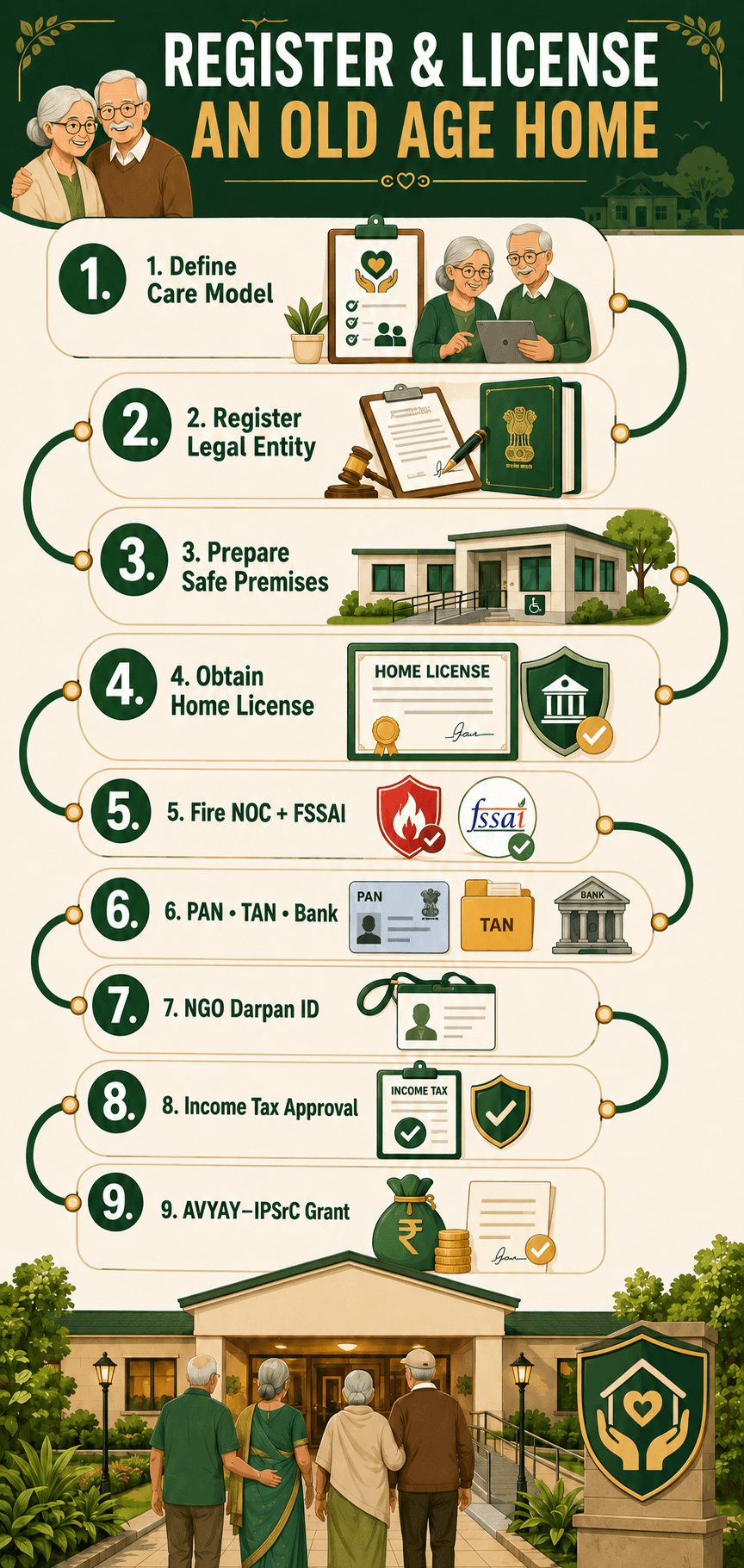
- Define scope: free shelter for indigent elders, paid assisted-living, or both.
- Register as a Society, Trust, or Section 8 Company.
- Prepare premises: ventilation, ramps, safety rails, adequate space per resident.
- Apply to the District Social Welfare Office for a home license (state-specific; e.g., Tamil Nadu's process).
- Get fire NOC and FSSAI license before admitting residents.
- Apply for PAN, TAN, and open a bank account.
- Register on NGO Darpan for a Unique ID.
- Apply for RNPO/donor-deduction approval with the Income Tax Department.
- Apply for AVYAY–IPSrC grant-in-aid via the MSJE Grants Portal once licensed and Darpan-listed.
What Will It Cost, and How Long Will It Take?
| Particulars | Cost | Timeline |
| Name approval/deed drafting | ₹1,000–₹3,000 | 2–4 days |
| DSCs (Section 8 only) | ₹3,000 | 1–2 days |
| Entity filing fee | ₹1,000–₹5,000 | 3–7 days |
| Fire NOC + FSSAI licence | ₹3,000–₹8,000 | 10–15 days |
| District Welfare Office license + inspection | ₹2,000–₹6,000 | 10–20 days |
| Darpan + RNPO application | ₹2,000–₹5,000 | 7–10 days |
| Total | ₹15,000–₹25,000 | 30–45 days |
Which Government Schemes Fund Old Age Homes?
| Scheme | What It Offers | Administered By |
| IPSrC (under AVYAY) | Grant-in-aid to run Senior Citizen Homes — shelter, food, medical care | MSJE |
| SAPSrC | State-level funding for elderly-care infrastructure | State Social Welfare Depts |
| Rashtriya Vayoshri Yojana | Free assisted-living devices for eligible seniors | MSJE / ALIMCO |
| SACRED & SAGE | Livelihood and "Silver Economy" support | MSJE |
| CSR-1 route | Corporate CSR funding for elder-care infrastructure | MCA / Companies |
What Do the Latest Numbers Say About India's Aging Population?
- India's 60+ population is projected to reach roughly 17.3 crore by 2026 (Ministry of Social Justice and Empowerment), driven by rising life expectancy.
- As of August 2025, 696 Senior Citizen Homes are operational across 29 States and Union Territories under the Ministry of Social Justice and Empowerment's (MSJE) Integrated Programme for Senior Citizens (IPSrC) scheme, offering free shelter, nutrition, medical care, and recreation to indigent elderly, with 84 additional homes selected for funding in FY 2025-26.
- Roughly half of India's government-supported old age homes have historically been concentrated in southern states, reflecting regional disparities in coverage.
Real-life example: SHEOWS (Delhi NCR & Uttar Pradesh)
- Founded in 2003 by Dr. G.P. Bhagat to rescue abandoned, destitute, and homeless elderly people.
- Registered under the Societies Registration Act, 1860, and FCRA, 1976, which allows it to accept both domestic and foreign donations.
- Provides free medical care, accommodation, and meals to residents rescued off the streets.
- Runs three fully equipped facilities, with a fourth planned in Gurgaon alongside a geriatric research center.
- Built on stakeholder engagement, partnering with corporates, other NGOs, and local communities to sustain funding and reach.
What Tax Rules Apply After Registration?
- From 1 April 2026, 12A and 80G merged into a single RNPO classification under the Income Tax Act, 2025.
- Tax exemption now runs under Section 332 (erstwhile 12A); donor-deduction approval under Section 354 (erstwhile 80G), both via the Income Tax Department.
- Organisations with valid 12A/80G approval continue as RNPO until renewal; no fresh application needed immediately.
- Track home-specific donations separately for CSR and grant utilisation certificates.
What Compliance Is Needed After You Start an Old Age Home?
- Annual returns and audited accounts
- District Welfare Office license renewal and inspections
- Resident records (admission, health history, consent) per NISD guidelines
- Fire NOC and FSSAI renewals
- FCRA compliance for foreign contributions
- CSR-1 filing and grant utilisation reporting to MSJE
What Mistakes Should You Avoid to Start an Old Age Home?
- Admitting residents before licensing is complete
- Skipping fire or FSSAI clearance for a "small" home
- Assuming registration alone brings funding
- Understaffing or skipping caretaker background checks
- Poor resident records during inspection
- Ignoring renewals after initial approval
Ready to Start Your Old Age Home?
Get expert assistance with choosing the right NGO structure, preparing documents, completing registration, and understanding applicable post-registration compliances.
Frequently Asked Questions
Which structure is best
Is a separate license needed beyond entity registration?
How to ensure the welfare and safety of residents?
What are the staffing requirements for an old-age home?
How to maintain compliance and reporting after starting the home?
Author
A Content Strategist at NGOExperts, who focuses on NGO registration, 12A and 80G registration, FCRA compliance, income tax filing for non-profits, and CSR funding guidelines in India. I research and write our compliance guides in collaboration with our in-house Chartered Accountants and Company Secretaries, so every article reflects current tax and regulatory requirements for the NGO and non-profit sector.
Written by Aabha Garg. Last updated on October 6, 2026