

Quick Summary
Starting an environmental NGO in India is a noble opportunity to make a real difference in protecting our planet. Whether you're passionate about planting trees, fighting pollution, or promoting sustainable living, establishing an environmental NGO gives you the legal credibility to turn your passion into action. The process involves choosing the right legal structure (Trust, Society, or Section 8 Company), registering your organisation, obtaining necessary certifications, and building a sustainable model for long-term impact. This guide walks you through every step in simple language, making it perfect for beginners.
Overview
In the past few decades, India has faced serious environmental challenges and climate change affecting communities nationwide. Starting an environmental NGO gives you the power to handle these problems and turn your concerns into real change for communities.
NGOs have the freedom to connect directly with people, create innovative solutions, and engage others in protecting our environment. With strong government-mediated CSR funding , several opportunities are bigger than ever.
If you have a vision for a cleaner, healthier India, there is no better time to begin. This simple guide will show you why your work matters, how to start your NGO, unlock funding opportunities, and set your mission up for success
Formation of an Environmental NGO
Starting an environmental NGO in India involves navigating a structured legal and regulatory framework. While the passion to protect the environment drives the mission, understanding the formal processes of registration, tax exemptions, and funding mechanisms is crucial for long-term sustainability.
1. The Registration Process
The first step in forming an environmental NGO is choosing the right legal structure. Most organisations opt for registration either as a Trust under the Indian Trusts Act, 1882, a Society under the Societies Registration Act, 1860, or as a Section 8 Company under the Companies Act, 2013. Each structure has its own advantages, but Societies and Trusts remain the most popular choices for environmental work due to their simpler compliance requirements.
2. Securing 12A and 80G Certifications
Once registered, obtaining tax exemptions becomes a priority for attracting donors. The 12A registration under the Income Tax Act exempts the NGO itself from paying income tax on its surplus income. On the other hand, the 80G certification is equally important as it allows donors to claim tax deductions on their contributions to your NGO. Donors can deduct 50% or 100% of their donation from their taxable income. This certificate significantly enhances the fundraising potential of your organisation.
The application for both 12A and 80G is now done online through the Income Tax Department's portal. If you are looking for a faster and convenient process, then consider partnering with a trustworthy online NGO registration company like NGOExperts and increase your eligibility for CSR Funding.
3. CSR-1 Registration for Corporate Funding
The CSR-1 form is a registration mechanism maintained by the Ministry of Corporate Affairs that allows NGOs to become visible to companies looking to fulfil their Corporate Social Responsibility obligations. By registering through the CSR-1 form on the MCA portal, your environmental NGO can get connected with its partners for CSR projects. This registration requires basic details about the organisation, its focus areas, geographical coverage, and past projects. CSR-1 registration significantly increases visibility among potential corporate donors and serves as a credibility marker for your organisation.
4. NITI Aayog Darpan Portal Registration
The NITI Aayog's Darpan portal serves as a comprehensive platform of NGOs working across India. For environmental NGOs, Darpan registration opens doors to government funding opportunities and partnerships with various ministries working on environmental conservation.
Many central and state government departments now make Darpan registration a prerequisite for receiving funds or participating in environmental programs like the National Clean Air Programme, waste management projects, or biodiversity conservation initiatives. The portal also helps in networking with other NGOs and government agencies working on similar environmental issues.
How these Registrations Help Secure Funding
If you are aiming for a successful Environmental NGO venture. These certifications and registrations work together to create a foundation of credibility and accessibility for your environmental NGO.
| Registration | How It helps Secure Funding | Who gets benefited |
| 12A Registration | Exempts NGO income from tax, allowing reinvestment in projects; signals long-term credibility | NGOs, donors, government |
| 80G Certification | Individual donors get tax benefits, making donations more attractive | Donors, government, and accounting clarity |
| CSR-1 Registration | Mandatory to receive CSR funds from companies as per MCA rules; opens corporate partnerships | Corporations, government, and transparency |
| NITI Aayog Darpan Reg. | Connects NGOs to government programs, shows nationwide visibility/compliance | Government funders, public agencies |
Additional Funding Benefits:
- Only legally registered NGOs with CSR-1 can seek CSR grants and be chosen as implementation partners by companies.
- 12A and 80G status enhance your donor pool by making funding more tax-efficient for contributors.
- NITI Aayog registration opens doors for collaboration with public sector bodies, especially on grassroots programs.
For any environmental NGO aiming to scale impact, securing all of these is essential for building funder confidence, increasing grant eligibility, and ensuring long-term sustainability.
Step-by-Step Process to Register Your Environmental NGO
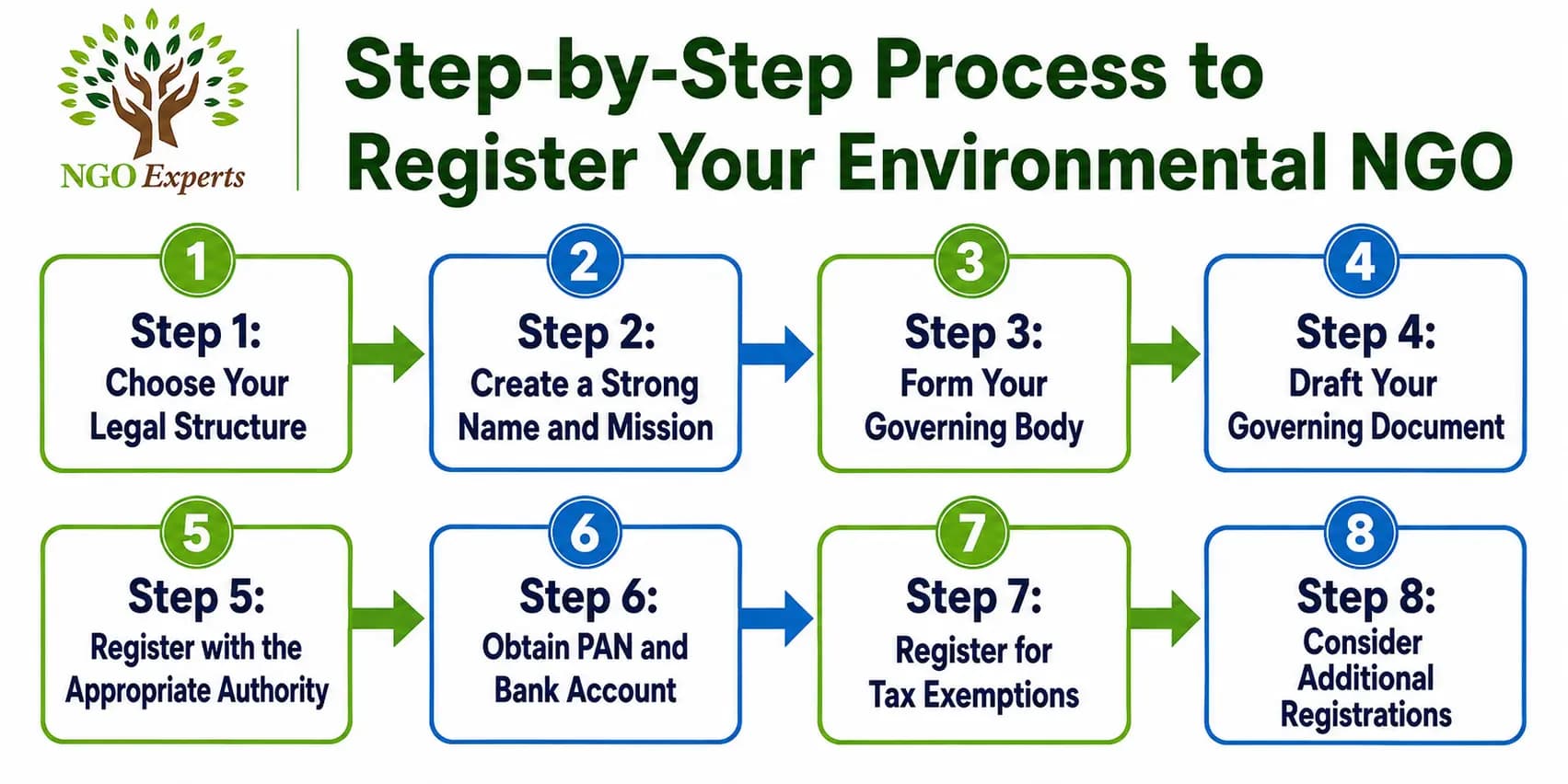
Step 1: Choose Your Legal Structure
You have three options:
- Trust: Suitable for smaller organisations, governed by trustees, requires a Trust Deed. Ideal if 2-3 passionate individuals want to start something focused.
- Society: Best for larger groups, a democratic structure with members, governed by the Societies Registration Act, 1860. Requires a minimum of 7 members and regular general body meetings.
- Section 8 Company: More formal corporate structure under the Companies Act, 2013. Best for organisations planning large-scale operations and corporate partnerships.
For beginners, a Society or Trust is usually simpler and less costly to establish.
Step 2: Create a Strong Name and Mission
Choose a unique name that reflects your environmental focus. Check availability with the Registrar.
Step 3: Form Your Governing Body
Assemble trustworthy, committed individuals as trustees (for Trust) or governing council members (for Society).
Step 4: Draft Your Governing Document
For Trusts, create a Trust Deed that lists objectives, trustee powers, and operational rules. For Societies, draft a Memorandum of Association (MOA) detailing membership, meetings, and governance structure.
Step 5: Register with the Appropriate Authority
Trust: Register with the local Sub-Registrar or Charity Commissioner's office Society: Register with the Registrar of Societies in your state Section 8 Company: Apply to the Ministry of Corporate Affairs through the MCA21 portal Submit required documents, including the governing document, identity proofs of trustees/members, address proof, and registration fees (typically ₹2,000-10,000 depending on state and structure).
Step 6: Obtain PAN and Bank Account
Apply for a PAN card in your NGO's name through the Income Tax Department. Open a bank account using your registration certificate and PAN.
Step 7: Register for Tax Exemptions
Apply for 12A and 80G registrations with the Income Tax Department. These certifications make your NGO tax-exempt, allowing donors to claim deductions, making fundraising easier.
Step 8: Consider Additional Registrations
- NGO Darpan: Register on NITI Aayog's portal to access government schemes
- CSR-1: Mandatory for receiving CSR funding from companies
- FCRA: Required only if you plan to receive foreign funding (complex process, attempt after establishing operations)
Tips for Running a Successful Environmental NGO
Start Small, Think Big: Begin with manageable projects in your locality. Success in small initiatives builds credibility for larger projects.
Document Everything: Maintain detailed records of activities, spending, and impact. Good documentation helps with funding applications and builds trust.
Build Community Partnerships: Collaborate with schools, local governments, resident associations, and other NGOs. Partnerships multiply your impact.
Leverage Technology: Use social media for awareness, mobile apps for monitoring, and online platforms for fundraising. Technology amplifies your reach without huge costs.
Focus on Measurable Impact: Track numbers—trees planted and surviving, waste collected and recycled, people trained, water bodies cleaned. Donors want to see real results.
Stay Compliant: File annual returns, maintain audit reports, and follow all legal requirements. Compliance protects your NGO's reputation and funding eligibility.
Frequently Asked Questions
How much does it cost to start an environmental NGO in India?
Registration costs vary by structure and state, typically ranging from ₹5,000 to ₹15,000. Initial operational costs, including documentation, bank account, and basic setup, may require ₹25,000-50,000.
Do I need an environmental science degree to start an environmental NGO?
No formal degree is required. Passion, commitment, and willingness to learn are more important. However, having team members with environmental knowledge strengthens your organisation.
How long does NGO registration take?
Trust and Society registration typically takes 15-30 days. Section 8 Company registration may take 30-60 days, depending on documentation completeness.
Can one person start an environmental NGO?
Not alone. Trusts need a minimum of 2 trustees, Societies require 7 members, and Section 8 Companies need 2 directors. Building a team ensures diverse perspectives and shared responsibility.
Author
Sakshi Kashyap
I am a dedicated and detail-oriented Website Content Writer with over two years of experience in creating compelling, reader-friendly, and SEO-optimized content. My expertise lies in developing well-structured web pages, landing pages, blogs, and service descriptions that enhance user engagement and drive organic traffic.
Written by Sakshi Kashyap. Last updated on October 7, 2026