
A small NGO doesn't need a big office or a big budget to start; it needs the right paperwork done in the right order. This 2026 guide walks you through starting a small NGO in India as a Trust, Society, or Section 8 Company, step by step, in plain language.
A small NGO can start as a Trust with 2 people, a Society with 7, or a Section 8 Company with 2 directors and 2 members. Register it, get a PAN and a bank account, list on NGO Darpan, and apply for RNPO (12A and 80G) approval. Cost usually stays under ₹15,000, taking 15–25 working days.
What Does It Mean to Start a Small NGO in India?
Starting a small NGO in India is the process of turning a narrow, focused cause — feeding 50 children in one neighbourhood or running a weekend literacy class — into a legal entity that can hold a bank account and accept donations. You don't need a large team or a big corpus, just two or three committed people, a clear cause, and one of three legal structures recognised under Indian law: a Trust, a Society, or a Section 8 Company.
Why Should a Small NGO Register at All?
Plenty of small groups do good work informally for years, but without registration they stay locked out of CSR money, government schemes, and tax-deductible donations.
- Legal identity: open a dedicated bank account and sign agreements.
- Credibility: donors trust a registered entity over an informal group.
- Funding access: CSR, schemes, and grants all need registration first.
- Tax benefit: RNPO status exempts the NGO and gives donors a deduction.
Which Structure Works Best for a Small NGO?
Quick Answer: a Trust for two founders, a Society for a group of seven or more, a Section 8 Company for CSR-readiness. The right structure for a small NGO is the one that matches your founder count and governance appetite — a Trust for the leanest setup, a Society for a community group, and a Section 8 Company for founders planning CSR funding down the line.
| Structure | Law | Minimum People | Best For |
| Trust | Indian Trusts Act, 1882 | 2 trustees | Two founders, simple charitable work |
| Society | Societies Registration Act, 1860 | 7 members | Community groups with local members |
| Section 8 Company | Companies Act, 2013 | 2 directors + 2 members | Founders planning CSR funding la |
- A Trust suits a small team wanting minimum paperwork.
- A Society suits a neighborhood group with several members.
- A Section 8 Company suits a founder planning corporate CSR funding later.
What Documents Do You Need to Start a Small NGO?
Starting a small NGO in India requires basic identity proofs, address documents, and a clear legal document defining its mission and objectives.
- PAN, Aadhaar, and photographs of all trustees/members/directors
- Trust Deed or MOA, with the objects clearly written out
- Address proof and NOC for the registered office
- A one-paragraph mission statement describing exactly what you'll do
If you plan to sell merchandise later to fund the cause, see our guide on trademark registration in India to protect your NGO's name early.
How Do You Start a Small NGO Step by Step?
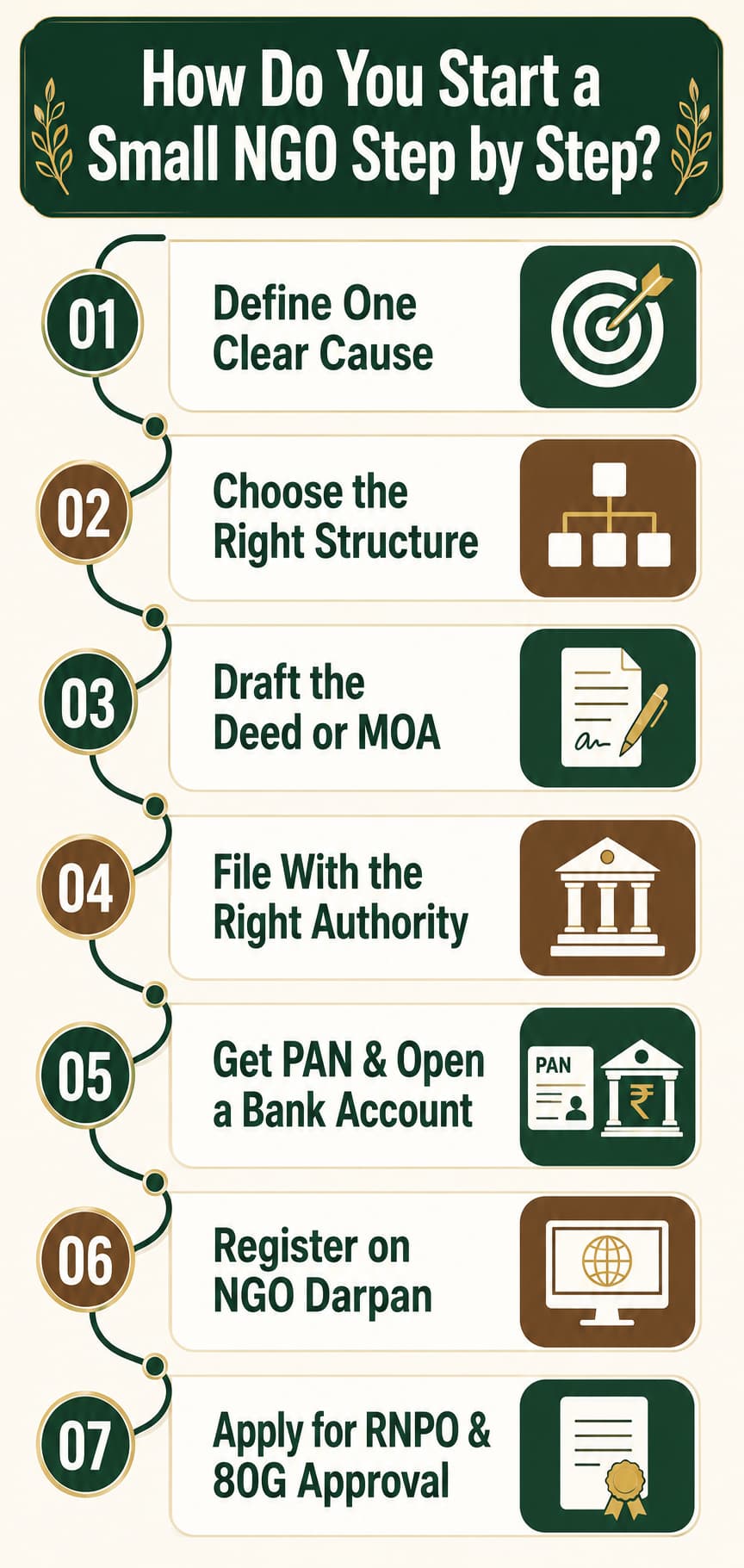
The process starts with defining your mission and ends with obtaining the registrations needed to receive funding and operate legally.
- Define one clear cause: pick a narrow focus, not a broad mission.
- Pick your structure: Trust for two founders, Society for a group, Section 8 Company for CSR-readiness.
- Draft the Deed or MOA: keep the objects clause tight.
- File with the right authority: Sub-Registrar for a Trust, Registrar of Societies for a Society, MCA for a Section 8 Company.
- Get PAN and open a bank account in the NGO's registered name.
- Register on NGO Darpan: get your Unique ID via the NITI Aayog portal — this step feeds directly into CSR-1 eligibility later.
- Apply for RNPO and 80G-equivalent approval with the Income Tax Department.
What Does It Cost to Start a Small NGO?
Budget is usually the biggest constraint for a small NGO, so here's what to set aside.
| Particulars | Cost | Timeline |
| Deed drafting/name approval | ₹1,000–₹3,000 | 2–4 days |
| Filing fee | ₹1,000–₹4,000 | 3–7 days |
| PAN, TAN, bank account | Included | With approval |
| Darpan + RNPO application | ₹2,000–₹5,000 | 7–10 days |
| Total | ₹8,000–₹15,000 | 15–25 days |
What Do the Latest Numbers Say About Small NGOs in India?
India already has 3.3 million+ registered NGOs, so registration is what makes a small one stand out.
- India has roughly 3.3 million registered NGOs, Societies, and Trusts, per the last official Central Statistical Organisation count, done in 2009; most started small.
- As per the Ministry of Corporate Affairs' CSR disclosure data, companies spent close to ₹27,000 crore on CSR in FY 2024–25, but only NGOs filing Form CSR-1 with the MCA can receive it; it is open to small NGOs too.
- As of 15 July 2026, the Ministry of Home Affairs' FCRA Online Services portal listed 14,449 active FCRA registrations — a reminder that FCRA is a later-stage goal.
- 72 new organisations got FCRA clearance in 2026 so far, per the same MHA data, mostly in health, education, and disaster relief.
Real Case Study
Anshu Gupta started Goonj in 1999 with 67 pieces of clothing and his wife's support — about as small a beginning as an NGO can have. He registered it as a Society, got 12A, 80G, and later FCRA approval, and built it into an organisation moving thousands of tonnes of relief material yearly, winning the Ramon Magsaysay Award in 2015. The size of the start didn't matter; the registration gave the mission a legal engine to grow on.
How Can a Small NGO Raise Money After Registering?
Once your NGO is registered and Darpan-listed, funding doors open even for a young, small NGO.
- CSR funding: file Form CSR-1 on the MCA portal.
- Government schemes: many fund small, Darpan-listed NGOs directly.
- Local donations: 80G-equivalent approval lets donors claim a deduction.
- FCRA, later: file through FCRA Online Services once you've completed 3 years of existence and spent ₹15 lakh on core activities — plan for it, don't start with it.
What Compliance Does a Small NGO Need to Keep Up With?
Staying small doesn't mean staying informal; regulators expect the same discipline from every NGO.
- Annual return filing and audited accounts, even at low volumes
- State-level renewal for Trusts/Societies, or ROC filings for a Section 8 Company
- CSR-1 renewal if receiving CSR funds
- FCRA annual returns, once FCRA-registered
What Mistakes Do First-Time Founders Make?
A vague mission statement and skipping Darpan registration cause most of the early delays.
- A mission statement too broad for the actual, small-scale work
- Skipping Darpan registration because the NGO "feels too small"
- Assuming registration alone will bring in donors
- Applying for FCRA before the 3-year, ₹15 lakh threshold
- Letting compliance slip once registration excitement fades
Across the small-NGO files NGOExperts has reviewed, a vague objects clause is the single most common reason a Darpan or RNPO application gets sent back for clarification; tightening that one paragraph before filing avoids most of the back-and-forth.
Ready to Start Your Small NGO?
A small NGO doesn't stay small because of the mission; it stays stuck because the paperwork never gets done. NGOExperts picks the right structure for your team size, files it correctly, and gets you Darpan-listed and RNPO-approved.
Disclaimer
NGOExperts is a private consultancy and is not a government body, ministry, or regulatory authority; it is not affiliated with the Registrar of Societies, MCA, NITI Aayog, or the Income Tax Department. This article is for general information only and is not legal or tax advice. NGO registration and FCRA rules can change; verify current rules with the relevant government portal or a qualified professional before acting.
Frequently Asked Questions
Can one person start an NGO in India?
No — the minimum is 2 trustees for a Trust, 7 members for a Society, or 2 directors plus 2 members for a Section 8 Company.
Is a Trust the cheapest way to start?
Generally, yes, since it needs only two founders and simpler paperwork
Do small NGOs need NGO Darpan registration?
Yes, if you seek any government grant, CSR funds, or FCRA clearance later.
What replaced 12A and 80G in 2026?
RNPO status under Sections 332 and 354 of the Income Tax Act, 2025, effective 1 April 2026.
Author
Aabha Garg
A Content Strategist at NGOExperts, who focuses on NGO registration, 12A and 80G registration, FCRA compliance, income tax filing for non-profits, and CSR funding guidelines in India. I research and write our compliance guides in collaboration with our in-house Chartered Accountants and Company Secretaries, so every article reflects current tax and regulatory requirements for the NGO and non-profit sector.
Written by Aabha Garg. Last updated on October 3, 2026