
Quick Summary
Incorporating a Section 8 Company in India involves obtaining DSC and DIN, reserving a unique name, drafting the MoA and AoA with charitable objectives, applying for a Section 8 license from the Regional Director, and filing incorporation forms with the Registrar of Companies. The entire process typically takes 20-40 days and requires compliance with the Companies Act, 2013.
NGO Experts simplifies Section 8 Company registration by handling documentation, government approvals, and legal formalities end-to-end. Our experienced team ensures accurate filing, faster approvals, and hassle-free incorporation, allowing you to focus on your social mission while we navigate the regulatory complexities efficiently.
Overview
Starting a non-profit organisation in India requires choosing the right legal structure that balances credibility, compliance, and operational flexibility. Unlike traditional trusts or societies, a Section 8 Company offers enhanced fundraising capabilities while maintaining complete non-profit status.
The Section 8 Company incorporation process involves multiple regulatory steps, including Ministry of Corporate Affairs approval, document preparation, and license application.
Key Features of Section 8 Company Incorporation
Legal Structure
- Registered under the Companies Act, 2013
- Separate legal entity with perpetual succession
- Limited liability protection for members
- Can sue and be sued in its own name
Governance Benefits
- Professional corporate governance framework
- Clear compliance and reporting structure
- Enhanced credibility with donors and beneficiaries
- Easier to scale operations nationally and internationally
Financial Advantages
- No minimum capital requirement
- Exemption from stamp duty in many states
- Tax benefits under Sections 11, 12, 12A, and 80G of the Income Tax Act
- Can receive foreign funding with FCRA registration
Operational Flexibility
- Engage in business activities related to objectives
- Can own property and assets
- Employ staff with formal employment contracts
- Can enter into contracts and partnerships
Have Questions?
Incorporate a Section 8 Company Eligibility Criteria
If you are looking to incorporate your non-profit as a section 8 company, it is crucial to meet these basic requirements:
Minimum Members
- At least 2 members for Private Section 8 Company
- least 7 members for the Public Section 8 Company
Minimum Directors
- Minimum 2 Directors for Private Company
- 3 Directors required for Public Company
- At least one Director must be an Indian resident
The proposed company must have charitable objects relating to:
- Commerce, art, science, sports, education, research
- Social welfare, religion, charity, and environmental protection
- Any other object useful to the community
Profit Application
- All profits must be applied toward promoting company objectives
- No dividend distribution to members
- Assets cannot be distributed to members upon dissolution
Documents Required for Incorporate a Section 8 Company Registration
For All Applicants, it is crucial to prepare this documentation before getting started with the incorporation
Identity Proof
- PAN Card (mandatory for all Directors and subscribers)
- Aadhaar Card
- Passport (for foreign nationals)
- Voter ID Card
Address Proof
- Aadhaar Card
- Passport
- Latest bank statement (not older than 2 months)
- Electricity/telephone bill (not older than 2 months)
- Rent agreement with utility bill
Photographs
- Recent passport-size photographs of all Directors
For the Company
Registered Office Proof
- Ownership documents (Sale Deed) if owned
- Rent Agreement (minimum 11 months) if rented
- No Objection Certificate from the owner
- Latest utility bill (electricity/water/gas)
Other Documents
- Digital Signature Certificate (DSC) of proposed Directors
- Director Identification Number (DIN) for all Directors
- Memorandum of Association (MoA)
- Articles of Association (AoA)
- Declaration of subscribers and first Directors
- Consent to act as Director (Form DIR-2)
Step-by-Step Incorporate a Section 8 Registration Process
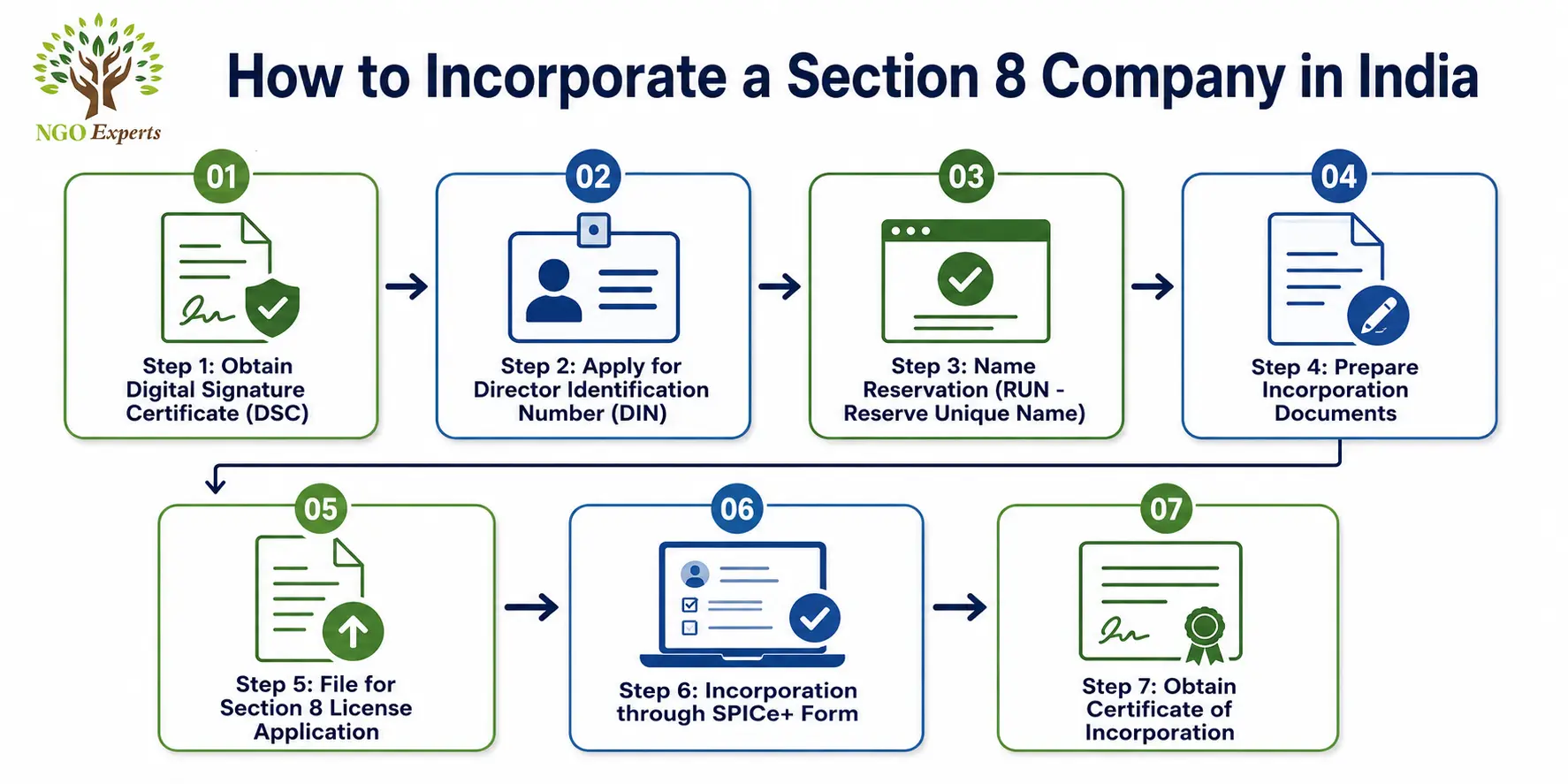
Step 1: Obtain Digital Signature Certificate (DSC)
The Digital Signature Certificate is required to digitally sign all electronic documents submitted to the Ministry of Corporate Affairs.
- Choose a licensed Certifying Authority
- Submit identity and address proof
- Complete online application and payment
- Receive DSC on USB token within 3-5 working days
- Cost: ₹500 - ₹1,500 (valid for 1-2 years)
Step 2: Apply for Director Identification Number (DIN)
Every proposed Director must obtain a unique Director Identification Number.
- File Form DIR-3 through the MCA portal
- Attach DSC, identity proof, and address proof
- Self-attest all documents digitally
- Pay the application fee of ₹500
- Timeline: 1-2 working days
Step 3: Name Reservation (RUN - Reserve Unique Name)
Reserve a unique name for your Section 8 Company through the MCA portal.
- Log in to the MCA portal with DSC
- File Form RUN (SPICe+ Part A)
- Suggest up to 2 name options with significance
- Pay a fee of ₹1,000
- Timeline: Immediate to 2 working days
Pro Tip: Check name availability using the MCA name search tool before applying to avoid rejection.
Step 4: Prepare Incorporation Documents
Draft the foundational documents that will govern your Section 8 Company.
Memorandum of Association (MoA) Articles of Association (AoA) Other Documents: Subscriber sheet with member details and signatures, Declaration by Directors (Form INC-9), Consent of Directors (Form DIR-2), Professional certificate from CA/CS/CMA (Form INC-8)
Step 5: File for Section 8 License Application
Apply for the special license required to operate as a Section 8 Company.
File Form INC-12 along with SPICe+ Part B Attach the MoA, AoA showing charitable objectives Include list of proposed Directors with consent Provide registered office address proof Submit a declaration that the company will comply with Section 8 provisions Attach estimated income and expenditure for the next 3 years Include a list of assets and liabilities (if any)
Step 6: Incorporation through SPICe+ Form
Once the Section 8 license is approved, complete the incorporation process.
SPICe+ Form Includes:
Part A: Name reservation (already completed)
Part B: Company incorporation details Linked forms: AGILE (for PAN and TAN), INC-9 (declaration)
Step 7: Obtain Certificate of Incorporation
Upon approval, the Registrar of Companies issues:
Certificate of Incorporation: Contains Company Identification Number (CIN) Confirms the company's legal existence Lists the registered office address and date of incorporation
PAN and TAN: Automatically generated and sent to the registered email PAN (Permanent Account Number) for tax purposes TAN (Tax Deduction Account Number) for TDS compliance
Have Questions?
Post-Incorporation Compliance
Once you have received your certificate of incorporation, there are a few mandatory post-incorporation compliance requirements (Within 30 Days)
First Board Meeting
Appoint additional Directors if required Appoint Key Managerial Personnel (if applicable) Approve the company seal design Authorise the opening of a bank account Decide on the registered office
Bank Account Opening
Certificate of Incorporation PAN card of the company MoA and AoA Board resolution for account opening KYC documents of authorised signatories
Accounting and Recordkeeping
Set up an accounting system Maintain statutory registers Establish a document storage system
Other Compliance:
Director KYC (Form DIR-3 KYC) - Annually by September 30 Update any changes in Directors/registered office within 30 days File Form FC-4 if received foreign contribution is received (FCRA compliance) Maintain statutory registers and records
Income Tax Registrations
Section 12A/12AB Registration
Provides exemption from income tax on surplus income Apply within 1 month of incorporation through Form 10A Valid indefinitely (subject to periodic review)
Section 80G Registration
Allows donors to claim tax deductions (50% or 100%) Significantly increases fundraising potential Apply through Form 10G on the Income Tax portal Valid for 5 years, renewable
GST Registration
- Required if annual turnover exceeds ₹20 lakhs (₹10 lakhs for special category states)
- Voluntary registration is available for smaller organisations
- File returns quarterly or monthly based on turnover
Benefits of Incorporation as a Section 8 Company
- Separate Legal Entity: The company exists independently of its members, providing continuity and stability. It can own property, enter into contracts, and maintain operations regardless of changes in membership.
- Limited Liability Protection: Members and Directors are protected from personal liability. Their financial risk is limited to the amount unpaid on their shares, safeguarding personal assets.
- Perpetual Succession: The company continues to exist despite changes in membership or management, ensuring long-term sustainability of projects and commitments.
- Financial Benefits: No Minimum Capital Requirement. Unlike regular companies, Section 8 Companies can be incorporated with any capital amount, even as low as ₹1,000, making it accessible for small charitable initiatives.
- Tax Exemptions: Incorporation for a Section 8 company allows your non-profit to enjoy an Income tax exemption so that donors receive 50% or 100% tax deduction under Section 80G
- Fundraising Advantages: With this incorporation, your NGO can receive CSR funds from companies and also accept foreign donations with FCRA registration
- Operational Advantages: With section 8 incorporation, your non-profit can engage in diverse activities across education, healthcare, environment, sports, arts, research, and social welfare without geographical restrictions.
Frequently Asked Questions
Can a Section 8 Company generate profits?
Yes, a Section 8 Company can generate surplus income, but all profits must be utilized only for promoting the company's charitable objectives. No part of income can be distributed as dividend to members. The company can engage in income-generating activities as long as they're aligned with or support the stated objectives.
Is it mandatory to have "Foundation" or similar terms in the company name?
No, it's not mandatory. However, the name should reflect the non-profit and charitable nature of the organization. Terms like "Foundation", "Association", "Federation", "Welfare", or "Society" help convey this purpose and enhance credibility.
Can foreign nationals be Directors of Section 8 Company?
Yes, foreign nationals can be Directors, but at least one Director must be a resident of India. The resident Director serves as the point of contact for regulatory authorities.
Can a Section 8 Company be converted to a regular company?
No, a Section 8 Company cannot be converted into a regular for-profit company. If the company wishes to operate on a for-profit basis, it must dissolve the Section 8 Company and incorporate a new regular company separately.
How long does 80G registration take?
After applying through Form 10G, 80G registration typically takes 2-6 months depending on document completeness and Income Tax Department workload. Provisional approval may be granted earlier in some cases.