NGO Experts Logo
NGO

How much money is required to start an NGO?

November 7, 20251 view
How much money is required to start an NGO?

Summary 

Starting an NGO in India is affordable for small-scale social initiatives and varies by structure. A Trust, governed by the Indian Trusts Act, 1882, remains the most economical option. The entire NGO registration ecosystem is regulated through the Ministry of Corporate Affairs (MCA), State Registrars, and the  IncometaxIndia .
However, the basic registration process just includes government fees and documentation charges. To start an NGO, what you need are funds for legal paperwork, a registered office address, and initial setup costs like a bank account and basic stationery. The actual amount varies depending on your chosen registration type, that are trust, society, or company. Most founders prefer to start small from home to minimize costs. Remember, registration is just the beginning because you'll need additional funds to set up the NGO office, pay staff salaries, and cover operational expenses once you begin working.

Overview

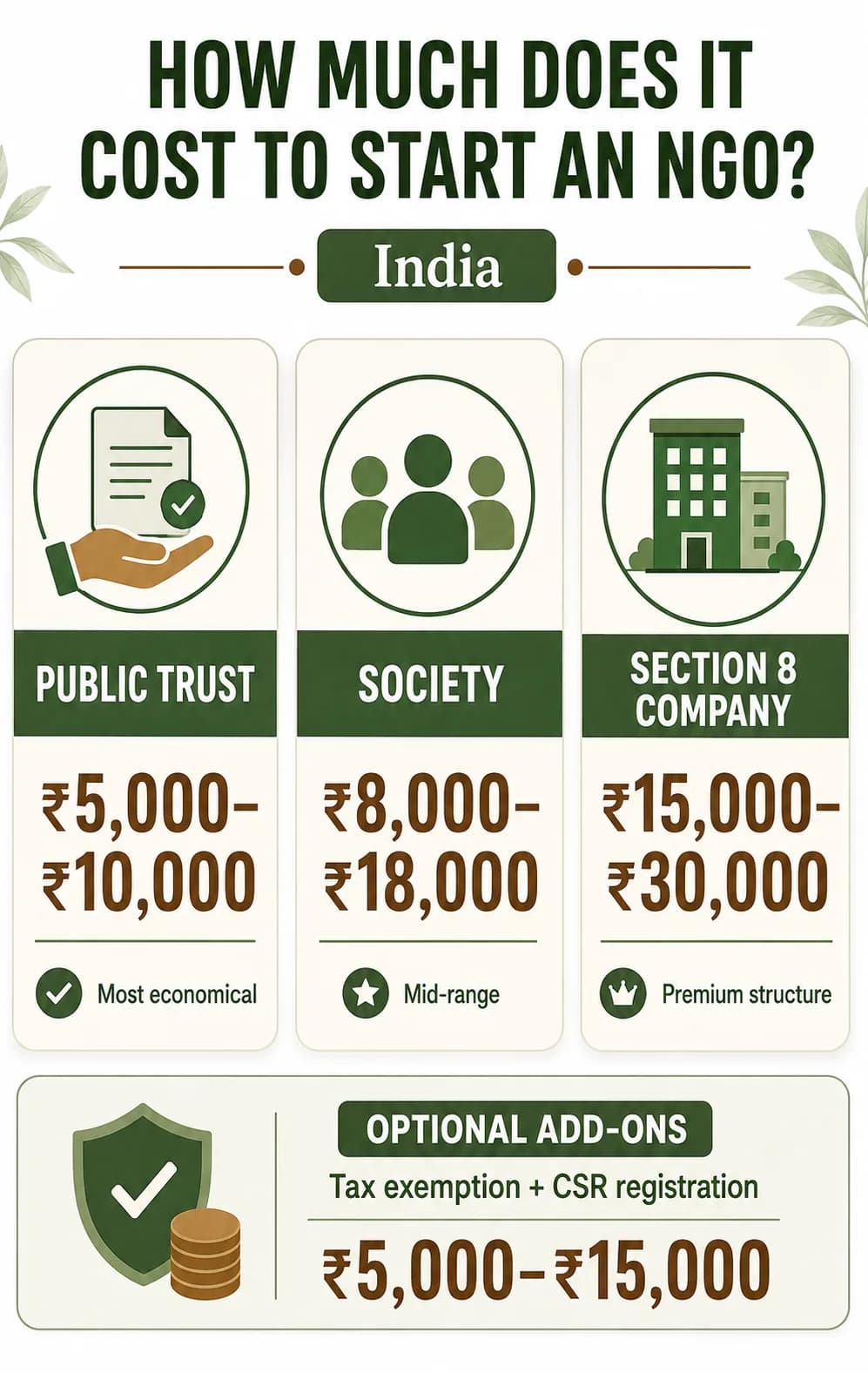
Starting a Non-Governmental Organization (NGO) in India is a noble initiative that enables individuals and groups to address social, educational, environmental, or health-related issues. However, to operate legally and gain public trust, registration is a crucial step. NGOs in India can be registered as a Trust under the Indian Trusts Act, 1882, a Society under the Societies Registration Act,1860 , or a Section 8 Company under the Companies Act, 2013. Each structure has distinct advantages, procedures, and cost implications. Generally, Trust registration costs range from Rs 5,000 to Rs 25,000, and may take 2 weeks to complete, depending on the state. 
Society registration ranges between Rs 8,000 and Rs 20,000 with a processing time of up to 45 days, while Section 8 Companies, known for their structured governance framework, cost Rs 15,000 to Rs 40,000 and may take up to 60 days to complete. Apart from registration, NGOs often pursue tax exemptions under Sections 12A and 80G of the Income Tax Act for credibility and donor benefits. Those seeking access to government or corporate grants must also register on the NGO Darpan Portal and, for CSR eligibility, file Form CSR-1 through the Ministry of Corporate Affairs.
By the end of this article, you will have a clear understanding of the costs involved in registering an NGO in India while focusing on key aspects, including the registration fees, procedures, benefits of this registration, and the distinction between different legal structures, such as Section 8 company registration.

Cost involved in registering as an NGO ( Trust, Society, and Section 8 )

Trust Registration

Registering a trust is the most affordable option for starting an NGO in India. The basic government fees typically range from Rs 5000/- to Rs 15000/-, approximately. This includes registration fees, stamp duty, and professional charges for legal help. Trusts are simple to establish and have lower ongoing compliance costs, making them suitable for small or family-run NGOs.

Key Points:

Government fees are minimal compared to other ngo registration types Stamp duty varies significantly between states, so check your local rates Professional fees for drafting the trust deed are additional but optional No minimum capital requirement makes it accessible for small community groups

Society Registration

Registering a society involves money ranging from Rs 18,000 to Rs 20,000, depending on the state and local registration fees. Society registration sits in the middle price range among NGO structures that are member-driven, with democratic elections, and are generally suitable for community-based organizations.
Key Points:
NGO Registration fees include government charges and professional assistance State-level registration is cheaper than national-level registration Documentation costs, like notarization, add to the total expense A democratic structure requires coordination among multiple founding members

Section 8 Company Registration

Section 8 company registration is considered to be the most expensive one, costing about Rs 20,000 to Rs 40,000, including government fees and documentation. This structure is ideal for NGOs aiming for long-term credibility, foreign donations, or substantial funding. It includes costs for DSC and DIN numbers Rs 3000/- approximately, company name reservation around Rs 1000/-, MOA drafting plus incorporation fees Rs 6000/- to Rs 8000/-, and professional charges.
Key Points:
Higher upfront costs but greater credibility and professional structure No minimum capital requirement despite being a company structure There are no stamp duty fees imposed on the entire process Investment includes digital infrastructure needed for modern compliance  

NGO Registration Fees in India: A complete breakdown

Here is a verified breakdown of Registration costs for starting an NGO in India, depending on your chosen legal structure—Trust, Society, or Section 8 Company. Costs include government charges, professional/legal consultant fees, document preparation, and ongoing compliance. 
NGO TypeRegistration FeesLegal FeesTotal Estimate
TrustRs500 – Rs2,000Rs5,000 – Rs25,000Rs5,500 – Rs25,000
SocietyRs500 – Rs2,000Rs5,000 – Rs25,000Rs5,500 – Rs25,000
Section 8 CompanyRs5,000 – Rs15,000Rs5,000 – Rs40,000Rs10,000 – Rs55,000

Common Hidden Costs

  • Annual audit and reporting fees: Rs10,000 – Rs50,000 (auditor fees)​
  • 12A & 80G tax exemption applications: Rs5,000 – Rs25,000 (professional fees)​
  • License renewals, PAN/TAN/other compliance fees

Can a Single Person Start an NGO?

If you are wondering about whether it's possible to register an NGO by yourself, it's important to note that Indian law requires more than one founding member, no matter which structure you choose. This means you always need to join hands with others. However, to form a Trust, the law requires at least two trustees to sign the trust deed together and oversee its work.
For a Society, you’ll need a group of at least seven members. If you prefer a Section 8 Company, at least two directors and two shareholders are mandatory to meet the rules set by the Ministry of Corporate Affairs. These member requirements aren’t just formality but are designed to guarantee transparency and discourage fraud, so your NGO benefits from teamwork right from the start. Any aspiring founder should know that it is simply not permitted to register an Indian NGO as a single person, but finding passionate collaborators is often easier than expected when your mission inspires others to work with you.
Therefore, before getting started as an NGO, you must understand the basic requirements:
  • Trust: Minimum 2 trustees
  • Society: Minimum 7 members
  • Section 8 Company: At least 2 directors and 2 shareholders

Registering NGO Online in India

Registering your NGO online through digital platforms has made the entire process faster, convenient, and transparent. Instead of dealing with piles of paperwork and multiple office visits, you can now complete much of the registration digitally from anywhere. One popular portal is the Ministry of Corporate Affairs (MCA) website, where you can register your NGO as a Section 8 Company, enjoying a seamless and mostly paperless experience.
Another key platform is the NGO Darpan portal managed by NITI Aayog, designed specifically for NGOs to gain recognition, access government grants, and enhance transparency. You can sign up on the NGO Darpan portal for free, fill in your NGO details, upload required documents like the registration certificate and PAN, and receive a unique Darpan ID. This ID is crucial for applying to government funding schemes, FCRA registration, and tax exemptions such as 12A and 80G.
It's important to note that while registering on these platforms is free, you may still be required to pay fees related to preparing legal documents or hiring consultants to ensure everything is accurate and complete. Overall, these digital platforms simplify launching your NGO and connecting it with government benefits, helping you focus more on your mission and less on complex paperwork.

Requirements to Register an NGO

Step 1: Firstly, you need to decide the legal structure of your NGO between a Trust, a Society, or a Section 8 Company
Step 2: Now, based on the structure chosen, invite the required number of members or trustees. Make sure everyone has valid ID and address proofs ready.
Step 3: Secure Your Registered Office Address, which can be a rented office or your own space. For rented spaces, get a No Objection Certificate (NOC) from the owner, along with a utility bill or rent agreement as proof.
Step 4: Prepare Necessary Documents
  • For a Trust: Draft a Trust Deed including objectives and trustee details; collect ID and address proofs of trustees.
  • For a Society: Prepare the Memorandum of Association (MoA) and Rules & Regulations along with ID proofs of all members.
  • For a Section 8 Company: Draft MoA and Articles of Association (AoA), get Digital Signature Certificates (DSC) and Director Identification Numbers (DIN) for directors, plus ID/address proofs.
Step 5: Apply for PAN & TAN to handle finances and tax compliance.
Step 6: Pay Stamp Duty and Registration Fees. Make sure you pay the correct amount as per government rules.
Step 7: Depending on your NGO type and state, submit your documents on the relevant portal:
  • Ministry of Corporate Affairs (MCA) for Section 8 companies
  • State Registrar offices for Societies and Trusts
  • NGO Darpan portal for government recognition and grant eligibility
Step 8: Once your NGO is registered, apply separately for 12A and 80G tax exemption certificates under the Income Tax Act.
Get Rs1 Crore Funding with This NGO Plan. Download this free PDF to Unlocking Major Grants and Donations.

Quick Tips for Budgeting Your NGO Registration

  • Collect all member documents and address proof in advance
  • Compare consultant fees and ask for transparent quotes
  • Check state-wise government fees before budgeting, as these may vary by region
  • Factor in long-term compliance costs: audits, filings, renewals
  • Register on official portals only and avoid unauthorized agents
  • Verify requirements and start the application on MCA.gov.in or  NGO Darpan

Frequently Asked Questions (FAQs)

Q1. What is the minimum registration fee for a Trust, Society, and Section 8 Company?
For a Trust/Society, it ranges from Rs500 – Rs2,000 for government/specific state fees And for Section 8, it costs Rs5,000 – Rs15,000 for government & stamp duty.
Q2. Can a single person start an NGO in India?
No. Every legal structure requires at least 2 people (Trust), 7 (Society), or 2 directors/shareholders (Section 8).​
Q3. Is NGO Darpan registration really free?
Yes. Registering on NGO Darpan is a free online process. While other costs are for legal documentation and government registration.​
Q4. Are there free online options to set up an NGO?
No, legal registration is not free. Only the NGO Darpan portal registration (for grants) is free; formal legal registration always incurs government/professional fees.
Q5. What additional costs should I expect?
Audit fees, annual filings, 12A/80G tax exemption applications, service renewals, and PAN/TAN fees.

📢Subscribe For Updates

Get the latest news delivered to your inbox

Recent Blogs

Stay updated with our latest insights and tips on business registration, compliance, and more.