
Quick Summary
The Government of India actively supports NGOs working in health, hygiene, and sanitation through several major initiatives. One of the most popular and impactful government schemes that funds NGOs working in health and sanitation is the
Ministry of Ayush, which was formed on November 9, 2014. Other notable government-backed funding sources include the National Health Mission (NHM) , which supports healthcare delivery, maternal and child health, and disease control (including HIV/AIDS and TB)
Thirdly, the Swachh Bharat Mission focused on sanitation, waste management, and hygiene awareness, and the Indian Council of Medical Research (ICMR) grants, which fund health research projects by NGOs and institutions.
Additionally, Corporate Social Responsibility (CSR) under the Companies Act ensures corporate contributions to public health and sanitation programs, making it another significant funding avenue for NGOs.
Overview
With over ₹1.5 lakh crore invested through CSR and government schemes combined, NGOs have huge opportunities to scale their impact. Understanding these funding mechanisms, eligibility criteria, and application processes is crucial for organizations working at the grassroots level.
The Ministry of Ayush, established in 2014, leads efforts to revive and promote India’s traditional medicine systems, including Ayurveda, Yoga, and Homoeopathy, providing vital funding to organizations working in the health and sanitation sectors.
In addition to Ayush, the National Health Mission (NHM) empowers NGOs to improve healthcare delivery, maternal and child health, and disease control, including HIV/AIDS and TB. The Swachh Bharat Mission furthers the cause of sanitation and waste management by backing initiatives that drive toilet construction, hygiene education, and safe waste disposal. The Indian Council of Medical Research (ICMR) offers grants for innovative health research by NGOs and academic institutions, helping generate new solutions for better health outcomes.
Moreover, Corporate Social Responsibility (CSR) mandates under the Indian Companies Act require large corporations to contribute part of their profits towards social welfare, with health and sanitation as priority areas.
NGOs play a vital role in driving grassroots change in these areas, and various government schemes actively support their efforts through grants and funding. This guide walks you through the top 5 government funding schemes for NGOs in health and sanitation, explaining their roles, focus areas, how you can apply, and what documents are required.
Top 5 Government Funding Schemes for NGOs
1. Ministry of Ayush Grants
Role and Focus Areas Ministry of Ayush Grants
Established in 2014, the Ministry of Ayush promotes traditional systems of medicine, including Ayurveda, Yoga, Naturopathy, Unani, Siddha, and Homoeopathy. It funds NGOs working on health promotion, awareness, and integration of these ancient medical practices into mainstream healthcare. Focus includes wellness programs, community health camps, training practitioners, and research dissemination.
How to Apply Ministry of Ayush Grants
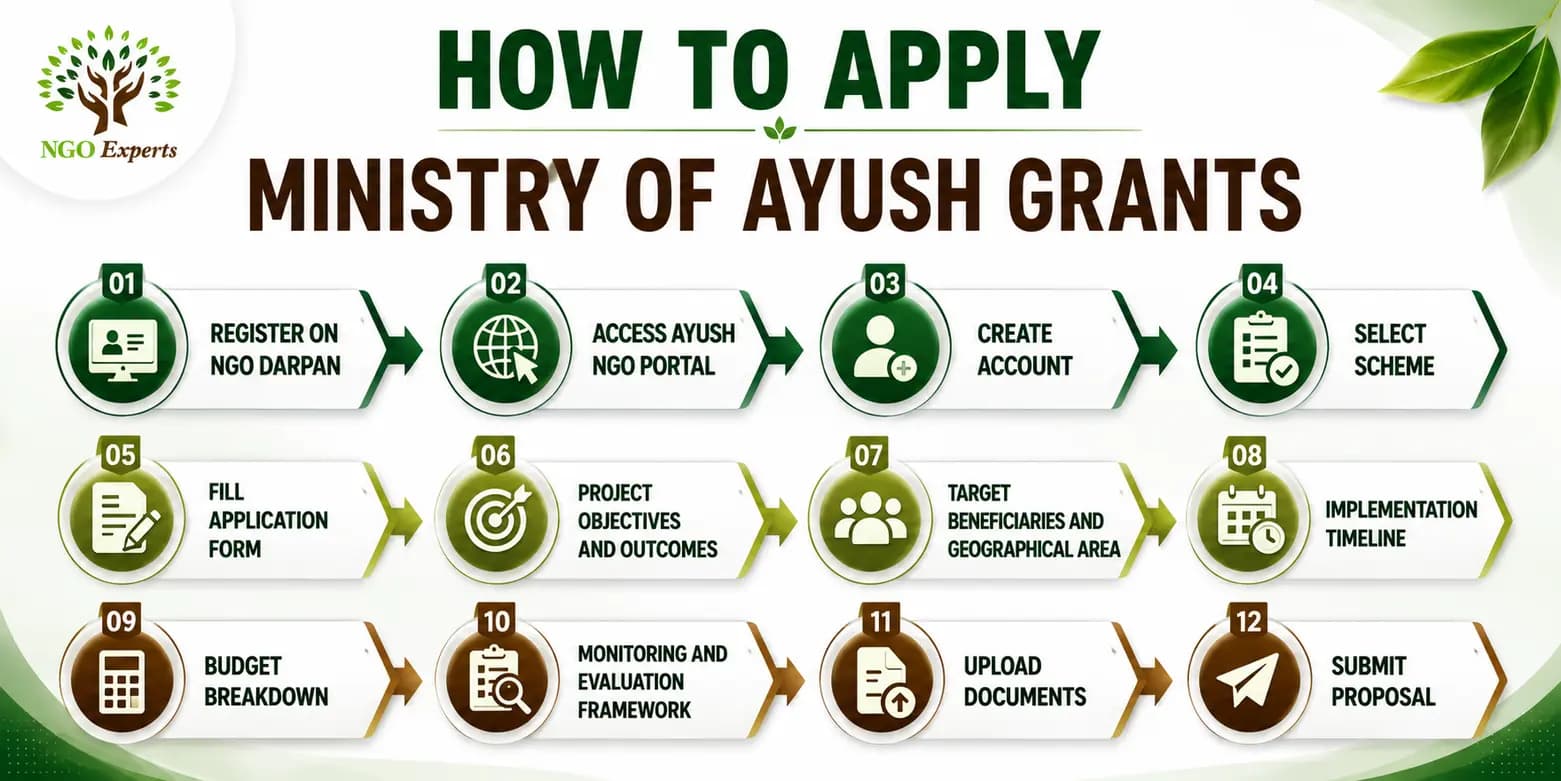
- Register on NGO Darpan: Visit https://ngodarpan.gov.in and complete registration with all organizational details
- Access AYUSH NGO Portal: Navigate to https://ngo.ayush.gov.in
- Create Account: Register using NGO Darpan credentials
- Select Scheme: Choose the appropriate Central Sector Scheme based on your project focus
- Fill Application Form: Complete the detailed project proposal form, including:
- Project objectives and outcomes
- Target beneficiaries and geographical area
- Implementation timeline
- Budget breakdown
- Monitoring and evaluation framework
- Upload Documents: Submit all required documents (see below)
- Submit Proposal: Review and submit through the integrated portal
Documents Required Ministry of Ayush Grants
- NGO Registration Certificate
- Project proposal with objectives, timeline, and budget.
- Annual reports and audited financial statements.
- Relevant medical/health program certifications.
Budget Allocation: The Union Budget for FY26 allocated ₹3,992.9 crore (14.2% increase from the previous year) to AYUSH schemes.
2. Swachh Bharat Mission (SBM)
Role and Focus Areas in SBM
A well-structured sanitation campaign aiming to eliminate poor sanitation issues and improve solid and liquid waste management. Focuses on toilet construction, hygiene awareness, community sanitation complexes, and behavior change communication. Supports rural and urban NGOs involved in sanitation infrastructure and awareness drives.
How to Apply in SBM
- Identify Implementing Agency: Contact the District Magistrate or State Mission Director (SMD) of SBM
- Obtain Project Guidelines: Download detailed guidelines from swach bharat mission
- Prepare Project Proposal: Develop a comprehensive proposal aligned with state/district priorities
- Submit to District Level: Present proposal to District Water and Sanitation Mission (DWSM)
- Technical Approval: Obtain clearance from the technical committee
- Sign MOU: Execute Memorandum of Understanding with the implementing authority
- Funding Through PFMS: Receive funds through the Public Financial Management System (PFMS)
Documents Required in SBM
- Registration documents, including the NGO DARPAN number.
- Detailed project plan with scope and beneficiary details.
- Partnership agreements with local bodies (if applicable).
- Financial documents and audit reports.
3. Indian Council of Medical Research (ICMR) Grants
Role and Focus Areas in ICMR
ICMR funds NGOs and research institutions for innovative health research addressing diseases like TB, malaria, HIV/AIDS, and other public health challenges. Grants promote evidence-based interventions and capacity building in health service delivery.
How to Apply in ICMR
- Register on ePMS Portal: Access ICMR's Electronic Project Management System at https://epms.icmr.org.in
- Prepare Concept Note: Draft preliminary proposal (5-7 pages) outlining research question, methodology, and expected outcomes
- Submit Concept Note: Upload through the ePMS portal for initial screening
- Await Shortlisting: ICMR reviews and shortlists promising proposals
- Develop Full Proposal: If shortlisted, prepare a detailed proposal using the prescribed format (Annexure-I)
Documents Required in ICMR
- Research proposal with methodology and expected outcomes.
- Institutional ethics committee approval (if relevant).
- NGO’s registration certificates and financial audits.
- Letters of collaboration/endorsement from partner organizations.
4. National Health Mission (NHM)
Role and Focus Areas in NHM
NHM addresses comprehensive healthcare delivery, including maternal and child health, immunization, disease control, and rural healthcare infrastructure. Supports NGOs working in direct healthcare delivery, awareness campaigns, and community health worker training.
How to Apply in NHM
- Contact State/District NHM: Approach the State Health Mission or the District Health Society in your operational area
- Review State PIP: Understand the state's Programme Implementation Plan (PIP) and identify priorities
- Submit Expression of Interest: Provide organizational profile and areas of expertise to the relevant authorities
- Prepare Technical Proposal: Develop a detailed proposal aligned with state priorities
- Technical Evaluation: State/district committee evaluates proposals based on relevance, feasibility, and organizational capacity
- Negotiate MOU: Finalize terms, deliverables, and payment schedules
- Sign Agreement: Execute a formal contract with the State Health Mission
Documents Required in NHM
- NGO registration with valid 12A/80G certificates (preferable).
- Proposal documents, including monitoring and evaluation plans.
- Past performance reports and financial statements.
- Agreements with local health departments.
Budget Scale: NHM received ₹36,576 crore in the 2021-22 Union Budget, representing over 50% of India's health budget. The funding follows a 60:40 (Centre: State) ratio for general states and 90:10 for special category states.
5. Corporate Social Responsibility (CSR) Funding
Role and Focus Areas for CSR Funding
- Large companies mandated by the Companies Act must spend at least 2% of profits on CSR activities, including health and sanitation projects.
- CSR funds are often channeled through partnerships with NGOs for impactful local interventions.
- Common focus areas: health camps, sanitation infrastructure, hygiene education, disease prevention, and clean drinking water.
How to Apply for CSR Funding
- Visit the MCA portal
- File Form CSR-1 with details of NGO and CSR activities
- Obtain a unique CSR registration number
- NGOs should identify and approach companies with aligned interests.
- Develop Compelling Project Proposal:
- Submit proposals and registration documents as per the company's CSR policies.
- Use platforms like NGO Darpan and CSR India to avail their profound opportunities.
- Sign the MOU/Agreement with clear terms
Documents Required for CSR Funding
- Valid NGO registration and FCRA certificate (if applicable).
- Detailed project proposal, budget, and impact metrics.
- Proof of past successful CSR collaborations (if any).
- Audited financial statements.
Comparison: Top 5 Government Funding Schemes
| Parameter | AYUSH | Swachh Bharat Mission | ICMR | National Health Mission | CSR Funding |
| Implementing Ministry | Ministry of AYUSH | Ministry of Jal Shakti (Rural) / MoHUA (Urban) | Ministry of Health & Family Welfare (ICMR) | Ministry of Health & Family Welfare | Private Companies (Companies Act 2013) |
| Primary Focus | Traditional medicine, wellness | Sanitation, waste management | Health research | Comprehensive healthcare | Multiple (as per Schedule VII) |
| Funding Type | Central Sector Schemes | Centrally Sponsored Scheme | Research Grants | Centrally Sponsored Scheme | Corporate Mandatory Spending |
| Application Mode | Online (AYUSH NGO Portal) | State/District Level (Offline/Online) | Online (ePMS Portal) | State/District Level | Direct to Companies |
| Fund Size Range | ₹5 lakh - ₹50 lakh per project | ₹10 lakh - ₹5 crore+ | ₹2 crore - ₹15 crore | Varies by state allocation | ₹1 lakh - ₹10 crore+ |
| Project Duration | 1-3 years | 1-5 years | 3-5 years | 1-3 years (renewable) | 1-3 years typically |
| NGO Darpan Mandatory | Yes | Recommended | Yes (for NGOs) | Recommended | Recommended |
| CSR-1 Required | No | No | No | No | Yes (Mandatory) |
| 12A/80G Required | Recommended | Not mandatory | Not mandatory | Not mandatory | Highly Recommended |
| Experience Required | 3+ years | 3-5 years | Varies by grant type | 5+ years | 3+ years |
| Geographic Focus | Pan-India | Rural & Urban India | Pan-India (research sites) | High-focus states prioritized | Pan-India |
| Fund Release Pattern | Installments | Through PFMS | Annual installments | Quarterly/Annual | As per MOU |
| Reporting Frequency | Quarterly/Annual | Monthly/Quarterly | Quarterly/Annual | Monthly/Quarterly | Monthly/Quarterly |
| Renewal Possible | Yes | Yes | No (new application) | Yes | Yes (new projects) |
| Processing Time | 3-6 months | 2-4 months | 4-8 months | 2-4 months | 1-6 months |
Essential Requirements for Receiving Government Funding
Statutory Registrations (Non-Negotiable)
NGO Registration: Valid registration as a Trust, Society, or Section 8 Company under the respective acts
PAN Card: Permanent Account Number for financial transactions
GST Registration: Goods and Services Tax registration (if turnover exceeds threshold)
NGO Darpan: Registration on NITI Aayog's NGO Darpan portal with a unique ID
CSR-1 Registration: Mandatory for receiving CSR funds (from the MCA portal)
Tax Exemptions (Highly Recommended)
12A Registration: Income tax exemption under Section 12A of the Income Tax Act
80G Certificate: Enables donors to claim tax deductions on contributions
FCRA Registration: Foreign Contribution Regulation Act registration for international funding
Financial Compliance
Audited Accounts: Annual audit by a qualified Chartered Accountant or any reputable CA firm, such as NGOExperts , a certified legal NGO service provider trusted by more than 1000+ clients in India.
Clean Tax Record: Regular filing of income tax returns
PFMS Registration: Public Financial Management System registration for direct fund transfers
Bank Account: Dedicated account for project-specific funds
Quick Tips for NGOs Seeking Government Funding
Before Applying
- Research Thoroughly: Study scheme guidelines in detail before investing time in proposals
- Align Projects: Ensure your proposal perfectly matches funding priorities and eligible activities
- Document Everything: Maintain comprehensive records of all past projects, impacts, and learnings
- Update Registrations: Ensure all certificates and registrations are current and valid
What to Avoid
- Overpromise: Set achievable targets you can realistically deliver
- Inflate Budgets: Unrealistic costs will be questioned during technical evaluation
- Don't Copy-Paste: Generic proposals are easily spotted and rarely funded
- Ignore Guidelines: Deviating from stated eligibility or procedures leads to rejection
- Don't Delay Reporting: Late submissions damage credibility and future funding prospects
Conclusion
Securing government funding for health and sanitation NGOs requires strategic planning, meticulous documentation, and persistent follow-up. The five schemes outlined, AYUSH, Swachh Bharat Mission, ICMR, National Health Mission, and CSR funding, offer substantial opportunities for organizations committed to improving public health and hygiene in India.For precise guidance on application processes, document preparation, and compliance, contact NGOexperts. Get in touch today to unlock government funding opportunities and scale your health and sanitation initiatives seamlessly!
Frequently Asked Questions
Can a newly registered NGO apply for government health funding?
Yes, most government schemes require NGOs to have a minimum track record of 3-5 years of operational experience in the relevant sector.
How long does it take to receive government funding after applying?
Processing times vary significantly by scheme, but usually it takes 2 to 8 months. However, it is always recommended to maintain regular follow-up and be prepared with any additional information requested.
Is 12A and 80G registration mandatory for receiving government grants?
No, 12A and 80G are not mandatory for most government funding schemes (AYUSH, SBM, ICMR, NHM), but they are highly recommended for CSR funding, especially.
Can one NGO apply to multiple government schemes simultaneously?
Yes, NGOs can and should diversify funding sources by applying to multiple schemes simultaneously. No restrictions are preventing this.
What are common reasons for government funding application rejection?
Understanding rejection reasons helps improve future applications. Common causes include, Incomplete or missing required documents or Expired registration.
Author
Sakshi Kashyap
I am a dedicated and detail-oriented Website Content Writer with over two years of experience in creating compelling, reader-friendly, and SEO-optimized content. My expertise lies in developing well-structured web pages, landing pages, blogs, and service descriptions that enhance user engagement and drive organic traffic.
Written by Sakshi Kashyap. Last updated on May 26, 2026