The Union Ministry of Home Affairs (MHA) cancelled the FCRA licence of the Students' Educational and Cultural Movement of Ladakh (SECMOL), an NGO founded by climate activist Sonam Wangchuk in theyear 1988. ThisSeptember 26, Mr Wangchuk was charged under theFCRA Act, citing serious violations, including misuse of foreign funds and failure to declare multiple bank accounts. (Source: The Indian Express)
In simple terms,SECMOL's FCRA license cancellationwas due to mishandling foreign funding rules, such as mixing funds, diverting money, and not complying with government procedures. These sections of theFCRA help regulate foreign donations in India, maintain accountability, and ensure that funds contribute only to legitimate, approved activities benefiting society. This decision in 2025 followed allegations of multiple financial discrepancies, in
Including fund transfers deemed against national interest amid Ladakh protests. For those looking to start or review NGO setup, refer to this comprehensive Guide.
Thinking About Starting an NGO in India?
Before applying for FCRA registration, your NGO must be properly established and compliant. Learn about the different NGO structures and the registration process.
The Ministry of Home Affairs cancelled SECMOL’s FCRA licence because of some financial problems. One big issue was aforeign fund transfer of ₹4.93 lakhfrom Sweden, which was meant for workshops discussing sensitive topics like sovereignty. The ministry said this was against India’s national interests. There were also other problems, like improper handling of donations from Sonam Wangchuk andincorrect fund transfersthat broke FCRA rules. This action happened during a time of protests in Ladakh demanding statehood, and officials were closely watching Wangchuk’s involvement. Here is a quick timeline of key events:
2021-22: ₹3.5 lakh deposited by Wangchuk, allegedly violating Section 17
2020-21: Local funds mistakenly credited to FCRA account
2026 (Recent): Foreign contribution linked to sovereignty study rejected
This case highlights the importance of NGOs to strictly follow FCRA regulations, maintain clear financial records, and use foreign funds transparently to avoid penalties like license cancellations, which prevent them from receiving donations for up tothree yearsafter cancellation.
What is the FCRA?
The Foreign Contribution Regulation Act, better known as the FCRA , is a law created to keep track of how foreign money flows into India, especially to individuals, NGOs, and associations. It was first introduced in 1976 during the Emergency, at a time when the government was worried that foreign funding might influence India’s internal affairs. In fact, concerns about this had been raised in Parliament as early as 1969 . The primary objective of the Act is to ensure that funds from abroad are utilised in a manner that aligns with India’s values as a sovereign and democratic nation.
How the FCRA Works
If you are an NGO ready to unlock international funding, securing your FCRA registration works legally in empowering your organisation toreceive donations from overseas donors, with full compliance.
Once registered, they are required toopen a bank account with the State Bank of India,New Delhi branch. This account is only for receiving foreign contributions.
The money received must beused strictly for the purpose it was meant for, and the utilisation has to follow the rules laid out in the Act.
In fact, the goal of the FCRA isn’t to stop NGOs or individuals from taking foreign support. Instead, it sets clear rules so that foreign donations are received transparently and spent responsibly without impacting India’s sovereignty.
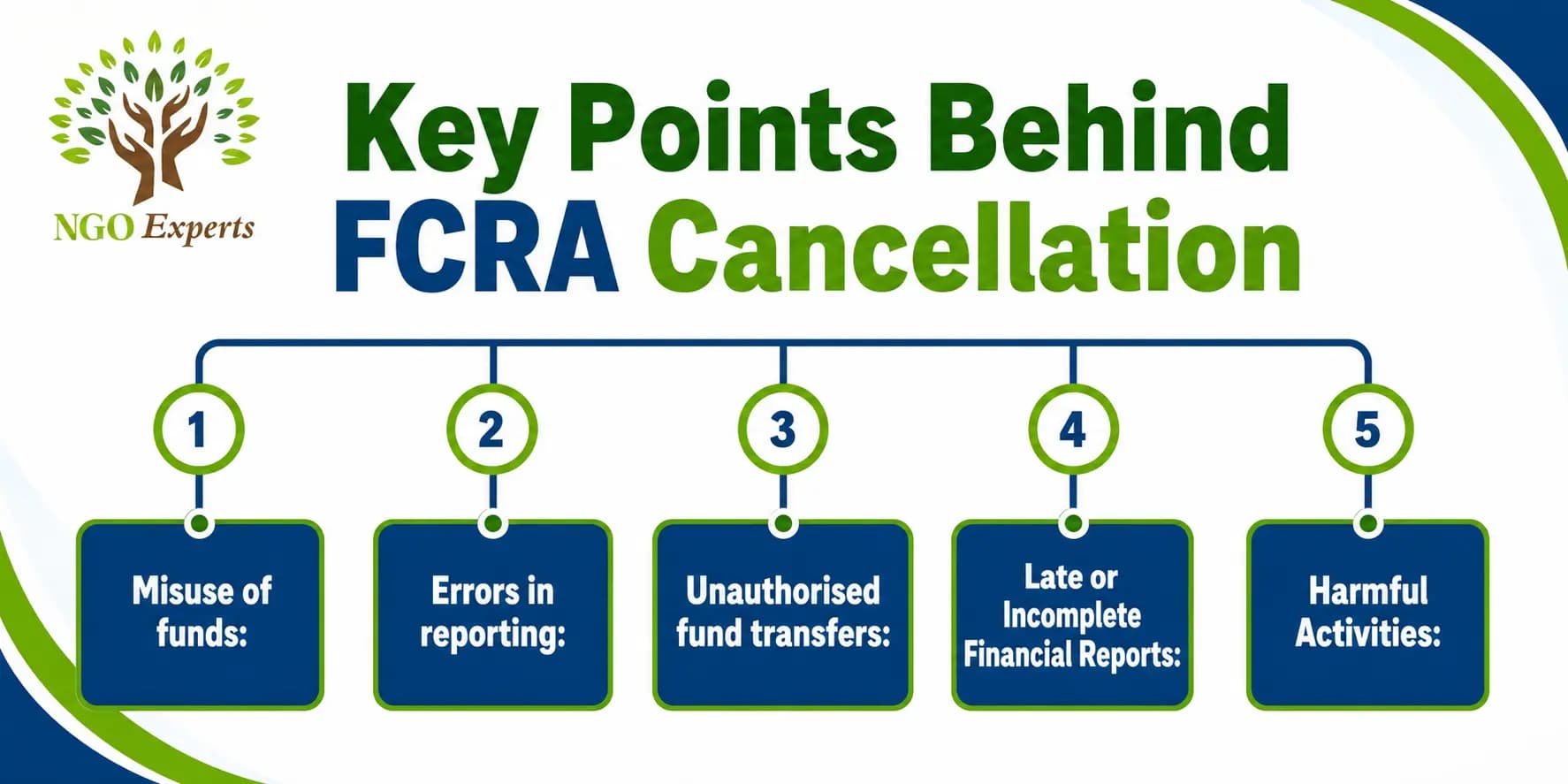
Misuse of funds: This means using foreign donations for activities that weren’t mentioned or approved in the FCRA application. Such miuse goes against the rules of transparency and accountability, and it’s one of the most common reasons licences get cancelled. The goal is to make sure foreign contributions are used for genuine, stated purposes only.
Errors in reporting: NGOs are required to submit annual returns and accurate financial statements on time. If they don’t file these or make mistakes in their reports, it’s a breach of FCRA law, which can lead authorities to suspend or cancel their license.
Unauthorised fund transfers: Mixing up local donations with foreign contributions or transferring funds without proper approval is not allowed. All money received from abroad must be kept separate and used strictly as per FCRA guidelines.
Late or Incomplete Financial Reports: If an NGO fails to file its annual returns or submits incorrect financial information.
Harmful Activities: If funds are used for activities that harm the country’s security, unity, or go against public interest.
Registrations are also cancelled when an audit finds irregularities in the finances of an NGO interms of misutilisation of foreign funds. According to FCRA, no order of cancellation of a certificate can be made unless the person or NGO concerned has been given a reasonable opportunity of being heard. Once the registration of an NGO is cancelled, it is not eligible forre-registration for three years.
These are the most common causes that lead to FCRA licence cancellation, and NGOs must follow these rules carefully to stay compliant.
Don't Let Compliance Mistakes Put Your NGO at Risk
Stay on top of your NGO's legal and regulatory requirements with expert guidance. Get professional support for 12A/12AB, 80G, FCRA, NGO Darpan, CSR-1, annual filings, and other compliance requirements to keep your organization compliant and focused on its mission.
Key FCRA sections involved in the SECMOL cancellation case
In the cancellation of the FCRA license of the SECMOL case, theNGO founded by Sonam Wangchukwas based on specific provisions of theForeign Contribution Regulation Act (FCRA), 2010. Additionally, SECMOL’s annual return for2020-21reported one receipt of₹79,200in foreign contributions, but the amount was not credited to the account. The organisation explained that the funds were deducted directly from staff salaries and stipends and used for food expenses. The Ministry said this pointed to poor financial recordkeeping and classified it as a violation. (Source: The Hindu)
Three main sections of the FCRA played a crucial role in this decision:
Section 12- Grant or refusal for FCRA licence,
Section 14- Grounds for suspension or cancellation,
Section 17- Restrictions on transfer of funds,
Section 12 covers the grant or refusal of an FCRA license. This section requires that the government carefully evaluate whether an organisation meets the necessary criteria to receive foreign contributions. In SECMOL's case, the authorities issued a show-cause notice and examined the NGO's responses before deciding to cancel the license. This section ensures that only eligible organisations are permitted to accept foreign funds and helps prevent misuse from the start.
Section 14 includes providing false information, violating terms and conditions, activities against public interest, or misuse of foreign funds. SECMOL was found to have deposited local funds into its FCRA account, diverted foreign funds for unauthorised activities, and failed to disclose transactions properly. These violations substantiated the cancellation under Section 14, emphasising that compliance is mandatory for continued registration.
Section 17 restricts how foreign contribution funds can be received and used. It mandates that foreign contributions must be received only in designated FCRA bank accounts and prohibits mixing of foreign and local funds. The investigation showed SECMOL received local donations in its FCRA account and deposited sale proceeds of assets without proper disclosure, contravening Section 17. This safeguards transparency and ensures foreign funds serve their intended purpose.
When foreign money is not used as promised or is spent on activities not allowed under FCRA rules.
The Growing Controversy Around FCRA and Its Impact on NGOs in India
In recent years, the Foreign Contribution Regulation Act (FCRA) has sparked significant debate in India. Several prominent NGOs, including Greenpeace India, Amnesty International, and the Ford Foundation, along with think tanks like the Centre for Policy Research, have faced increased government scrutiny over alleged violations of FCRA rules. These allegations often involve financial irregularities or political activities, leading to licence cancellations or suspensions. (Source: The Indian Express)
Critics argue that the government is using FCRA regulations as a tool to stifle dissent and target organisations that challenge official policies. For instance, Greenpeace India had to scale down operations after its FCRA licence wascancelled in 2015due to allegations of multiple bank accounts and questionable fund transfers. Similarly, the Lawyers Collective faced investigations and had its licence revoked on claims of using foreign funds for political purposes.
In2015, the Ford Foundation was placed under a “prior approval” system, requiring government clearance for every fund transfer to India, citing national security concerns. This move exemplifies the stricter oversight that NGOs have experienced, with over20,000 FCRA registrationscancelled and15,000 licences not renewedso far, reflecting the growing government scrutiny of NGOs receiving foreign funding.
Lessons for Other NGOs:
Maintain dedicated FCRA bank accounts exclusively for foreign funds,
File annual FC-4 returns timely and accurately,
Ensure transparent and audited accounts are accessible,
Strictly avoid intermingling local and foreign funds.
Checklist for FCRA Licence Cancellation of NGOs in 2025
Main Reasons for FCRA Cancellation
Explanation
Improper Use of Funds
Foreign funds not used as declared or spent on activities not permitted under FCRA rules.
Late or Incomplete Financial Reports
Failure to file annual returns on time or submit incorrect financial information.
Use of Funds Against National Interest
Using funds for activities that harm India’s security, unity, or go against public interest.
For more guidance, consult 80G & 12A Registration assistance and NGO Accounting Services. Contact experts for an FCRA compliance review.
Need Help With Your NGO Registration or Compliance?
Whether you're starting a new NGO or managing an existing organization, our experts can help you with NGO registration, 12A/12AB, 80G, FCRA compliance, and related NGO services.
Navigating FCRA compliance is never easy, and each cancellation affects countless lives behind the scenes. For those working hard to make a genuine difference, even small rule changes can feel overwhelming. Remember, staying informed and proactive helps protect the noble work to which many communities depend. It's time to become more familiar with FCRA so that the positive impact you bring isn’t lost, even in difficult times.
Quick Tips for NGOs to Stay FCRA Compliant in 2025
Maintain a separate FCRA-designated bank account strictly for foreign funds.
File annual FC-4 returns on time and ensure accuracy in reporting.
Keep all audit reports transparent, prepared by Chartered Accountants.
Avoid unauthorised fund transfers, especially mixing local and foreign funds.
Regularly review FCRA rules in India updates to stay compliant with the latest amendments.
Train staff and trustees on NGO FCRA compliance essentials.
Ensure proper documentation of every foreign contribution received.
Download our FREE " Ultimate FCRA Compliance Checklist 2025 " to protect your NGO’s foreign funding license and avoid costly cancellations.
Ready to Build a Compliant NGO?
Don't wait until compliance issues affect your NGO's funding or operations. Get professional guidance for NGO registration and ongoing compliance requirements.
What are the main reasons for FCRA licence cancellation in 2025?
The FCRA licence cancellation 2025 commonly occurs due to misuse of foreign funds, delayed or inaccurate filing of annual returns, and unauthorised fund transfers violating FCRA rules in India.
How can SECMOL NGO FCRA cancellation be avoided by other NGOs?
NGOs should maintain strict accounting standards, timely file their returns, avoid fund misuse, and ensure transparent audit reports to comply with FCRA rules and prevent SECMOL NGO FCRA-like cancellation.
What is the process for NGO registration in India with FCRA?
NGOs must be registered under relevant acts, have a minimum 3-year operation record, and apply for FCRA registration with compliance with all audit and reporting norms to legally receive foreign contributions.
What are the key FCRA compliance requirements for Indian NGOs?
NGOs must use designated bank accounts for foreign funding, file annual returns (FC-4), keep detailed financial documentation, avoid prohibited activities, and comply with all FCRA rules in India.
What steps should an NGO take after receiving foreign contributions under FCRA?
NGOs should deposit funds only into the FCRA-designated account, maintain clear usage records for audit, and submit timely returns to MHA, ensuring ongoing NGO FCRA compliance.
What happens if an NGO violates FCRA rules in India?
Non-compliance can lead to penalties, suspension, or cancellation of the NGO’s FCRA licence, affecting its ability to legally receive foreign funds, as seen in the FCRA licence cancellation 2025 cases.
I am a dedicated and detail-oriented Website Content Writer with over two years of experience in creating compelling, reader-friendly, and SEO-optimized content. My expertise lies in developing well-structured web pages, landing pages, blogs, and service descriptions that enhance user engagement and drive organic traffic.
Written by Sakshi Kashyap. Last updated on July 28, 2026
Recent Blogs
Stay informed with in-depth articles, guides, and updates on NGO registration, compliance, and key legal aspects for NGO.