
Section 8 Company Registration – The Smart Choice for NGOs
Looking to start a credible NGO? A Section 8 Company Registration provides stronger legal recognition, better governance, and greater opportunities for CSR funding, grants, and donor trust. Start your NGO with the right legal structure.
What Is an NGO?
What Is a Section 8 Company?
- Formed to promote commerce, art, science, education, social welfare, religion, charity, or environmental protection.
- Governed by a Board of Directors, with full Companies Act compliance, audits, ROC filings, and board meetings.
- All profits must be reinvested in the company's objectives; nothing is distributed to members.
Is a Section 8 Company the Same as an NGO?
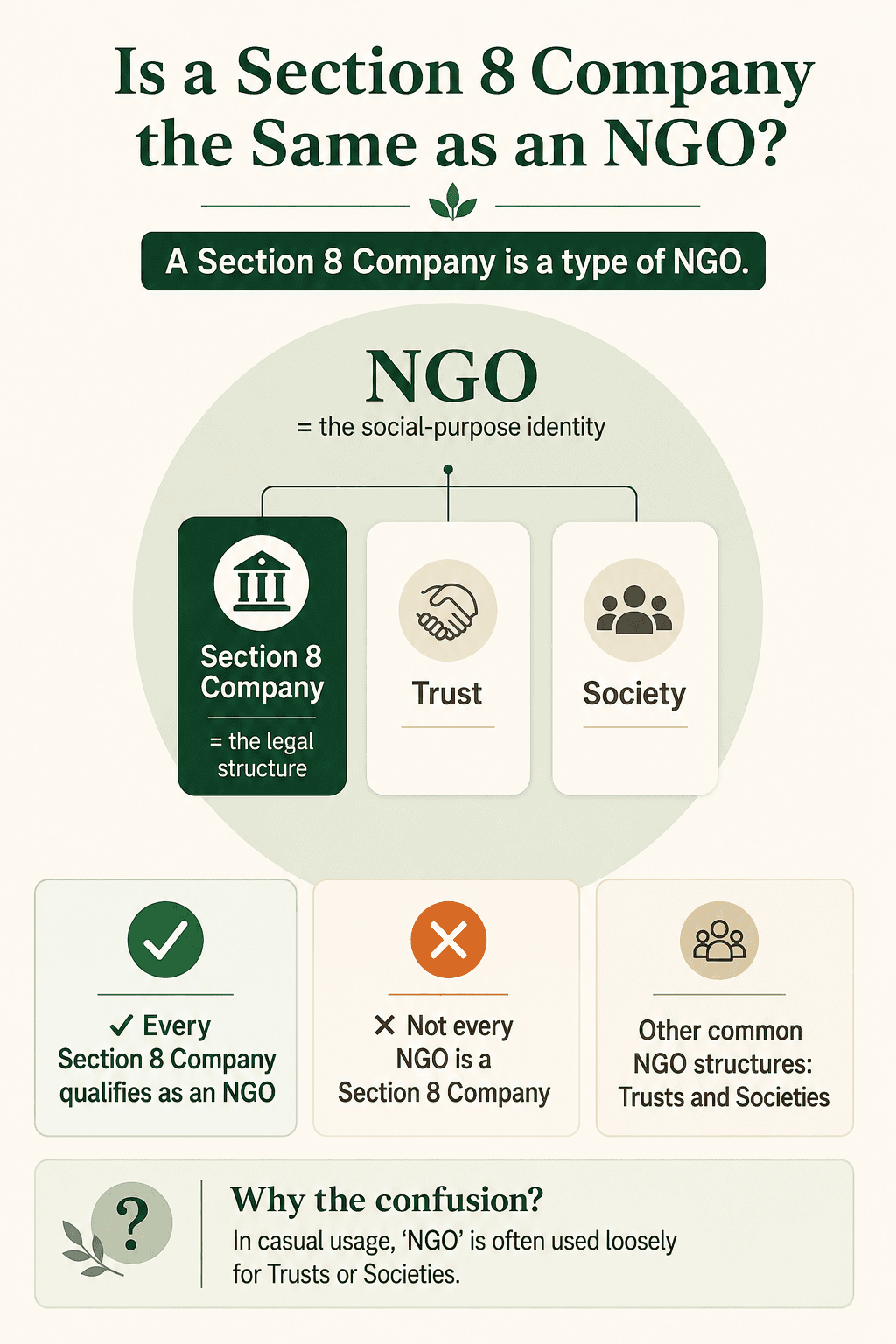
- Every Section 8 Company qualifies as an NGO.
- Not every NGO is a Section 8 Company; many are Trusts or Societies instead.
- The confusion mostly comes from casual usage, where "NGO" loosely means "Trust" or "Society" specifically.
Ready to Register Your NGO as a Section 8 Company?
While an NGO is a general term, a Section 8 Company is one of the most trusted legal structures for non-profit organizations in India. Our experts handle the complete online registration process from documentation to MCA approval.
What Legal Structures Fall Under the NGO Umbrella?
- Trust: Formed via a Trust Deed under the Indian Trusts Act, 1882, or a state Public Trust Act; run by trustees.
- Society: Formed under the Societies Registration Act, 1860; needs at least 7 members and a managing committee.
- Section 8 Company: Formed under Section 8 of the Companies Act, 2013; run by a board of directors, with the strictest governance of the three.
How Is a Section 8 Company Different From a Trust or Society NGO?
| Parameter | Trust / Society (typical NGO) | Section 8 Company |
| Governing Law | Indian Trusts Act, 1882 / Societies Registration Act, 1860 | Companies Act, 2013 |
| Regulator | State Charity Commissioner / Registrar of Societies | Ministry of Corporate Affairs (MCA), via ROC |
| Governing Body | Trustees / Managing Committee | Board of Directors |
| Minimum Members | 2 (Trust) / 7 (Society) | 2 (private) / 7 (public) |
| Annual Compliance | Lighter, varies by state | Mandatory audit, ROC filings, board meetings |
| Public Transparency | Limited disclosure | High — filings public on MCA portal |
| Donor/CSR Perception | Considered less transparent | Generally preferred by CSR committees |
| Registration Cost | ₹3,000–₹10,000 | ₹8,000–₹15,000 (2026 average) |
Step-by-Step Process to Register a Section 8 Company in 2026
Which Fundraising and Compliance Strategies Work Best for Each Structure?
- CSR funds: Register on Form CSR-1 with the MCA (mandatory for all three structures); lean into a Section 8 Company's audited, public filings, since CSR committees favor this transparency.
- Foreign donations: All three structures (Trust, Society & Section 8 Company) can apply for FCRA registration after 3 years and ₹15 lakh in core spending, but note the FCRA Amendment Rules, 2026, restricting foreign nationals (other than PIO/OCI) from being "key functionaries" in any FCRA entity.
- Local/individual donations: A Trust or Society is often sufficient, since donors usually go by 80G eligibility and local reputation.
- Government schemes: Register on NGO Darpan early; mandatory across all structures for central grants.
Real-Life Example
- It's still an NGO in every practical sense: non-governmental, non-profit, mission-driven.
- Its Section 8 status gives it corporate-style governance: a board of directors, mandatory audits, and MCA-level public disclosure.
- That transparency helps it operate at national scale, partnering with government school programs and drawing large CSR and institutional funding — exactly the advantage a Section 8 structure is built for.
Conclusion
Start Your Section 8 Company Registration Online
If you want to build a professional and growth-focused NGO, choose Section 8 Company Registration. We provide end-to-end online assistance, including incorporation, NGO Darpan, 12AB, and 80G registrations.
Frequently Asked Questions
Is a Section 8 Company legally the same as an NGO?
Which is better: an NGO or a Section 8 Company?
Can a Section 8 Company receive CSR funding?
Is a Section 8 Company owned by the Government?
Can a Section 8 Company earn profits?
Can foreign citizens become directors of a Section 8 Company?
Is a PAN card mandatory for a Section 8 Company?
Author
A Content Strategist at NGOExperts, who focuses on NGO registration, 12A and 80G registration, FCRA compliance, income tax filing for non-profits, and CSR funding guidelines in India. I research and write our compliance guides in collaboration with our in-house Chartered Accountants and Company Secretaries, so every article reflects current tax and regulatory requirements for the NGO and non-profit sector.
Written by Aabha Garg. Last updated on August 6, 2026