
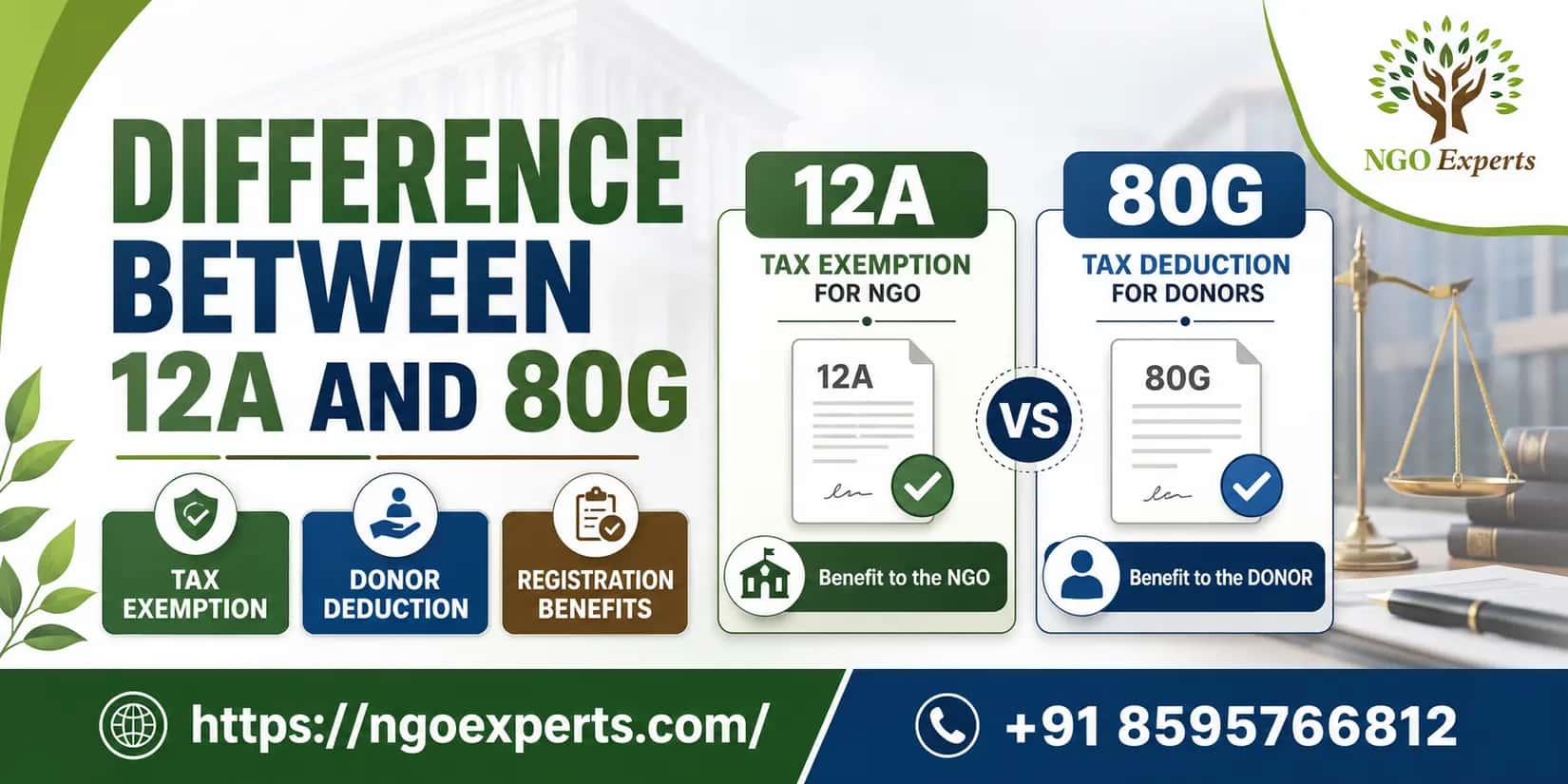
The difference between 12A and 80G is mainly about who gets the tax benefit. 12A registration helps an eligible NGO or charitable organisation claim tax exemption on qualifying income, while 80G approval lets eligible donors claim a deduction for qualifying donations. From 1 April 2026, the corresponding provisions are covered under Section 332 and Section 354 of the Income-tax Act, 2025. An eligible nonprofit may need both, but they serve different purposes.
Confused Between 12A and 80G?
Understand which registration your NGO needs and get professional assistance with the application process.
What Is 12A Registration for NGOs?
12A registration is an income tax exemption granted to eligible non-profit trusts, societies, and Section 8 companies. Under Section 332 of the Income-tax Act, 2025, this registration exempts qualifying surplus and revenue from income tax, provided the funds are applied toward approved charitable or religious purposes.
- Primary Benefit: Protects the NGO's operational income, donations, and surplus from corporate tax liability. (Unlike 80G, which benefits donors, 12A directly benefits the NGO itself.)
- Core Rule: At least 85% of income must typically be applied toward charitable objectives during the financial year to qualify for full exemption.
- Ongoing Compliance: To retain 12A status, the organization must maintain audited accounts, file annual income tax returns (ITR-7) on schedule, and ensure activities strictly align with its registered objectives.
Difference Between 12A and 80G: Key Differences Explained

The easiest way to distinguish between 12A registration and 80G approval is to look at who receives the tax benefit.
12A protects the non-profit's operational revenue, while 80G offers a direct tax write-off to the contributor. They serve distinct legal purposes and are not interchangeable; most growth-oriented non-profits secure both.
| Basis | 12A | 80G |
| Main purpose | Helps an eligible organization claim exemption on qualifying income | Allows eligible donors to claim a deduction |
| Main beneficiary | NGO or charitable organization | Donor |
| Tax benefit | Applies to the organization's qualifying income | Applies to qualifying donations, subject to conditions |
| Main focus | Income-tax exemption | Donation-related tax deduction |
| 2026 provision | Section 332 | Section 354 |
| Main compliance | Application of income, books, returns and audit | Donation records, reporting and certificates |
| Foreign funding | Does not provide FCRA permission | Does not provide FCRA permission |
| Nature of benefit | Direct benefit to the organization | Direct benefit to the donor |
The table makes the 12A vs 80G difference clear. Both can support an NGO, but they address different tax requirements.
Who Can Apply for 12A Registration?
Eligible organizations may include:
- Public charitable trusts
- Registered societies
- Section 8 companies
- Eligible charitable or religious institutions
- Eligible educational institutions
- Eligible medical institutions
- Other qualifying nonprofit organizations
The organization must first be legally formed under the applicable law. 12A registration does not create a Trust, Society, or Section 8 Company. It is a tax-related registration that becomes important when the organization wants to claim income-tax exemption.
Benefits of 12A Registration for NGOs
Getting 12A registration can provide several important benefits to an eligible nonprofit.
Tax Exemption on Qualifying Income
An eligible organization may claim exemption on qualifying income when it applies or accumulates income under the applicable tax rules.
Better Use of NGO Funds
Tax exemption can help an organization use more of its available resources for charitable, educational, medical, religious, or social activities.
Improved Credibility
A valid tax registration can improve confidence among donors, grant-making organizations and other stakeholders.
Better Tax Compliance
Maintaining 12A registration and following the related requirements can help establish a proper tax compliance record for the organization.
Important Note: 12A does not give an NGO permission to receive foreign contributions. FCRA separately regulates foreign funding.
What Is 80G Approval for NGOs?
80G approval allows qualifying non-profits to issue tax-deductible receipts to donors under Section 354 of the Income-tax Act, 2025, while the donor deduction is linked with the applicable provision under Section 133(1)(b)(ii).
- Eligible Donations: Deductions typically cover monetary contributions made through banking channels (NEFT, RTGS, UPI, cheque). In-kind donations—such as food, clothes, or equipment—do not qualify.
- Donor-Side Limitations: Deductions depend on statutory limits, specific qualifying ceilings (often 50% of the donated amount), and the donor's selected tax regime (generally available under the old tax regime unless explicitly allowed).
- Reporting Compliance: To ensure donors receive their tax benefit, the NGO must file statutory statements of donations (such as Form 10BD) and issue formal donation certificates on time.
- Cash Limit: Cash donations exceeding (typically ₹2,000) are ineligible for 80G relief; electronic transfers are standard.
However, not every donation automatically qualifies for a deduction. It depends on the approved recipient, payment method, applicable limits,the donor's tax regime, and other conditions.
Need 12A and 80G Registration for Your NGO?
Get expert guidance on eligibility, documents, application filing, and the registration process.
Who Can Apply for 80G Approval?
Eligible applicants for 80G Approval include:
- Public charitable trusts
- Registered societies carrying out charitable activities
- Section 8 companies
- Eligible educational institutions
- Eligible medical institutions
- Other qualifying nonprofit organizations
The organisation must meet the applicable requirements before applying for approval.
Benefits of 80G Approval for Donors and NGOs
Securing 80G approval creates a powerful two-way incentive: it rewards contributors with tax relief and provides essential funding channels for non-profit entities.
Tax Deduction for Eligible Donors
The biggest benefit of 80G approval is that eligible donors may claim the applicable deduction for qualifying donations.
Better Fundraising Potential
When donors can receive a tax benefit on qualifying contributions, an NGO may become more attractive to potential donors.
Greater Donor Confidence
Proper approval, donation reporting, and certification can help improve transparency and donor confidence.
Better Donation Records
Organisations with the applicable approval need to maintain donor information, report eligible donations, and issue the prescribed donation certificate. Under the 2026 framework described in the source, Form 10BD and Form 10BE from the earlier framework are referred to as Form 113 and Form 114 from 1 April 2026.
12A vs 80G: Which Registration Does an NGO Need?
The answer depends on what the organization wants to achieve.
- If an NGO wants to claim exemption on qualifying income, 12A registration is important.
- If an NGO wants eligible donors to claim deductions on qualifying donations, 80G approval becomes important.
For many nonprofits, having both can be useful because the registrations work together from different sides of the organization's financial activities.
12A focuses on the organization's income, while 80G focuses on eligible donations and donor benefits.
Is 12A Required Before 80G Registration?
This is a common question when comparing 12A and 80G registration.
You do not always need to complete one application before starting the other; an eligible organization that has not started its activities may use Form 104 for provisional registration under Section 332, provisional approval under Section 354, or both.
An organization that has already commenced activities generally uses Form 105 for regular registration or approval.
Form 104 and Form 105 replace the earlier Form 10A and Form 10AB under the 2026 framework described in the source.
Therefore, the exact application route depends on the organization's formation status, activities, and applicable requirements.
Latest 12A and 80G Rules and Updates for 2026
The tax framework for charitable organizations has important terminology and numbering changes from 1 April 2026.
The key changes described in the supplied source include:
- The 12A-related registration framework is covered under Section 332 of the Income-tax Act, 2025.
- The 80G-related approval framework is covered under Section 354.
- The donor deduction is linked with Section 133(1)(b)(ii).
- Earlier Form 10A and Form 10AB are now Form 104 and Form 105.
- Earlier Form 10BD and Form 10BE are now Form 113 and Form 114.
For NGOs, the important point is not just the change in section or form numbers. Organisations should also continue to maintain proper records, follow income-tax requirements, and complete applicable reporting on time.
Ready to Register Your NGO Under 12A & 80G?
Simplify the registration process with professional support from start to finish.
Frequently Asked Questions
What is the main difference between 12A and 80G?
The main difference between 12A and 80G is who receives the tax benefit. 12A-related registration helps an eligible organization claim exemption on qualifying income, while 80G approval allows eligible donors to claim a deduction on qualifying donations.
Are 12A and 80G registration the same?
No. They are different. 12A mainly relates to tax exemption for the organization, while 80G mainly relates to tax deductions for eligible donors.
Can an NGO apply for both 12A and 80G?
Yes, an eligible nonprofit may apply for both where it meets the applicable requirements. The two approvals address different tax benefits.
Is 12A required before applying for 80G?
Not necessarily in every case. The applicable application route depends on whether the organization has started activities and other relevant conditions. The supplied 2026 framework provides for provisional and regular routes using Form 104 and Form 105.
Does 12A allow an NGO to receive foreign donations?
No. Section 12A does not provide permission to receive foreign contributions. An NGO needs to follow the applicable FCRA requirements for foreign funding.
Can donors claim an 80G deduction for every donation?
No. The donation must meet the applicable conditions. Factors such as the recipient's approval, payment method, applicable limits, and the donor's tax position can affect eligibility.
Are donations in kind eligible for an 80G deduction?
The supplied source states that donations in kind are not eligible in the same way as qualifying monetary donations. Donors should check the applicable rules before claiming a deduction.
What are the 2026 section numbers for 12A and 80G?
From 1 April 2026, the supplied source identifies Section 332 for the 12A-related registration framework and Section 354 for the 80G-related approval framework.
Author
Aabha Garg
A Content Strategist at NGOExperts, who focuses on NGO registration, 12A and 80G registration, FCRA compliance, income tax filing for non-profits, and CSR funding guidelines in India. I research and write our compliance guides in collaboration with our in-house Chartered Accountants and Company Secretaries, so every article reflects current tax and regulatory requirements for the NGO and non-profit sector.
Written by Aabha Garg. Last updated on September 24, 2026