
Quick Summary
Corporate Social Responsibility (CSR) in India has evolved from a voluntary action to a legally bound structure today. Managing CSR funding involves more than just doing good; it also requires doing it correctly and legally. The CSR-1 Form has become the ultimate cover for corporations and the ultimate opportunity for NGOs since the Ministry of Corporate Affairs (MCA) revised the regulations. CSR-1 has completely changed how corporates can fund NGOs under CSR. This guide from NGOExperts explains CSR-1 in simple terms and provides a practical checklist for corporate CSR teams before funding an NGO.
What is Corporate Social Responsibility (CSR)?
Under Section 135 of the Companies Act, 2013, Companies with a net worth of Rs. 500 crore, turnover of Rs. 1000 crore, or net profit of Rs. 5 crore must spend 2% of their average net profits on social causes through Corporate Social Responsibility (CSR). CSR projects must fall under Schedule VII areas, such as education, health, environment, rural development and similar social causes.
From 1 April 2021, the Ministry of Corporate Affairs (MCA) introduced Form CSR-1 to tighten CSR governance and ensure only verified NGOs implement CSR projects. CSR-1 is therefore the bridge between corporate CSR obligations and NGO implementation on the ground.
What is the CSR-1 Form under the Companies Act, 2013?
Form CSR-1 is an electronic registration form prescribed under the Companies (Corporate Social Responsibility Policy) Rules for entities seeking funding for CSR projects. It is filed online with the Registrar of Companies (ROC) through the MCA portal, and once approved, it generates a unique CSR Registration Number for the NGO.
Why Is CSR-1 Registration Mandatory Before Funding an NGO?
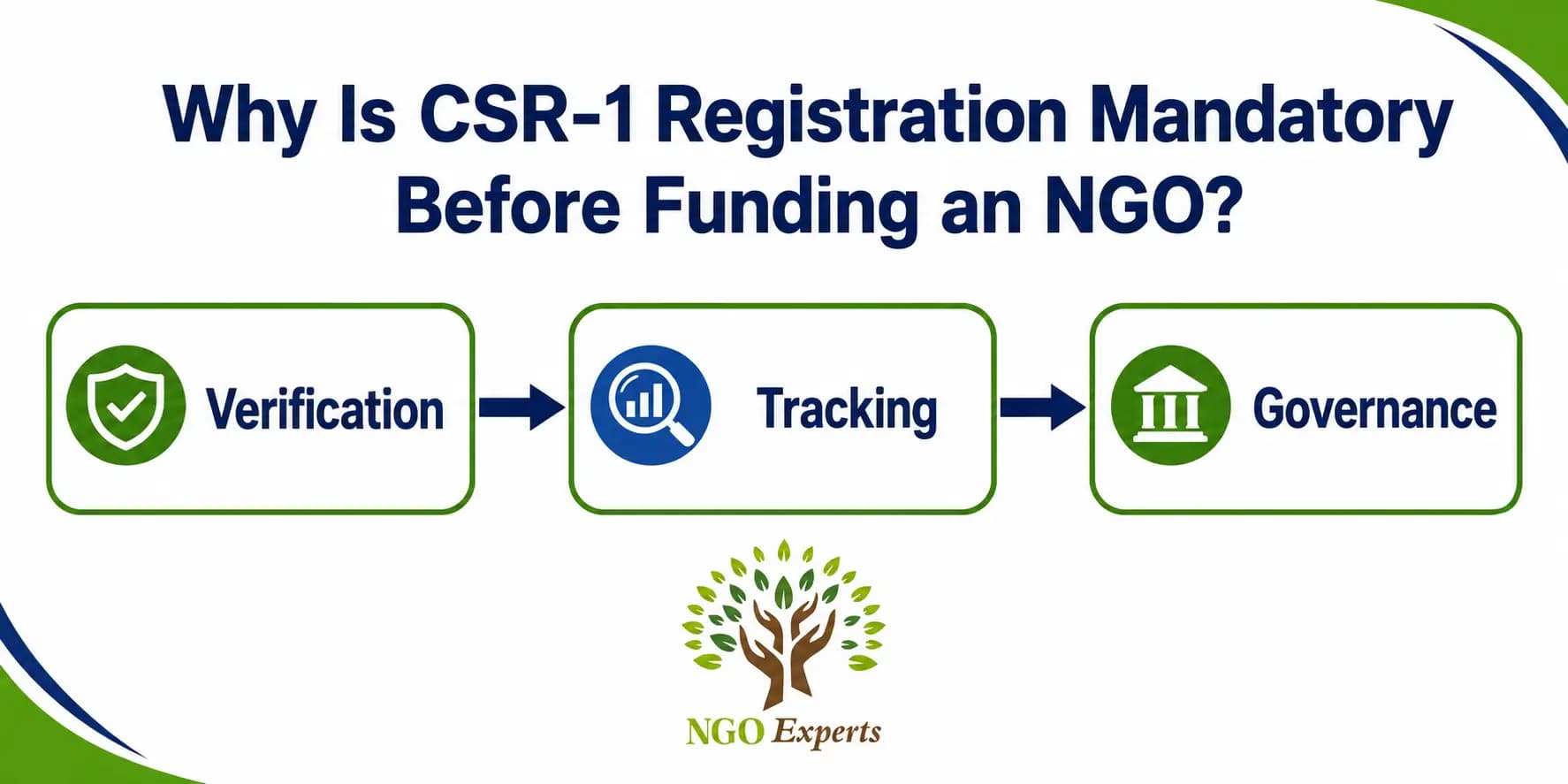
The Ministry of Corporate Affairs (MCA) made CSR-1 compulsory so that only compliant entities can implement CSR projects of companies covered under Section 135. Before April 2021, any NGO could receive funds. Today, the law is strict: No CSR-1, No Funding.
- Verification: It proves the Central Government recognises the NGO.
- Tracking: It allows the MCA to monitor where corporate money is going.
- Governance: It ensures that only registered NGOs handle public money.
From 1 April 2021, companies are expected to spend their CSR funds only through NGOs registered on CSR-1. If an NGO is not registered in CSR-1, it is not recognised as an eligible implementing agency for CSR purposes.
Which NGOs are eligible for CSR funding after CSR-1?
Under the CSR Rules, the following types of entities can apply for CSR-1 and become eligible for CSR funding:
- Section 8 companies registered under the Companies Act.
- Registered public charitable trusts.
- Registered societies.
- Entities established by an Act of Parliament, State Legislature or by the Central/State Government.
Most NGOs are also expected to have 12A registration for income tax exemption and 80G registration for donor tax benefits. Track record conditions like ( three years of similar activities) generally apply unless the NGO is set up by the government or by the company itself, as per the CSR Rules.
Corporate checklist before funding any NGO under CSR
A clear internal checklist can protect your CSR budget, brand and Board. Before signing any CSR MoU or releasing funds, your CSR or legal team should confirm at least:
- NGO CSR-1 status
- Valid CSR-1 filed on the MCA portal and CSR Registration Number obtained.
- Entity type (Trust/ Society/ Section 8/ Gvernment-backed) matches the CSR-1 filing.
- Statutory registrations
- Registration certificate of trust/society/Section 8 company.
- 12A registration for income-tax exemption.
- 80G registration for donor tax benefit, if the company wants proof of deduction for CSR spends in line with policy.
- Experience & governance
- Track record in the proposed area and geography (project reports, photos, previous donor references).
- Board/Trustee details, background and related-party risk checks.
- Project alignment
- Proposed activities clearly fall under Schedule VII of the Companies Act.
- Clear outputs, outcomes, timelines and budgets are documented in a written CSR agreement.
- Compliance & reporting
- Defined reporting frequency, utilisation certificates and audit mechanisms.
- Clarity on the impact assessment requirement for CSR spending above the notified thresholds.
Consequences of funding an NGO without CSR-1 registration
If a company funds an NGO that is not registered under CSR-1, multiple risks may arise:
- Risk of CSR spend being treated as non‑compliant or ineligible for CSR credit in CSR-2 and Board reporting.
- Questions from statutory auditors, internal auditors and even regulators during reviews or inspections.
- Reputational risk if any misuse of funds, governance issues or fraud is later reported about the unregistered NGO.
- Need for corrective actions, reallocation of CSR budget or explanatory notes in the Board’s Report.
Because of these risks, many corporates now treat CSR-1 as a non‑negotiable condition in their CSR policy and SOPs(Standard Operating Procedures)
CSR-1: Due date, filing process & validity
There is no one‑time, annual deadline to file CSR-1, but NGOs must register before they start receiving CSR funds. Practically, if the NGO wants to be considered for CSR in a given financial year, it should complete CSR-1 at the earliest.
The basic filing process is:
- Prepare the DSC (Digital Signature Certificate) of the NGO’s authorised signatory.
- Fill e‑Form CSR-1 on the MCA portal with NGO details, registrations and contact information.
- Get the form certified by a practising CA/CS/CMA.
- Submit the form online and receive an acknowledgement/CSR Registration Number on approval.
CSR-1 is generally a one‑time registration, and the CSR Registration Number remains valid as long as the NGO and its registrations are active and compliant.
Difference between CSR-1, CSR-2 & CSR annual compliance
For clarity, CSR-1, CSR-2 and annual CSR reporting serve different players and purposes.
| Aspect | CSR-1 | CSR-2 | CSR Annual Report |
| Who files | NGOs / implementing agencies | Companies covered under Section 135 | Companies covered under Section 135 |
| Filed with | MCA (ROC) | MCA (ROC) | As part of the Board’s Report / AOC-4 disclosures |
| Purpose | Registration of the NGO as an eligible CSR implementing agency | Detailed reporting of CSR spending, projects and unspent amounts | Narrative and financial disclosure of CSR policy, CSR committee and spending |
| Key user | Companies selecting NGOs | Regulators, investors, auditors | Shareholders, regulators, stakeholders |
| Frequency | One‑time (or on change) | Annual, for each financial year | Annual, with financial statements |
Understanding this distinction helps corporate teams design correct internal calendars and responsibilities for CSR compliance.
Conclusion
For any responsible company in India, CSR is a regulated compliance function tied to law, audit and reputation. Treating CSR-1 as the first filter for selecting NGO partners, supported by a documentation checklist, helps corporates spend wisely, compliantly and with measurable impact.
If your company wants expert help with shortlisting CSR-compliant NGOs, drafting MoUs, or verifying CSR-1 status, a specialised advisory like NGOExperts can streamline this entire process for your CSR and finance teams.
Frequently Asked Questions
Is CSR-1 mandatory for every NGO in India?
CSR-1 is mandatory only for NGOs that want to receive CSR funds from companies covered under Section 135 of the Companies Act.
Can a company do CSR without any NGO or CSR-1?
Yes, companies can implement CSR projects directly in some cases, such as through their own Section 8 company or in-house programs.
Does CSR-1 guarantee the quality of an NGO?
CSR-1 confirms that the NGO is registered and has been recorded by MCA as an eligible implementing agency.
Is there any renewal for CSR-1?
CSR-1 is generally a one‑time registration and remains valid as long as the entity and its registrations remain active.
Do foreign NGOs need CSR-1 to receive CSR funds?
CSR Rules primarily recognise Indian-registered entities. For cross‑border projects, companies usually work through Indian entities that meet CSR-1 and FCRA requirements, and this area needs specific legal advice.
Author
Aabha Garg
A Content Strategist at NGOExperts, who focuses on NGO registration, 12A and 80G registration, FCRA compliance, income tax filing for non-profits, and CSR funding guidelines in India. I research and write our compliance guides in collaboration with our in-house Chartered Accountants and Company Secretaries, so every article reflects current tax and regulatory requirements for the NGO and non-profit sector.
Written by Aabha Garg. Last updated on June 5, 2026