
Ready to Start Your NGO in India?
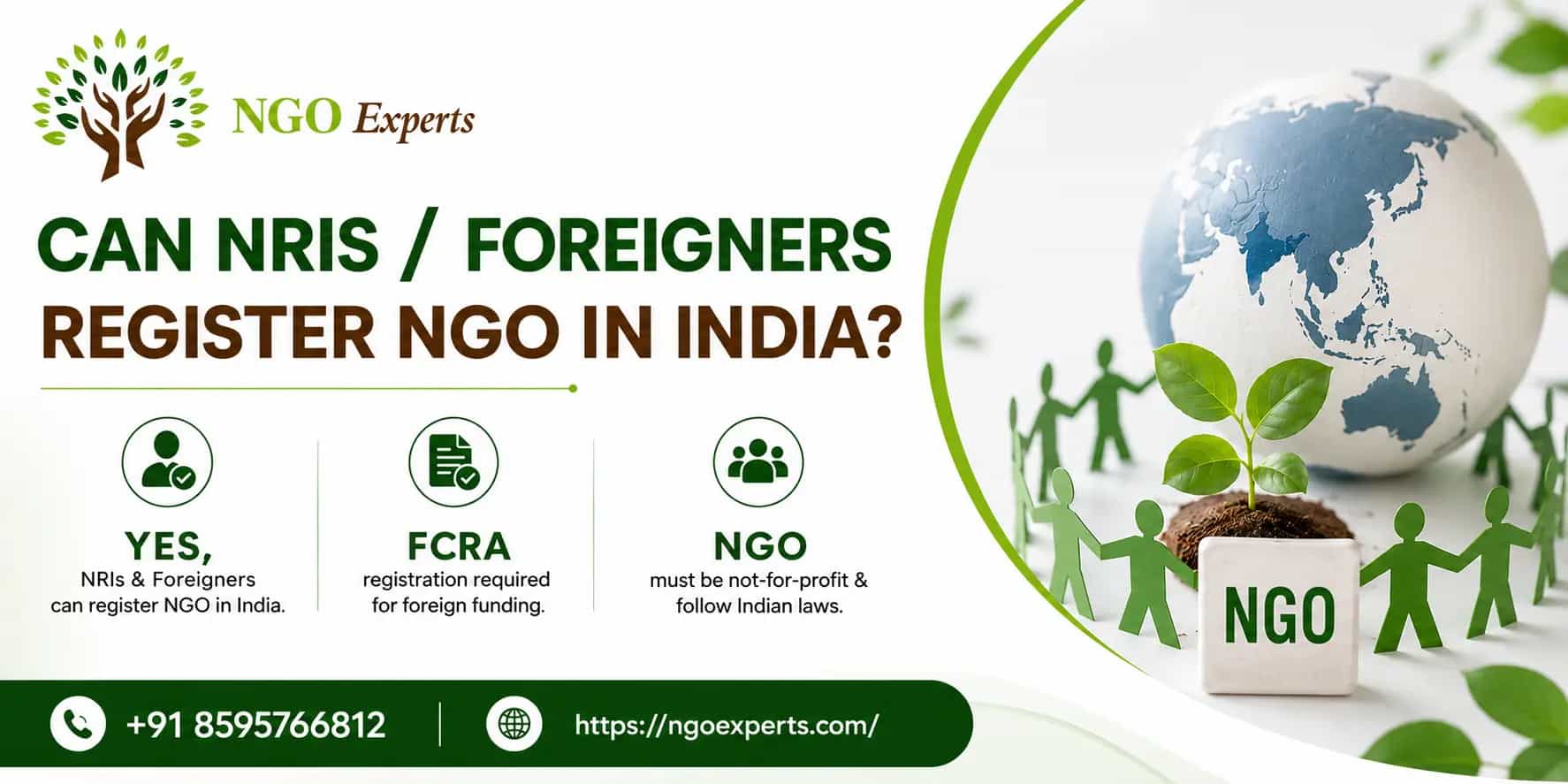
Are you an NRI or foreign national planning to register an NGO in India? Get expert assistance with Section 8 Company registration, Indian resident director requirements, 12A & 80G registration, and FCRA compliance.
Quick Definitions
- NRI (Non-Resident Indian): An Indian citizen who lives outside India but continues to hold an Indian passport.
- Foreign National: A person who is not an Indian citizen, including most OCI cardholders.
- FCRA: The Foreign Contribution (Regulation) Act, 2010, which regulates how Indian NGOs receive foreign donations.
- Section 8 Company: A non-profit company registered under the Companies Act, 2013 and regulated by the Ministry of Corporate Affairs (MCA).
Can an NRI Register an NGO in India?
- Register a Trust, Society, or Section 8 Company in your own name
- Sit on the governing board or act as a trustee, director, or chief functionary
- Route personal funds from your NRE or NRO account into the NGO, generally without triggering FCRA
Register Your Section 8 Company with Expert Guidance
Setting up an NGO in India as an NRI or foreign national can involve complex legal and compliance requirements. Our experts can help you choose the right structure and guide you through the registration process.
Can a Foreign National Register an NGO in India?
- If you go with a Section 8 Company, you need a minimum of 2 directors, and at least one of them must be an Indian resident, meaning they've stayed in India for 182+ days in the previous financial year, per Section 149(3) of the Companies Act. One foreign director alone is not enough to incorporate; you need the resident director as a second, mandatory appointee. Under the Companies Act, 2013, it is a mandatory legal requirement, not an optional addition.
- Your personal funds count as "foreign contribution" the moment they enter the NGO's accounts, which means you can't legally use them to run operations until the NGO holds FCRA registration or prior permission.
- The Ministry of Home Affairs generally discourages foreign nationals from sitting on the board of an entity that's applying for FCRA. While inclusion doesn't trigger an automatic denial, expect rigorous government scrutiny and a significantly extended timeline for final approval.
- If you're relocating to India to run the organisation, you'll need to register with the Bureau of Immigration under the Immigration and Foreigners Act, 2025.
Which Legal Structure Actually Fits You?
| Structure | Governed By | Best If You... | Key Requirement / Consideration |
| Section 8 Company | Companies Act, 2013 | Want CSR eligibility, national recognition, and a structure funders already trust | Needs min. 2 directors, 1 Indian resident |
| Trust | State Public Trusts Acts (only some states have one — Maharashtra, Gujarat, Rajasthan, MP) | Have a narrow charitable purpose and don't need a national footprint | No central law; rules vary sharply by state |
| Society | Societies Registration Act, 1860 (plus state amendments) | Are building something membership-driven and grassroots | Needs at least 7 members; governance is looser |
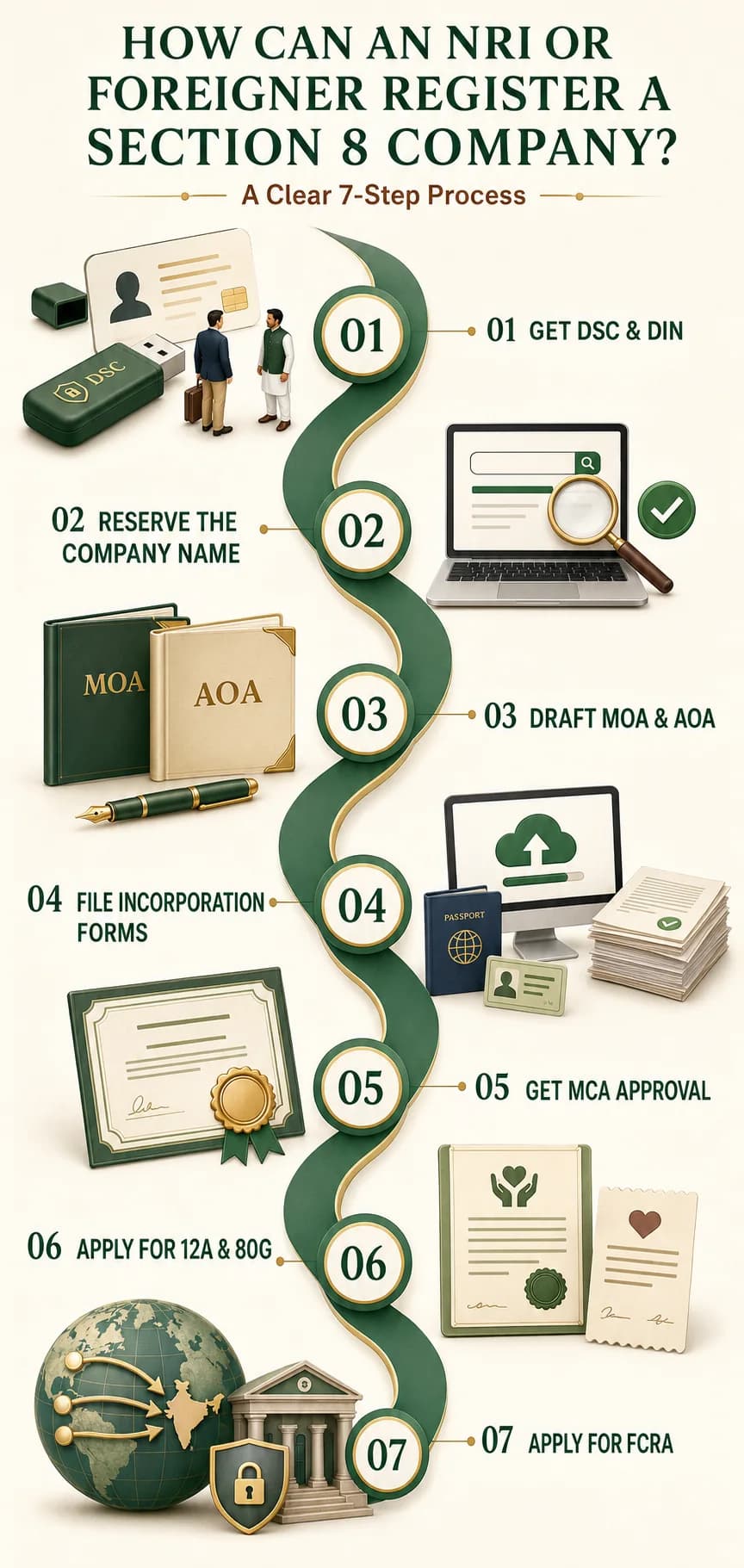
How to Register a Section 8 Company as an NRI or Foreigner: Step-by-Step Process
How Does FCRA Affect Your NGO's Funding?
- Around 16,000 NGOs currently hold an active FCRA registration, according to the Ministry of Home Affairs (MHA) FCRA Division (2026).
- More than 37,000 NGOs have exited the FCRA system since 2011. Government data shows 22,273 registrations were cancelled and 15,182 lapsed, highlighting the importance of ongoing compliance.
- To apply for regular FCRA registration, your NGO must have completed at least 3 years of operation and spent a minimum of ₹15 lakh on its core charitable activities during that period.
- Under the Foreign Contribution (Regulation) Amendment Rules, 2026, NGOs must clearly specify the purpose and geographical area where foreign funds will be used. Any changes require prior approval from the Ministry of Home Affairs.
- Before applying for FCRA, every NGO must obtain a Unique ID from the NGO Darpan portal managed by NITI Aayog. Without this ID, an FCRA application cannot be submitted.
A Real Example
Planning to Register an NGO from Abroad?
From Section 8 Company incorporation to FCRA compliance, make sure your NGO is set up correctly from the beginning. Talk to our NGO registration experts for personalised guidance
Frequently Asked Questions
Can an OCI cardholder register an NGO in India?
Do I need to live in India to register an NGO here?
Can I send money to my own NGO before it has FCRA registration?
How long does the whole process take, start to finish?
Should NRIs register a Trust, Society, or Section 8 Company?
What happens if my FCRA application gets rejected?
Author
A Content Strategist at NGOExperts, who focuses on NGO registration, 12A and 80G registration, FCRA compliance, income tax filing for non-profits, and CSR funding guidelines in India. I research and write our compliance guides in collaboration with our in-house Chartered Accountants and Company Secretaries, so every article reflects current tax and regulatory requirements for the NGO and non-profit sector.
Written by Aabha Garg. Last updated on August 4, 2026