NGO Experts Logo
NGO

Can a Single Person Start an NGO in India

May 20, 20268 min read604 views
Can a Single Person Start an NGO in India

Quick Summary

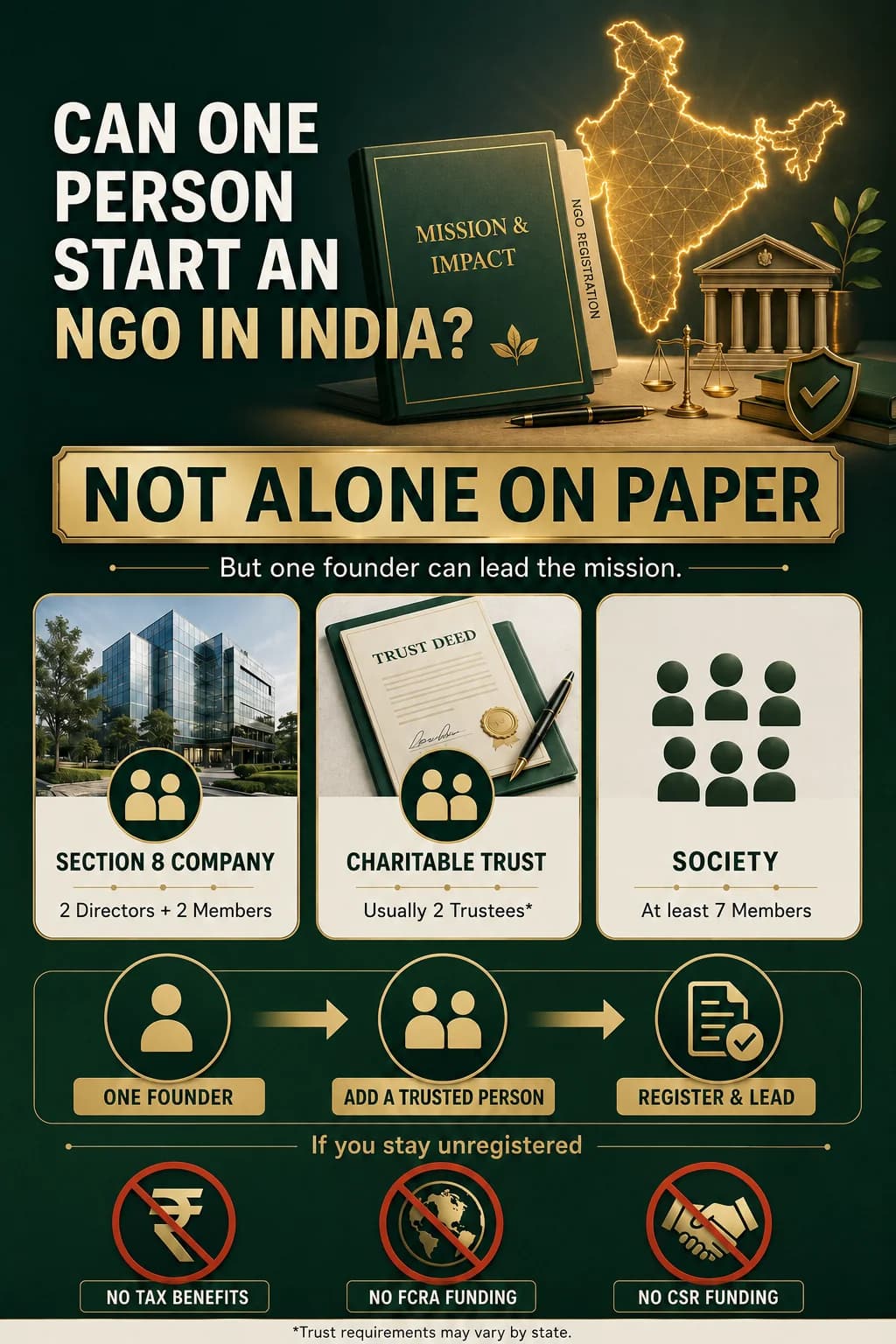
In India, while one person can conceptualise, plan, and initiate an NGO's mission, they cannot register an NGO on their own. Every legal structure, be it a Trust, Society, or Section 8 Company, requires a minimum of 2 to 7 members. However, you can launch an NGO as a one-person Trust, which requires only two trustees (you can name family members). Discover costs from ₹5,000, steps, docs, funding tips, and compliance. This guide provides a clear, step-by-step process for NGO registration in India and helps you choose the right path for your mission. 

Can One Person Legally Start an NGO in India?

A single person can legally start an NGO in India if they choose the right legal structure. Legally, no structure allows a sole member forever, but a trust lets you begin with yourself as the settlor and a family member as the trustee. For example, Richa Gupta started Labhya Foundation solo, focusing on kids' education, and it now impacts millions. This makes "can I open an NGO alone in India" a reality for many solo NGO founders.
The minimum number of members required to start an NGO in India varies: Trust (2), Society (7), Section 8 (2 directors). Over 91% of NGOs run on small budgets of under ₹10 crore per year, proving that solo starts work.

Best NGO Registration Options for a Single Person

The best NGO structure for a single founder in India is a Public Charitable Trust:  simple, quick, and low-cost. It suits "NGO registration for a person" perfectly. Section 8 Company works, but it needs more paperwork; Society requires 7 member, so skip it.
Let's compare with a simple table
StructureMinimum MembersBest For
Public Charitable Trust2 TrusteesLow maintenance and local operations.
Section 8 Company2 Directors/MembersHigh credibility and nationwide scaling.
Society7 MembersMember-based groups like clubs or unions.
Trusts are India's first choice for small NGOs, with easy admin and FCRA eligibility for foreign funds. You may pick between the two,  based on your goals: 
Trust for family-run, and Section 8 for big funding later.

Have Questions? Talk to Our NGO Experts

Talk to our experts

Can a Single Person Register a Trust Alone?

Yes, it is possible to register a public charitable trust with a single person as the founder or settlor. However, for the board of trustees, a minimum of 2 trustees is generally required, though this may vary slightly by state.
  • Registered under the Indian Trusts Act, 1882 (or state-specific legislation)
  • Minimum two trustees required (in most cases)
  • Easy to set up and manage
  • Ideal for small-scale charitable activities
While you can initiate the process alone, you will need at least one more individual to complete the registration legally. Once registered, you can apply for 12A and 80G registrations, which are essential for tax exemptions and attracting donors.

Can One Person Start a Society Registration?

No, a single person cannot register a society. Societies must have at least 7 members from different states to register as a national-level society. For state-level societies, at least seven individuals from the same state are needed.
  • Registered under the Societies Registration Act, 1860
  • Minimum seven founding members required
  • Operates with a governing body or managing committee
  • Suitable for educational, cultural, and charitable organisations
Because of the higher membership requirement, societies are more collaborative and democratic. Once established, societies are also eligible for 12A and 80G registration to facilitate tax exemptions and donor incentives.

Is a Section 8 Company Possible with One Founder?

No, you cannot register a Section 8 Company as a single individual. You need at least two directors and two shareholders. However, these can be the same individuals, allowing for a more streamlined formation process than in societies.
  • Registered under the Companies Act, 2013
  • Minimum two directors and shareholders required
  • High level of compliance and transparency
  • Ideal for NGOs seeking government grants and CSR funding
Despite the initial setup requiring two people, a Section 8 Company offers numerous long-term advantages, including greater credibility, structured governance, and better access to funding. You can also apply for 12A and 80G registration once the company is incorporated.

Have Questions? Talk to Our NGO Experts

Talk to our experts

Sole Founder NGO vs Team-Based NGO: Which is Better?

The sole founder of an NGO has full control and can make faster decisions, ideal for testing ideas like rural health camps. Team-based adds diverse skills but slows starts. Stats show small solo NGOs (91% under ₹10cr) thrive on personal drive.
AspectSole Founder NGOTeam-Based NGO
ControlFullShared
SpeedFast startSlower consensus
CostLow (₹5k+)Higher docs
FundingPersonal networks firstBroader appeal 
ChallengesOverloadConflicts 

Can I Start the Process Alone and Add Members Later?

Yes, in many cases, you can begin the groundwork on your own by ideating the mission, drafting the objectives, and preparing documentation. However, you will need to involve additional members when it comes time to register the NGO officially, regardless of whether you choose a Trust, Society, or Section 8 Company.

Documents Required to Start an NGO as a One-Person

Even if you are the main lead, you must collect documents required for an NGO registration for both yourself and your second member:
  • Identity Proof: PAN Card (Mandatory) and Aadhaar Card. 
  • Address Proof: Voter ID, Passport, or Driving License.
  • Office Proof: Rent agreement and a Utility Bill (Electricity/Water) for the registered office address. 
  • Photographs: Passport-sized photos of all proposed members. 
  • Drafts: Trust Deed (for Trusts) or MOA/AOA (for Section 8). 
Trust needs settlor/trustee details; keep digital for online NGO registration for one person. 

Step-by-Step Process to Start an NGO Alone

  1. Choose Your Partner: Find a trusted individual (husband, wife, or friend) to meet the 2-member minimum.
  2. Digital Signature (DSC): Apply for DSC and DIN for both directors (if choosing Section 8). 
  3. Name Approval: Apply for a unique name that reflects your social mission.
  4. Drafting Documents: Prepare the Trust Deed or Memorandum of Association.
  5. Registration: Submit the files to the Sub-Registrar (for Trust) or MCA (for Section 8).
  6. PAN/TAN: Apply for the NGO’s tax identities once the certificate is issued. 
  7. NGO Darpan: Register on the NITI Aayog portal to get your Unique ID. 
  8.  12A/80G Registration: Apply for 12A/80G for tax perks.

Benefits of Starting an NGO as a Single Founder

You may avail yourself of the following benefits if you want to start an NGO as a single person.
  • Zero Conflict: You execute your vision exactly how you want.
  • Speed: No waiting for board meetings to approve small expenses.
  • Personal Brand: You become the face of the cause, which helps build a one-person charitable organisation registration in India.

Challenges Faced by Solo NGO Founders

Many solo founders struggle initially with the following tasks:
  • Finding Committed Members: Look for like-minded individuals on social media, through volunteer networks, or at community events.
  • Navigating Legal Requirements: Work with legal experts or platforms like NGOExperts for smooth registration and compliance.
  • Securing Funding: Begin with small-scale fundraising while building credibility through proper governance and tax exemptions.
  • Multitasking: They struggle alone and are supposed to multitask, being a single person

How to Get Funding for a One-Person NGO?

Can a solo NGO founder get grants? Yes!
  • Individual Donors: Focus on crowdfunding and small personal donations first.
  • CSR Funding: Companies prefer Section 8 structures. Ensure you have 12A and 80G registration to offer tax benefits to your donors. 
  • Bootstrapping: Most solo founders start by using their own savings to prove the concept before asking for outside help.
Register on NGO DARPAN, apply for CSR (89% eligible), crowdfunding, and personal networks. Every day, small donors now make up 1/3 of funds; 96% NGOs say it works.

NGO Compliance Requirements After Registration

Registration is just the beginning. To keep your NGO active, you must:
  • Annual Audit: Get your accounts checked by a Chartered Accountant.
  • Income Tax Returns: File ITR-7 every year. 
  • ROC Filings: (For Section 8) File Form AOC-4 and MGT-7 annually. 
  • 12A/80G Renewals: Ensure your tax-exempt status is renewed every 5 years. 

Can Family Members Be Added as Co-Founders?

Yes! In fact, the question "can husband and wife start NGO together" is one of the most common queries we get. This is a perfectly legal and efficient way to fulfil the minimum number of members required to start an NGO in India. Most solo founders include their spouse or siblings to maintain family control over the mission.

Cost of Starting an NGO with One Person in India

The cost to start an NGO as a single person varies:
  • Trust: ₹5,000 to ₹15,000 (depending on state stamp duty). 
  • Section 8 Company: ₹8,000 to  ₹20,000 (including Govt fees and professional help).
At NGOExperts, we offer specialised packages for solo founders to keep the online NGO registration for one person affordable and fast.

Why Choose NGOExperts

We understand that as a solo founder, your time is best spent on the ground, not in government offices. NGOExperts provides end-to-end support, from picking the right partner for your board to handling all your NGO setup for single-founder India paperwork. We ensure your NGO is built on a solid legal foundation so you can focus on changing lives.

Conclusion

In conclusion, while you can start planning on your own, you will need at least one other person to register your NGO, depending on the legal structure you choose. Among the options, Trusts require the fewest people, while Societies require the most. If you are serious about building a transparent, credible, and professionally run NGO, partnering with at least one other committed individual to register a Section 8 Company is the most strategic choice.
No matter the structure, don’t forget to obtain 12A and 80G registration to unlock key tax benefits and funding opportunities.

Frequently Asked Questions

NGOs aren't owned like businesses; boards manage them. However, in a Section 8 company, you can hold the majority of the voting rights.
Yes, you can receive a reasonable salary for your professional services (e.g., as the CEO), provided it is specified in the bylaws and approved by the board.
Section 8 is better for transparency and getting corporate CSR funds, while a Trust is cheaper and easier to manage for very small, local initiatives.
You need a registered office address, but it can be your home address as long as you have an NOC (No Objection Certificate) from the owner.
A Trust can be done in 7-10 days, while a Section 8 Company usually takes 20-30 days.
Absolutely. single person can start with 2 members and expand your board to 10 or 20 people as your NGO grows.

Recent Blogs

Stay informed with in-depth articles, guides, and updates on NGO registration, compliance, and key legal aspects for NGO.

📢Subscribe For Updates

Get the latest news delivered to your inbox

Live Update