


Not Sure If Your NGO Needs an Audit?
NGO audit requirements depend on your legal structure, income, tax registrations, and foreign funding. Learn which audits and annual filings may apply to your NGO.
Who actually needs an audit
- Not every NGO is legally required to get audited. It depends on income, structure, and whether you receive foreign funds.
- An RNPO (the entity holding what used to be called 12A/80G registration) must get its accounts audited once its total income — before RNPO exemptions — crosses the basic exemption limit in a tax year.
- Section 8 companies are audited every year regardless of income because company law requires it — separately from the income tax audit.
The three audit layers that can apply to your NGO
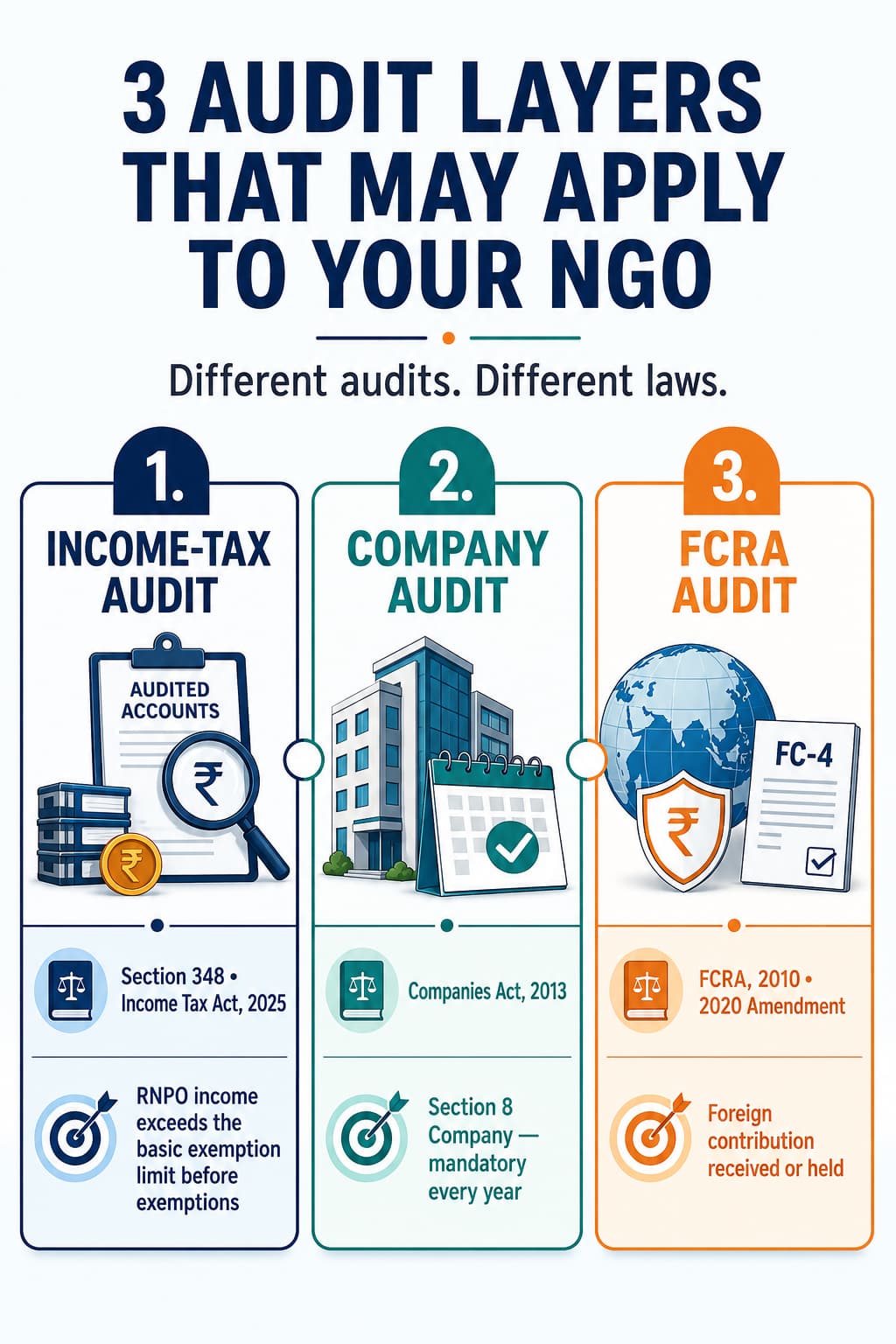
| Audit | Governed by | Applies when |
| Income-tax audit | Section 348, Income Tax Act, 2025 | RNPO income exceeds the basic exemption limit before exemptions |
| Company audit | Companies Act, 2013 | You are registered as a Section 8 company — mandatory every year |
| FCRA audit | FCRA, 2010, and 2020 Amendment | You receive or hold any foreign contribution, even ₹0 in a given year |
Income-tax audit: Form 112
Who must file it
- Any RNPO whose total income, before RNPO exemptions, exceeds the basic exemption limit in a tax year.
- Applies to trusts, societies, Section 8 companies, universities, and hospitals holding RNPO status.
Who can sign it
- A practicing Chartered Accountant, as defined under Section 288 of the Income Tax Act, 2025.
When it is due
- At least one month before the ITR-7 filing due date.
- Filed electronically on the Income Tax e-filing portal — once submitted, it cannot be edited.
FCRA audit, if you receive foreign funds
- Foreign contributions must move through one designated FCRA bank account at the SBI, New Delhi Main Branch.
- Administrative expenses out of foreign funds are capped at 20% of the foreign contribution utilised in the year, under the FCRA Amendment Act, 2020.
- Form FC-4 (annual return) reports foreign receipts, donor details, purpose, and transfers, with the audited FC balance sheet, income-and-expenditure statement, and receipts-and-payments account attached.
- A NIL FC-4 is mandatory even in a year with no foreign receipts if the FCRA registration is active.
- Due date: 31 December, for the preceding financial year.
Confused About Your NGO's Audit and Filing Requirements?
Whether you run a Trust, Society, or Section 8 Company, missing the right audit or annual filing can create compliance issues. Get clarity on your NGO's audit, tax, FCRA, and annual compliance requirements.
Company-law audit, for Section 8 companies
- AOC-4 (financial statements) is due within 30 days of the AGM.
- MGT-7A (annual return) is due within 60 days of the AGM.
- The statutory auditor is appointed under Section 139 and reports under Section 143 of the Companies Act.
Annual filing calendar
| Period | Filing | What to do |
| April–May | Form 10BD / 10BE | File the donation statement and issue donor certificates. |
| June–August | Books and audit | Complete the annual audit with your CA; prepare Form 112. |
| On or before Sept | Form 112 | Upload it on the Income Tax e-filing portal, one month before ITR-7 is due. |
| By 31 October | ITR-7 | File the income tax return; quote the Form 112 acknowledgement number. |
| Within 30/60 days of AGM | AOC-4 / MGT-7A | Section 8 companies file with the MCA. |
| By 31 December | FC-4 | File the FCRA annual return, NIL if there are no foreign receipts. |
What happens if you miss a filing
- Missing Form 112 blocks your RNPO exemption for that year — income becomes taxable even if it was spent on charitable work.
- Failing to file ITR-7 for three consecutive years can trigger RNPO cancellation under Section 334 of the Income-tax Act, 2025.
- Late or missing FC-4 filings can lead to penalties, and repeated defaults can result in cancellation of FCRA registration.
- RNPO cancellation is not automatically reversible — reinstatement needs a fresh application and is not guaranteed.
Mistakes that come up most often
- Mixing foreign and domestic funds in the same bank account — FCRA requires a separate designated account.
- Filing the wrong form due to confusion over the old 10B/10BB split — there is now only Form 112.
- Treating the September Form 112 deadline as optional because ITR-7 isn't due until October.
- Not updating the CA's details on the FCRA portal after changing auditors.
- Missing state Charity Commissioner or Registrar of Societies filings while focused only on income-tax and FCRA.
Need Help With Your NGO Audit and Annual Compliance?
Let our experts help you manage your NGO's audit and compliance requirements, including income-tax filings, FCRA annual returns, and Section 8 company compliance.
Frequently Asked Questions
Is an audit mandatory for a small NGO with an income of less than ₹5 lakhs?
Can any accountant perform an NGO audit?
What is the due date for NGO audit filing in 2026?
Do we need an audit if we didn't receive any foreign funds?
What happens if I file Form 10BB instead of 10B?
Author
A Content Strategist at NGOExperts, who focuses on NGO registration, 12A and 80G registration, FCRA compliance, income tax filing for non-profits, and CSR funding guidelines in India. I research and write our compliance guides in collaboration with our in-house Chartered Accountants and Company Secretaries, so every article reflects current tax and regulatory requirements for the NGO and non-profit sector.
Written by Aabha Garg. Last updated on August 26, 2026