


If you run a Section 8 company, you may think that because you don't earn a profit, you don't need to file returns. That's not true. The government treats a Section 8 company like any other registered company when it comes to paperwork, and skipping it can put your license at risk. This article explains, in simple words, which returns are mandatory, when to file them, what happens if you're late, and the latest rules for 2026.
Every Section 8 company must file Form AOC-4 within 30 days of its AGM and Form MGT-7 within 60 days, along with ITR-7, DIR-3 KYC, and ADT-1. Skipping deadlines leads to daily late fees with no upper limit. MCA's 2026 Companies Compliance Facilitation Scheme (CCFS-2026) gave companies a limited window to clear old pending filings at a lower penalty.
What Is a Section 8 Company?
A Section 8 company is a non-profit registered under Section 8 of the Companies Act, 2013, to promote charity, education, or similar causes. Even though it earns no profit, the Ministry of Corporate Affairs (MCA) still requires it to file annual returns every year, just like any other company.
What Is an Annual Return for a Section 8 Company?
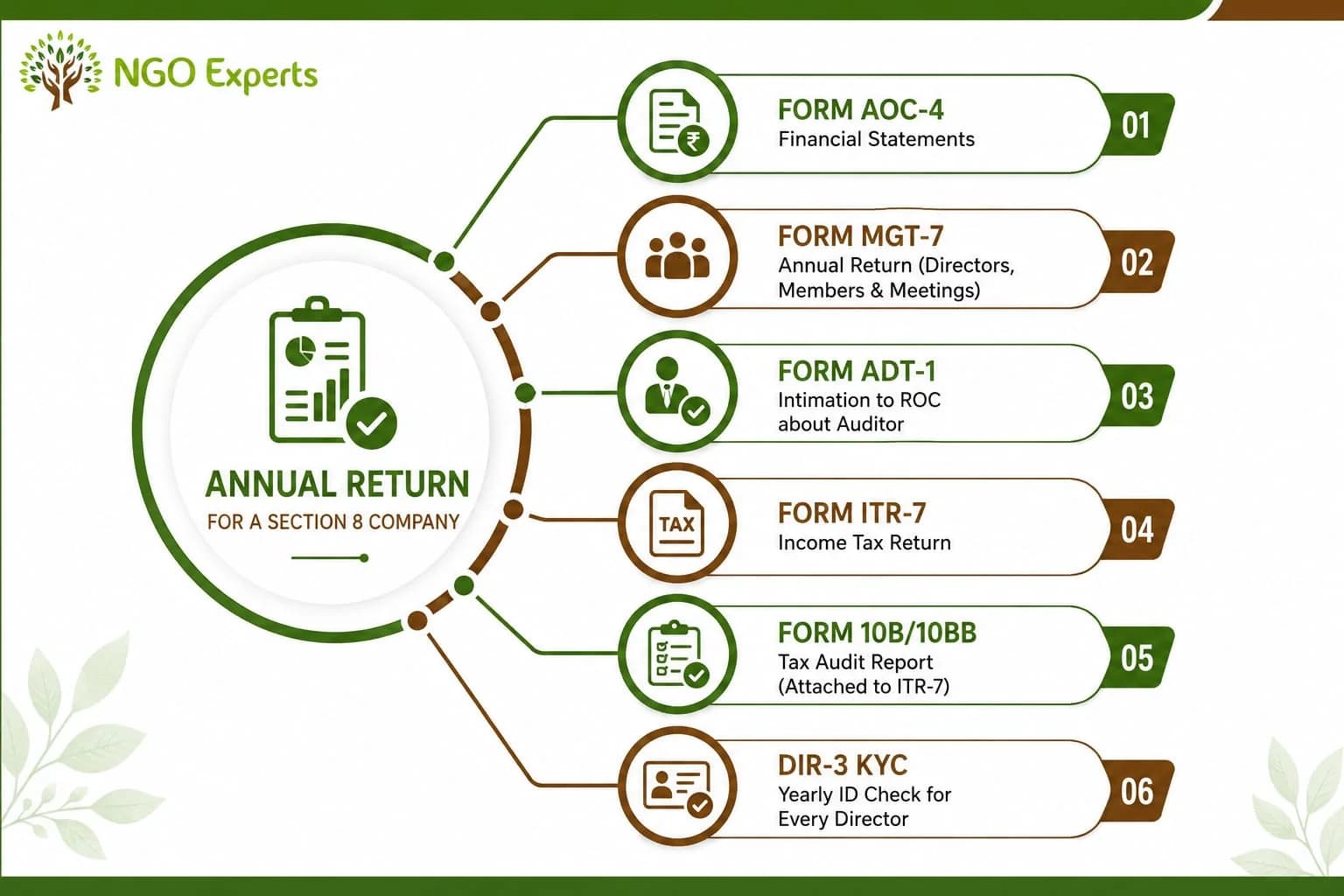
An annual return is a yearly report that tells the government about your company — who your directors are, who your members are, and how your finances look. It's a small group of filings that work together:
- Form AOC-4: your financial statements (balance sheet, profit & loss, director's report)
- Form MGT-7: the actual "annual return," with details of directors, members, and meetings
- Form ADT-1: tells the ROC who your auditor is
- Form ITR-7: your income tax return
- Form 10B/10BB: the tax audit report attached to ITR-7
- DIR-3 KYC: yearly ID check for every director
What Is the Deadline for Each Filing?
The easiest way to remember your filing deadlines is to count the required number of days from your Annual General Meeting (AGM) date.
| Form | What It Is | Deadline | File With |
| ADT-1 | Auditor appointment | 15 days after AGM | MCA |
| AOC-4 | Financial statements | 30 days after AGM | MCA |
| MGT-7 | Annual return | 60 days after AGM | MCA |
| DIR-3 KYC | Director ID check | 30 September every year | MCA |
| ITR-7 + Form 10B/10BB | Income tax return + audit report | 31 October (if audit applies) | Income Tax e-Filing Portal |
| FC-4 (if FCRA-registered) | Foreign contribution return | 31 December | FCRA Online Portal, MHA |
Why Are Annual Returns Important for a Section 8 Company?
These returns are mandatory because they keep your company's financial and statutory records up to date and ensure compliance with MCA requirements.
- You need it to keep your Section 8 license: If you don't file for 3 years in a row, the Registrar of Companies can strike your company off the register under Section 248.
- You need it to keep your tax exemption: Filing ITR-7 on time keeps your exemption under Section 11 and 12 of the Income Tax Act alive.
- You need it to receive CSR funds: Companies check your filing history before giving you CSR money, so a clean record matters.
- You need it if you take foreign donations: FCRA-registered companies must also file Form FC-4 with the Ministry of Home Affairs, separate from MCA filings.
- You may also need an NGO Darpan Certificate: NGOs applying for certain government grants, schemes, or registrations may need an updated NGO Darpan profile and certificate.
- You need it to keep your director's DIN active: If a director skips DIR-3 KYC, their Director Identification Number gets deactivated.
Latest Section 8 Company Compliance Updates in 2026
Section 8 Companies should stay alert to the latest MCA rules, filing requirements, and compliance changes in 2026 to maintain their legal and tax-exempt status.
- CCFS-2026 waiver scheme: MCA launched the Companies Compliance Facilitation Scheme (CCFS-2026), letting companies (including Section 8 companies) clear old pending ROC forms by paying only 10% of the extra late fee — a 90% waiver. This ran from April to 31 August 2026; check the MCA portal for any new scheme, because normal penalties apply once a scheme window closes.
- FY 2024–25 extension has ended: MCA earlier gave companies until 31 January 2026 to file AOC-4 and MGT-7/MGT-7A for FY 2024–25 without extra pressure. That extension is now over.
- Filings now go through MCA V3 portal: All ROC forms, DIR-3 KYC, and CSR-1 filings now happen on the upgraded MCA V3 portal, which uses OTP-based verification for directors filing KYC for the first time.
What Happens If a Section 8 Company Misses a Filing Deadline?
Missing an MCA filing deadline can lead to additional fees, penalties, and compliance issues.
- Late fee has no upper limit: MGT-7 and AOC-4 attract ₹100 per day in extra fees, with no cap; a one-year delay can cost around ₹36,500 per form.
- Heavy penalty on the company: Fines can range from ₹10 lakh to ₹1 crore depending on how serious the default is.
- Penalty on directors too: Directors in charge can be fined ₹25,000 to ₹25 lakh, and in serious cases face jail up to 3 years.
- DIN gets locked: Missing DIR-3 KYC deactivates the director's DIN; reactivating it costs ₹5,000.
- Company can be shut down: After 3 years of non-filing, the ROC can strike the company's name off completely.
Frequently Asked Questions
Do I need to file an annual return even if my Section 8 company had no income this year?
Yes. Filing is compulsory no matter how much income you earned. It depends on being registered, not on how much money came in.
Is MGT-7 the same as AOC-4?
No. AOC-4 carries your financial statements. MGT-7 is the actual annual return with director and member details. Both are separate, and both are mandatory.
Can a Section 8 company file the shorter MGT-7A form instead?
No. MGT-7A is only for small companies and one-person companies. Section 8 companies must always file the full MGT-7.
What if my AGM gets delayed?
The filing deadlines for AOC-4 and MGT-7 shift along with your AGM date, but you still can't skip filing — and a delayed AGM can attract its own separate penalty.
Is audit compulsory for every Section 8 company?
Yes. Every Section 8 company must get its accounts audited by a Chartered Accountant every year, no matter its size or turnover.
Author
Aabha Garg
A Content Strategist at NGOExperts, who focuses on NGO registration, 12A and 80G registration, FCRA compliance, income tax filing for non-profits, and CSR funding guidelines in India. I research and write our compliance guides in collaboration with our in-house Chartered Accountants and Company Secretaries, so every article reflects current tax and regulatory requirements for the NGO and non-profit sector.
Written by Aabha Garg. Last updated on October 6, 2026