Disclaimer: NGO Experts is a private professional legal and compliance consultancy firm. We are not affiliated with, endorsed by, or representing the Ministry of Corporate Affairs (MCA), NITI Aayog, or any government authority.
12A and 80G Registration
12A (now 12AB) exempts your NGO from income tax on income applied to charitable purposes. 80G lets your donors claim a deduction on what they give you. Both are filed online on the Income Tax portal using Form 10A for a new provisional registration or Form 10AB for final registration and renewal, and both can be filed together. Neither is permanent—provisional runs for 3 years, regular for 5.
Claim Income Tax Exemption for Your NGO
Enable Donors to Get Tax Benefits
Increase NGO Credibility & Trust
Attract More CSR Funding & Donations

5000+
Happy Customers
2427+
NGOs Registered
3499+
Govt Registrations
Claim Income Tax Exemption for Your NGO
Enable Donors to Get Tax Benefits
Increase NGO Credibility & Trust
Attract More CSR Funding & Donations
5000+
Happy Customers
2427+
NGOs Registered
3499+
Govt Registrations
About the Author
Aabha Garg
A Content Strategist at NGOExperts, who focuses on NGO registration, 12A and 80G registration, FCRA compliance, income tax filing for non-profits, and CSR funding guidelines in India. I research and write our compliance guides in collaboration with our in-house Chartered Accountants and Company Secretaries, so every article reflects current tax and regulatory requirements for the NGO and non-profit sector.
Written by Aabha Garg. Last updated on Jul 22, 2026, 10:45 AM
If your NGO does not have 12A and 80G, two things are happening quietly.
You are paying income tax on surplus that could be exempt.
Your donors get no deduction, so they hesitate before writing a larger cheque.
Both are fixable. 12A exempts your organisation; 80G gives your donors the incentive. NGOExperts files both online for trusts, societies and Section 8 companies and handles the renewals that catch most NGOs out three years later.
Need 12A and 80G Registration for Your NGO
Get expert assistance with 12A and 80G registration to help your NGO claim income tax exemption and enable donors to receive tax benefits.
Check your 12A/80G eligibility free—it takes 2 minutes
Send us your NGO name, structure (Trust / Society / Section 8) and city. We confirm eligibility and the exact document list within 24 hours.
Call +91 85957 66812 | support@ngoexperts.com | WhatsApp document check: wa.me/918595766812
What is 12A registration?
Section 12A, now administered through Section 12AB, lets a trust, society, or Section 8 company claim income tax exemption on income applied to its charitable objects. Without it, the Income Tax Department treats your surplus as taxable income — even if every rupee goes back into the work.
One correction to a claim you will see on a lot of NGO websites: 12A does not exempt everything automatically. The exemption applies to income applied to charitable purposes, and you must apply at least 85% of your income towards those objects in the year or accumulate the balance under the conditions the Act allows.
Validity: 12A is not a one-time registration
This is the single most common error in NGO tax content, and it costs organisations their exemption. Under the framework introduced by the Finance Act, 2020:
Registration
Form
Validity
What happens next
Provisional 12AB
Form 10A
3 years
Convert to regular registration by filing Form 10AB at least 6 months before it expires, or within 6 months of starting activities, whichever is earlier.
Regular 12AB
Form 10AB
5 years
Renew by filing Form 10AB at least 6 months before expiry. The cycle repeats every 5 years.
Provisional 80G
Form 10A
3 years
Same conversion route as 12AB, filed in parallel.
Regular 80G
Form 10AB
5 years
Same 5-year renewal cycle as 12AB.
There is no permanent 12A registration and no registration with "no fixed expiry" under the current framework. If a diary reminder is not set six months before your expiry date, set one today.
What 12A gives you
Income tax exemption on income applied to your charitable objects, subject to the 85% application rule.
A prerequisite for 80G approval, FCRA registration, and most institutional funding.
Government departments and corporate CSR teams ask for it before releasing grants.
What is 80G registration?
Section 80G lets a donor deduct part of their contribution from their taxable income. It benefits your donors, not your NGO directly, which is exactly why it matters. An NGO with 80G is easier to raise money for.
What 80G gives you
A tax incentive that makes larger gifts easier to ask for from individuals and from HNIs.
CSR readiness — most companies check for it before approving a CSR budget.
Less resistance in the fundraising conversation.
Important: what the 80G deduction actually is
The deduction is generally 50% of the amount donated, and it is capped by a qualifying limit of 10% of the donor's adjusted gross total income. Certain specified national relief and government funds attract a 100% deduction instead. Donors who opt for the regime under Section 115BAC cannot claim 80G unless they opt out for that assessment year.
Any page that says only "80G gives your donors a 50% deduction" is telling donors something incomplete about their own tax position. Donors should confirm their specific position with a Chartered Accountant before donating. This page is general information, not individual tax advice.
12A vs 80G: the difference in one table
The short version: 12A saves money for your NGO. 80G saves money for your donors. Most NGOs need both.
12A / 12AB registration
80G registration
Main benefit
Income tax exemption on your NGO's income applied to charitable objects.
Tax deduction for your donors on what they contribute.
Who benefits
Your NGO.
Your donors.
Tax impact
An exemption on income applied to charitable purposes, subject to the 85% application rule.
Generally 50% of the donation, capped at 10% of the donor's adjusted gross total income.
Why you need it
Required for government grants, CSR funding, and FCRA.
Needed to attract retail donors, corporate CSR teams, and institutional funders.
Validity
Provisional for 3 years. Regular 5 years, then renewable.
Provisional for 3 years. Regular: 5 years, then renewable.
Forms
Form 10A (new/provisional) and Form 10AB (final/renewal).
You do not have to choose. Both can go in as a single filing exercise on the portal, and doing them together saves a round of document collection.
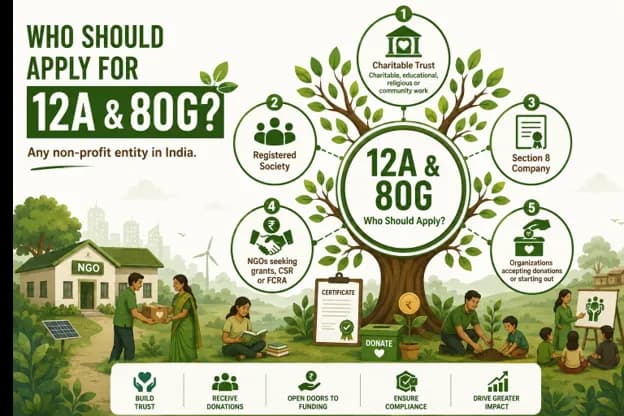
Who should apply for 12A and 80G?
Any non-profit entity in India. Apply if you run or are setting up:
A trust doing charitable, educational, religious, or community development work.
A Section 8 company formed for non-profit purposes.
Any NGO planning to apply for domestic grants, CSR funding, or foreign contributions under FCRA.
Any organization that accepts donations or wants to start.
Typical compliance timeline for a new NGO
Stage
Timing
What happens
Entity registration
Month 0
Trust deed, society registration, or Section 8 incorporation completed.
Provisional filing
Month 1–3
Form 10A filed for 12A and 80G in parallel.
Provisional approval
Month 2–5
30–90 days of processing. A unique registration number is issued for both.
Operating period
Years 1–3
The NGO operates under provisional registration. CSR and grant eligible.
Regular registration
Before year 3 ends
Form 10AB filed at least 6 months before provisional expiry or within 6 months of commencing activities—whichever comes first.
Renewal cycle
Every 5 years
Form 10AB is filed again 6 months before each expiry.
CMS note: replace this table with the compliance timeline infographic. Alt text: "Compliance timeline for a new Indian NGO from registration through 12A and 80G provisional approval to the five-year renewal cycle."
Provisional vs regular registration
Every new NGO goes through two stages. Provisional is the learner's license. Regular is the full one — but even the full one expires.
Provisional registration
Regular registration
Who gets it
NGOs that have not yet started charitable activities or are newly formed.
NGOs converting from provisional and NGOs already operating.
Validity
3 years from the assessment year for which it is granted.
5 years. Not permanent.
Form filed
Form 10A
Form 10AB
Next step
Convert before expiry, or 6 months after starting activities — whichever is earlier.
Renew via Form 10AB, 6 months before expiry.
CSR/grant eligible
Yes, accepted by most funders.
Yes. The stronger form of approval.
If your 12A or 80G was issued before April 2021
The Finance Act, 2020, required every NGO holding a pre-April 2021 registration to re-register under the 12AB system. If you never did, your exemption status may no longer be valid, and you may have been non-compliant for several assessment years without knowing. Send us your registration order, and we will check where you stand.
What the Income Tax Act, 2025, changes
TheIncome Tax Act, 2025, introduced the Registered Non-Profit Organisation regime underSections 332 to 355, effective 1 April 2026. It replaces the 12A/12AB and 80G structure described on this page. Existing registrations carry across into the new regime rather than lapsing, and donor-deduction approval now sits inside the RNPO registration instead of a separate 80G certificate.
In practice, the vocabulary has not caught up. Corporate CSR checklists, grant application forms, and bank KYC packs still ask for "12A and 80G certificates." They mean your registered non-profit status. Keep both your RNPO registration and your legacy 12A/80G orders in the same folder and send both.
If you are unsure which regime your registration now sits under, or when your next filing falls due, ask us for a status check before you assume you are covered.
Benefits of 12a and 80g registration
Key Benefits of 12A Registration
Your NGO's income utilized for charitable activities is 100% exempt from income tax.
Essential prerequisite for obtaining 80G approval, FCRA registration, and corporate funding.
Government departments and CSR teams require 12A status before releasing institutional grants.
Key Benefits of 80G Registration
Donor Tax Incentive: Boosts your NGO's credibility with high-net-worth individuals (HNIs) and retail donors.
Corporate CSR Readiness: Required by most companies before approving corporate social responsibility (CSR) budgets.
Frictionless Fundraising: Helps NGOs raise more funds with less resistance from prospects.
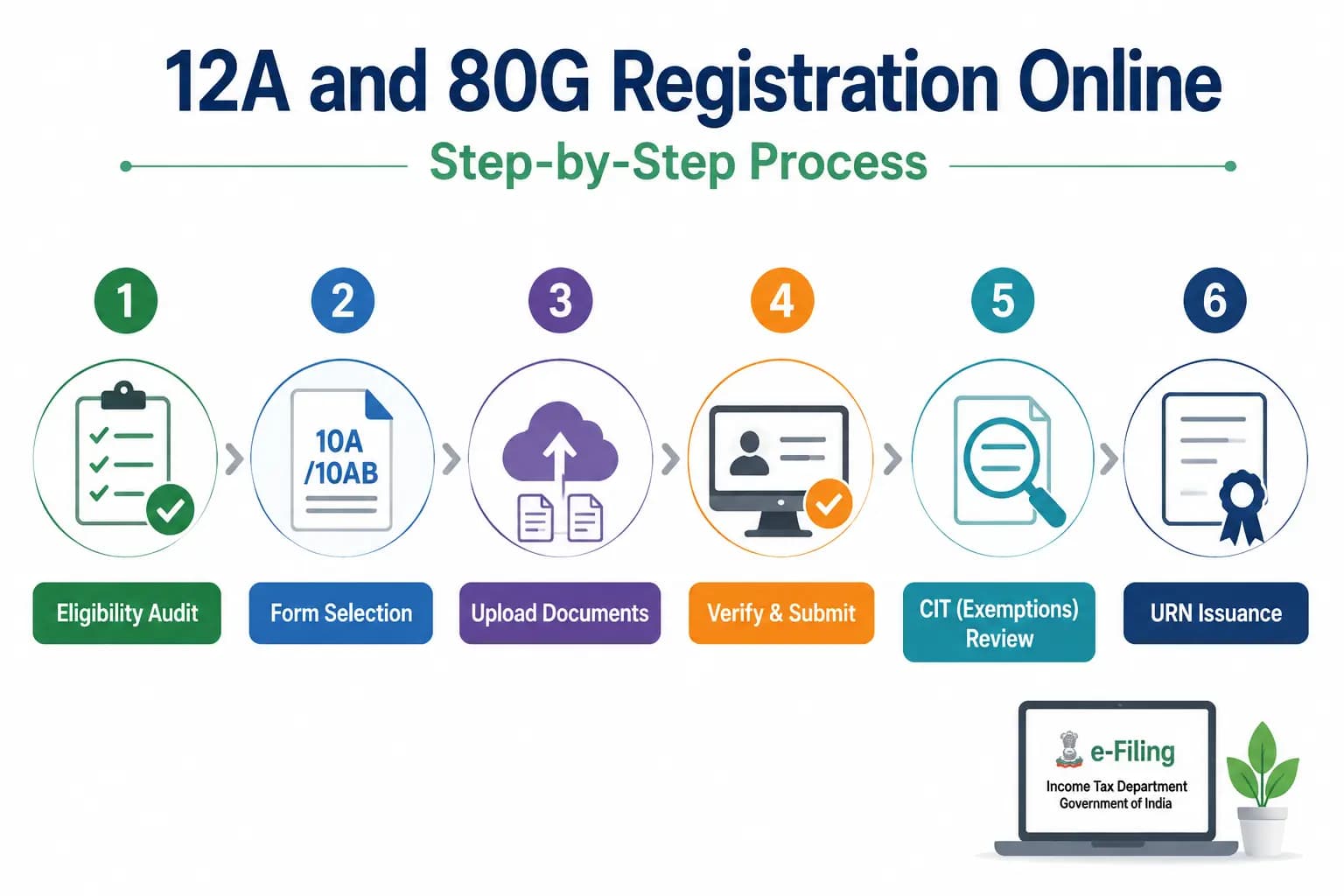
12A and 80G Registration Process Online
Both 12A and 80G registrations are now filed online through the Income Tax portal. Here is how the process works:
Step 1: Eligibility audit
We check your structure, objects, age, and existing registration status and confirm which regime you fall under.
Step 2: Form selection
Form 10A for a new or provisional application. Form 10AB for conversion, renewal, or re-registration.
Step 3: Dual application upload
Constitutional documents, activity reports, and accounts are uploaded for 12A and 80G together.
Step 4: Verification and submission
The application is verified through DSC or EVC and submitted using the organisation's PAN credentials.
Step 6: URN issuance
The registration order is passed, and the Unique Registration Number appears on the portal. Typically 30 to 90 days from submission.
Filed together, 12A is normally processed first, since 80G approval depends on it. Delays are almost always caused by missing or inconsistent documents, not by the department.
Documents Required for 12A and 80G Registration
For 12A Registration
Form 10A (for new applicants) or Form 10AB (for renewal or re-registration).
Registration certificate of the Trust, Society or Section 8 company.
Trust deed or MOA and AOA, as applicable.
PAN card of the organisation.
Last three years' accounts and balance sheets (for existing organisations).
Activity report for the last three years, if applicable.
List of trustees, directors, or governing body members with their PAN and Aadhaar.
For 80G Registration
Form 10A or Form 10AB, as applicable.
Registration certificate and constitutional documents (Trust deed, MOA).
PAN card of the organisation.
Details of donors and their addresses (for existing operations).
Last three years' ITR and audited accounts.
List of welfare activities and a progress report.
NOC from the property owner if the organisation does not own the registered office.
Utility bill (electricity or water bill) for address proof.
Note: The exact documents required depend on whether you are a new applicant or applying for renewal and the age and structure of your organization. We confirm the final list after reviewing your case.
Missing Documents for 12A and 80G Registration?
Don't let incomplete paperwork delay your application. We help NGOs prepare and submit the correct documents for faster approval.
We work only with NGOs, non-profits and social enterprises. We know what the exemption authority looks for in these files, and we prepare them accordingly.
End-to-end handling of 12A and 80G filing, including conversions and renewals.
Document preparation aimed at reducing the risk of a notice or rejection.
Renewal tracking, so the 3-year and 5-year deadlines do not pass unnoticed.
Complete your 12A & 80G registration with confidence. From documentation to application filing, we provide end-to-end support to help your NGO qualify for tax exemptions and attract more donors.
12A Registration is a tax registration that allows an NGO to claim exemption from income tax on its eligible income under the Income Tax Act.
What is 80G Registration?
80G Registration allows donors to claim tax deductions on eligible donations made to a registered NGO.
Why are 12A and 80G Registration Important?
12A helps NGOs save tax on their income, while 80G encourages donations by providing tax benefits to donors.
Who is Eligible for 12A and 80G Registration?
Trusts, Societies, and Section 8 Companies that are legally registered and engaged in charitable activities can apply, subject to the prescribed conditions.
Can a New NGO Apply for 12A and 80G Registration?
Yes. A newly registered NGO can apply for provisional 12A and 80G registration.
What Documents are Required for 12A and 80G Registration?
Generally, you need the NGO registration certificate, PAN card, Trust Deed or MOA & AOA, address proof, details of trustees or directors, and other supporting documents as required.
Can 12A and 80G Registration Be Applied for Together?
Yes. NGOs can apply for both 12A and 80G registration together through the Income Tax Department portal.
Is 12A and 80G Registration Done Online?
Yes. The application for 12A and 80G registration is submitted online through the Income Tax Department portal.
How do I know if my trust is eligible for 80G?
The first step is to ensure that your trust is registered & actively carrying out charitable activities. Once that requirement is met, you can submit an application to the Income Tax Department to seek approval to be eligible for 80G.It is important to note that not all trusts qualify for this status, & even those that do must comply with specific requirements to maintain it. Seeking the guidance of a tax expert like NGOExperts can help ensure your trust remains eligible for 80G & can continue to receive tax benefits.
Can an NGO Receive Donations Without 12A and 80G Registration?
Yes. An NGO can receive donations without 12A and 80G registration, but it will not receive the related tax benefits, and donors will not be eligible to claim tax deductions under Section 80G
What is the Difference Between 12A and 80G Registration?
12A Registration provides income tax exemption to the NGO, while 80G Registration provides tax benefits to donors who contribute to the NGO. Both registrations serve different purposes and are often obtained together.
Can a Trust, Society, and Section 8 Company Apply for 12A and 80G?
Yes. A registered Trust, Society, or Section 8 Company engaged in charitable activities can apply for both 12A and 80G registration, subject to eligibility.